Monte Rosa
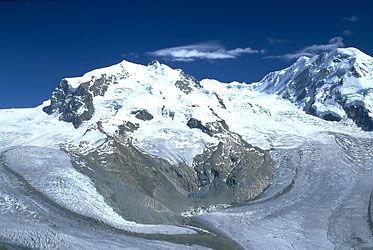
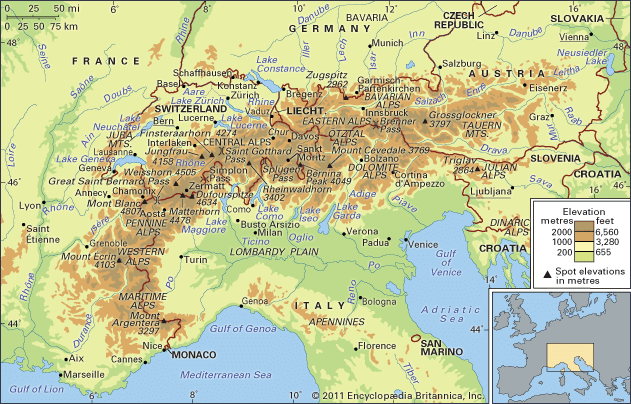
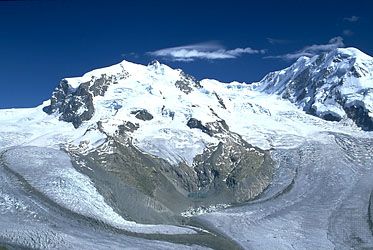
Monte Rosa is a massive, snow-covered mountain located in the Pennine Alps along the border of Switzerland and Italy.
What is Monte Rosa?
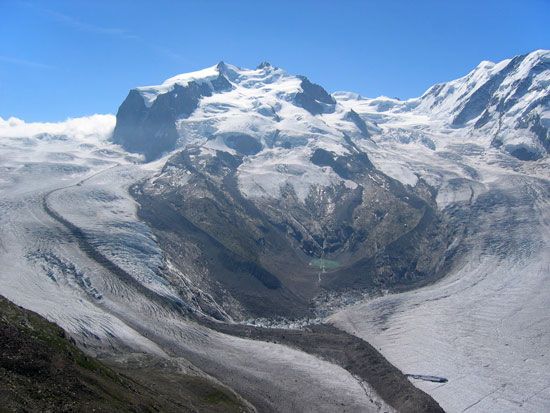
Monte Rosa is a massive, snow-covered mountain located in the Pennine Alps along the border of Switzerland and Italy.12
The massif consists of ten distinct summits, the highest of which is the Dufourspitze. Standing at 15,203 feet (4,634 meters), the Dufourspitze is the highest peak in Switzerland and the second-highest in the Alps. The name “Monte Rosa” originates from an Aostian patois word, roëse, which translates to “glacier,” reflecting the significant glacial activity found on its slopes, such as the Gorner Glacier near Zermatt. Additionally, the Italian side of the massif hosts a laboratory dedicated to nuclear research.1
What is the difference between a mountain and a massif?
A mountain is a landform that rises prominently above its surroundings, typically characterized by steep slopes, a confined summit area, and significant local relief. While they are often found in elongated ranges or chains, the term itself does not have a standardized geological definition.3
In contrast, a massif is defined as a principal mountain mass or a specific block of the Earth’s crust. Geologically, a massif is a distinct section of the crust bounded by faults or flexures that has been displaced as a unit without undergoing significant internal deformation.4
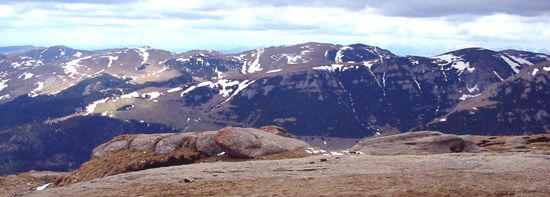
Essentially, while a mountain refers to the individual landform or peak, a massif describes a larger, cohesive structural block that may contain multiple summits or mountain groups. For example, the Bucegi Massif is a mountain massif that includes several distinct peaks and ridges within its structural unit.54
How do glaciers shape mountain landscapes?
Glaciers are powerful agents of landscape transformation, acting as “destructional” forces that reshape mountain ranges through intense erosion and the transport of material.89
Erosional Processes
Glaciers drastically alter the topography of mountains by carving out distinct features:
- U-Shaped Valleys: Glaciers inherit V-shaped stream valleys and reshape them into broad, parabolic U-shaped valleys by removing debris and eroding the bedrock along the base and lower sidewalls.1011
- Cirques and Horns: High in the mountains, glaciers form cirques—amphitheatre-shaped hollows. When multiple cirques erode a mountain radially, they leave behind sharp, jagged peaks known as horns, such as the Matterhorn.109
- Arêtes and Hanging Valleys: The narrow ridges between parallel glacial valleys are carved into knife-edge arêtes. Additionally, smaller tributary glaciers erode their beds less deeply than the main glacier, leaving behind hanging valleys that often feature waterfalls.1011
Depositional Processes
As glaciers move, they transport rock debris and deposit it as till, forming moraines. These include lateral moraines along valley slopes and end moraines that mark the glacier’s furthest advance.129
What are some other famous peaks in the Alps?
The Alps are home to numerous iconic peaks, many of which exceed 14,000 feet (4,300 meters) in elevation. Beyond the highest summit, Mont Blanc, several other notable mountains define the region’s landscape:
- Dufourspitze: Located in the Monte Rosa group, this is the highest point in the Pennine Alps at 15,203 feet (4,634 meters).1314
- Matterhorn: Perhaps the most famous peak in the Alps, known for its distinct, jagged pyramidal shape.1314
- Weisshorn: A prominent high peak situated within the Pennine Alps.1314
- Finsteraarhorn: A major summit known for its significant elevation.13
Additionally, the Mont Blanc massif itself contains several significant peaks, including:
- Mont Blanc du Tacul
- Mont Maudit
- Aiguille du Géant
- Les Grandes Jorasses
- Mont Dolent
- Aiguille du Midi15
Sources
- Monte Rosa — Encyclopædia Britannica
- Rosa, Monte — Merriam-Webster
- list of mountains — Encyclopædia Britannica
- Pyrenees - Geology — Encyclopædia Britannica
- mountain — Merriam-Webster
- Bucegi Massif — Encyclopædia Britannica
- massif — Merriam-Webster
- glacial landform - Cirques , tarns, U-shaped valleys, arêtes, and horns — Encyclopædia Britannica
- glacial valley — Encyclopædia Britannica
- glacial landform - Moraines — Encyclopædia Britannica
- geology - Geomorphology — Encyclopædia Britannica
- Pleistocene Epoch - Glaciation — Encyclopædia Britannica
- Exploring 7 of Earth’s Great Mountain Ranges - Alps — Encyclopædia Britannica
- Mont Blanc — Encyclopædia Britannica
- Pennine Alps — Encyclopædia Britannica
Published on · 3 min read