Moravian Karst
The Moravian Karst is a protected karst region located in the Jihomoravský region of the eastern Czech Republic. Situated north of Brno, this limestone area…
What is Moravian Karst?
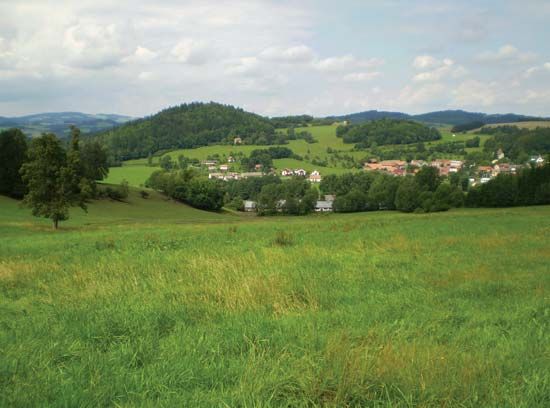
The Moravian Karst is a protected karst region located in the Jihomoravský region of the eastern Czech Republic. Situated north of Brno, this limestone area spans approximately 20 miles north-south and 6–9 miles east-west.12
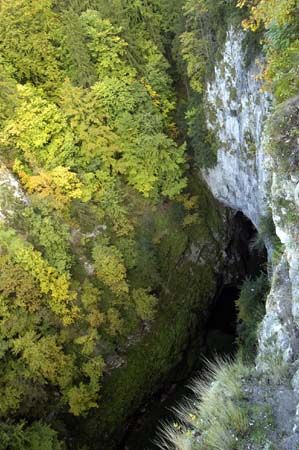
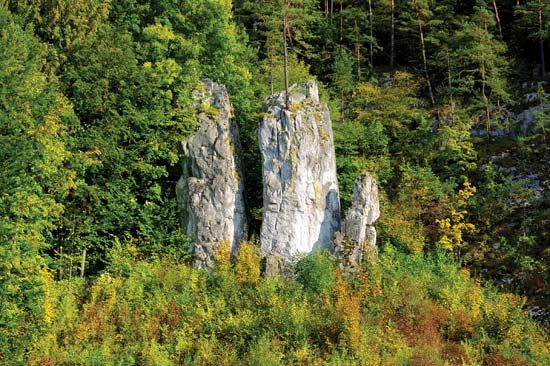
The landscape is defined by a complex network of geological features, including swallow holes, underground passages, lakes, and various calcareous formations. A prominent highlight of the region is the Macocha Gorge, a 420-foot-deep chasm likely formed by the collapse of an underground cave roof. This area also contains the Catherine Cave—the largest cavern in the district—and the Punkva water caves, which visitors can explore by boat.13
Recognized for its unique natural heritage, the Moravian Karst is managed as a nature reserve where the government provides controlled access to tourists to ensure the preservation of its delicate environment.2
How are limestone caves and stalactites formed?
Limestone caves and their internal formations, known as speleothems, are primarily created through the chemical action of water on bedrock.45
Formation of Limestone Caves
Caves are typically formed by the dissolution of limestone or dolomite by carbonic acid. As rainwater infiltrates soil, it absorbs carbon dioxide, forming a dilute carbonic acid solution. This acidic water percolates through fractures and joints in the bedrock, gradually dissolving the calcium carbonate and widening these openings into sizable passages over thousands of years.64789
Formation of Stalactites and Stalagmites
Once a cave is formed, secondary chemical deposits occur as water drips into the air-filled void.45
- Stalactites: As water emerges from a ceiling joint, it hangs as a pendant drop. A small amount of calcite is deposited in a ring where the drop touches the ceiling. As drops fall and are replaced, this process builds an icicle-like structure with a central canal.104
- Stalagmites: When these water droplets hit the cave floor, the remaining mineral matter is deposited, building up mounds or columns that lack a central canal.104
When a stalactite and stalagmite meet, they form a column.10
What is the Macocha Gorge and how was it created?
The Macocha Gorge is a prominent natural landmark located in the Moravian Karst region of the Czech Republic. As the most frequently visited feature in the area, it spans approximately 900 feet in length and reaches a maximum width of 390 feet.3
The gorge is notable for its impressive depth of 420 feet (128 meters) and its complex internal environment, which houses a labyrinth of galleries, caves, and various stalactites and stalagmites. Geologically, the Macocha Gorge is believed to have been created by the collapse of an underground cave roof.3
The site is part of a larger subterranean system that includes the Catherine Cave—the district’s largest cavern—and the Punkva water caves, which are accessible to visitors via boat.3
What other types of karst landscapes exist around the world?
Karst landscapes are diverse, shaped by the dissolution of soluble rocks like limestone and dolomite. While they share common features like caves and sinkholes, they are categorized by their dominant landforms:128
- Doline Karst: Characterized by numerous sinkholes (dolines), this is one of the most common types of karst terrain, found extensively in regions like Kentucky and Tennessee in the United States.138
- Cone and Tower Karst: Primarily found in tropical regions, this landscape features isolated conical hills or near-vertical limestone towers that remain as remnants after surrounding rock is dissolved by water.18
- Pavement Karst: Often initiated by glacial activity that strips away soil, this type exposes bare bedrock. It is common in high-latitude and alpine regions and is marked by intricate surface features known as karren.148
- Fluviokarst: This landscape combines surface stream drainage with underground karst features, often found in areas where surface water interacts with soluble bedrock.138
- Pseudokarst: These are landscapes that mimic karst features but are formed by different processes, such as the collapse of windblown loess or thermokarst in frozen ground.12
Sources
- Moravian Karst — Encyclopædia Britannica
- Czech Republic - Plant and animal life — Encyclopædia Britannica
- Macocha Gorge — Encyclopædia Britannica
- stalactite and stalagmite — Encyclopædia Britannica
- cave - Depositional materials and features — Encyclopædia Britannica
- carbonic acid — Encyclopædia Britannica
- cave deposit — Encyclopædia Britannica
- karst — Encyclopædia Britannica
- cave - Process of formation — Encyclopædia Britannica
- cave - Initiation phase — Encyclopædia Britannica
- cave - Solution caves — Encyclopædia Britannica
- cave - Geographic distribution of karst terrain — Encyclopædia Britannica
- cave - Pavement karst — Encyclopædia Britannica
- cave - Cone and tower karst — Encyclopædia Britannica
- cave - Karst topography — Encyclopædia Britannica
Published on · 3 min read