Moreton Island
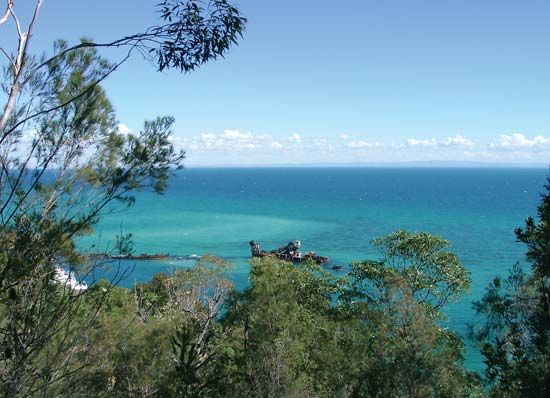
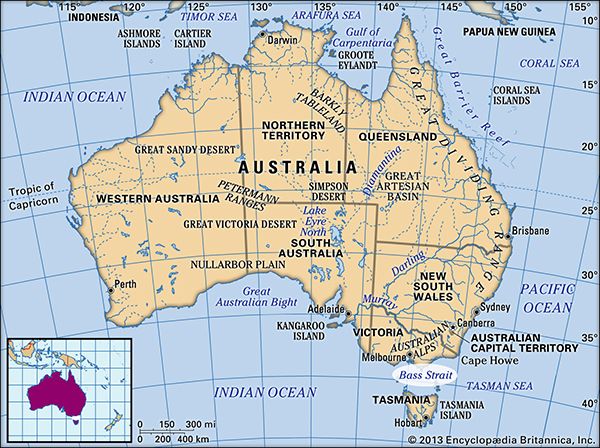
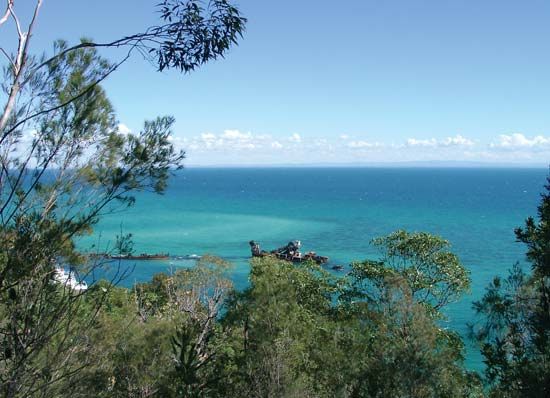
Moreton Island is an island located off the southeast coast of Queensland, Australia, situated across Moreton Bay from Brisbane. Measuring approximately 25…
What is Moreton Island?
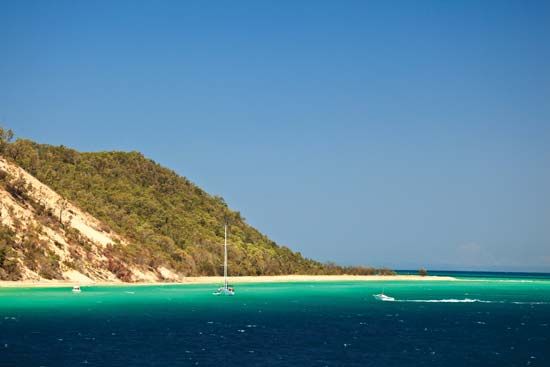
Moreton Island is an island located off the southeast coast of Queensland, Australia, situated across Moreton Bay from Brisbane. Measuring approximately 25 miles (40 km) long and 5 miles (8 km) wide, it features notable sand dunes, including Mount Tempest, which rises to 912 feet (278 metres) and may be the world’s loftiest.1
The island was visited in 1770 by James Cook, who initially mistook it for a peninsula, but its true insular nature was confirmed by Matthew Flinders in 1799. Historically, the island served as the site for the state’s first lighthouse in 1857 and hosted a short-lived whaling station at Tangalooma in 1952. Today, it is accessible from Brisbane via ferry.1
How do sand dunes like those on Moreton Island form?
Coastal sand dunes, such as those found on Moreton Island, form through the interaction of wind, sediment supply, and physical obstructions. The process begins as wind transports fine to medium-sized sand from the beach in a landward direction. When this moving sediment encounters an obstruction, it is deposited, eventually creating small wind-shadow dunes known as coppice mounds.4
If the supply of sediment remains consistent and the beach is not subject to significant erosion, these mounds can develop into foredunes, which form the seaward-most line of a dune system. This process allows a coastline to prograde, or grow seaward. While many dunes are shaped by active wind movement—often creating ripples or large lobes of sand—the dunes on Moreton Island are notable for being originally wind-formed but now fixed and stabilized by vegetation.41
Most dune sand is composed of quartz, which accumulates because it resists chemical breakdown better than many other minerals. While true sand dunes are typically defined by their wind-driven mobility, coastal dunes often rely on vegetation to maintain their structure over time.546
What was the significance of the whaling station at Tangalooma?
The whaling station at Tangalooma, established on Moreton Island in 1952, was a short-lived industrial facility. While the provided records note its existence as a specific historical site on the island, they do not detail its broader economic or environmental significance beyond its brief period of operation.1
Who was Matthew Flinders and what were his contributions to Australian exploration?
Matthew Flinders (1774–1814) was a distinguished English navigator and Royal Navy officer whose meticulous work significantly advanced the mapping of the Australian continent.
His primary contributions include:
- Circumnavigation and Charting: In 1801, he was appointed to command the Investigator, tasked with surveying the Australian coast. He successfully circumnavigated the continent, virtually completing the charting of its coastline.89
- Tasmanian Discovery: In 1798, alongside George Bass, he circumnavigated Tasmania, proving it was an island separated from the mainland by what is now known as the Bass Strait.9
- Naming Australia: Flinders was the primary advocate for using the name “Australia” to describe the entire continent, replacing the term “New Holland.” His suggestion gained official support in 1817.9
- Legacy: His extensive surveys left no doubt that Australia was a single landmass. Numerous geographical features, such as Flinders Island and Investigator Strait, are named in his honor.91011
Sources
- Moreton Island — Encyclopædia Britannica
- Moreton Bay — Encyclopædia Britannica
- list of islands - Australia — Encyclopædia Britannica
- coastal landforms - Coastal dunes — Encyclopædia Britannica
- sand dune - Sands — Encyclopædia Britannica
- sand dune — Encyclopædia Britannica
- Queensland - Federation and the state of Queensland — Encyclopædia Britannica
- Matthew Flinders — Encyclopædia Britannica
- Australia - Later explorations — Encyclopædia Britannica
- Flinders Island — Encyclopædia Britannica
- Investigator Strait — Encyclopædia Britannica
Published on · 2 min read