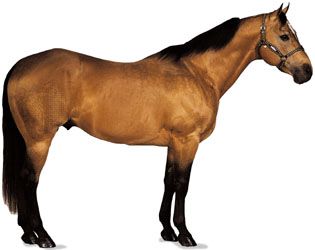
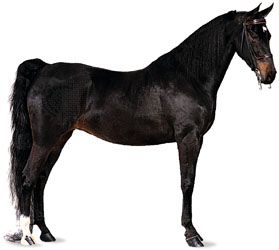
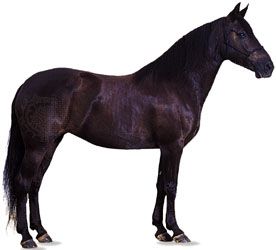
Morgan
The Morgan horse has played a significant role in the development of several American horse breeds due to its versatility, stamina, and prepotent…
How has the Morgan horse influenced other American horse breeds?
The Morgan horse has played a significant role in the development of several American horse breeds due to its versatility, stamina, and prepotent nature—meaning it consistently passed its desirable traits to its offspring.123
The breed’s influence is particularly notable in the following:
- Tennessee Walking Horse: This breed was developed using a foundation that included Thoroughbred, Standardbred, and Morgan bloodlines. Specifically, the stallion Allan F-I, who had several crosses of Morgan breeding, is credited with having the greatest influence on the development of the Tennessee Walking Horse.23
- General Versatility: Because the Morgan was historically prized as an all-purpose horse—capable of riding, pulling carriages, and performing farm labor—its genetics were frequently integrated into other American lines to improve temperament, intelligence, and physical robustness.23
The Morgan breed itself originated from a single stallion owned by Justin Morgan in Vermont around 1795, and its enduring legacy continues to be recognized in the American equine landscape.124
What are the main physical characteristics of the Morgan horse breed?
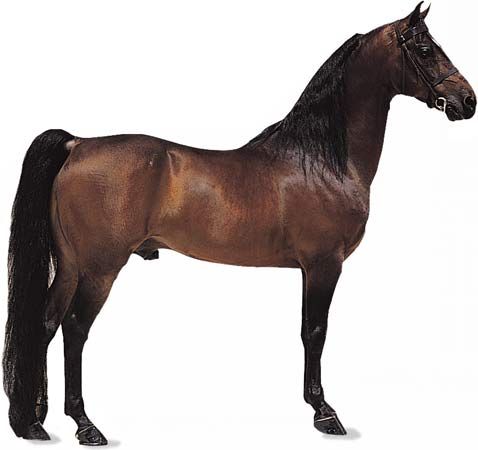
The Morgan horse is recognized for its compact, stylish, and active build. Modern representatives of the breed typically exhibit the following physical characteristics:
- Height: They generally stand between 14.1 and 15.2 hands (approximately 57 to 61 inches, or 145 to 155 cm) tall.1
- Weight: They typically weigh between 900 and 1,100 pounds (400 to 500 kg).1
- Conformation: The breed is known for its smooth lines and a nicely crested neck.1
- Head: They possess expressive eyes and small, alert ears.1
Historically, the breed’s foundation sire, Justin Morgan, was a smaller, virile horse standing about 14 hands high. Today, while they remain versatile all-purpose animals, they are primarily categorized as a riding-horse type.1
How does the Morgan horse compare to other popular American horse breeds?
The Morgan horse is distinguished from other popular American breeds primarily by its historical role as a versatile, all-purpose animal and its unique origin from a single prepotent stallion. While many American breeds were developed for specialized tasks, the Morgan was prized for its ability to perform a wide range of duties, including riding, pulling carriages, farm labor, and cattle cutting.15
Compared to other prominent American breeds, the Morgan’s characteristics and uses differ in several ways:
- Versatility vs. Specialization: Unlike the American Quarter Horse, which is noted for its agility and quick bursts of speed for racing and ranch work, or the Standardbred, which is primarily used for harness racing, the Morgan is a generalist.45
- Gaited Breeds: While breeds like the American Saddlebred, Tennessee Walking Horse, and Missouri Fox Trotting Horse were specifically developed for specialized, smooth gaits, the Morgan is not defined by these unique gait patterns.5
- Physical Build: Morgans are compact and robust, typically standing 14.1 to 15.2 hands high. They are generally smaller than the American Saddlebred (15–16 hands) and share a similar height range with the American Quarter Horse and Appaloosa.1465
How has the Morgan horse’s role changed throughout American history?
The Morgan horse has evolved from a ubiquitous American workhorse to a specialized riding breed. Originally, the breed was the most famous and widely disseminated horse in the United States, valued for its versatility as an all-purpose animal capable of farm labor, carriage pulling, and riding.1
The breed’s foundation sire, Justin Morgan, was a compact, virile horse whose influence became so significant that his descendants were meticulously tracked to preserve the line. As the 19th century progressed, the breed’s popularity eventually declined, leading to a period where government supervision was required to maintain the population.1
Efforts to revitalize the breed began in earnest with the publication of the American Morgan Horse Register in 1894 by Colonel Battell, which helped organize and encourage breeding efforts. By 1909, the formation of the Morgan Horse Club (now the American Morgan Horse Association) solidified the breed’s status. Today, while they remain versatile, the breed has shifted its primary role toward the riding-horse type.1
Sources
- Morgan — Encyclopædia Britannica
- horse - American breeds — Encyclopædia Britannica
- Tennessee walking horse — Encyclopædia Britannica
- Morgan — Merriam-Webster
- Horse breeds — Encyclopædia Britannica
- American Saddlebred horse — Encyclopædia Britannica
Published on · 3 min read