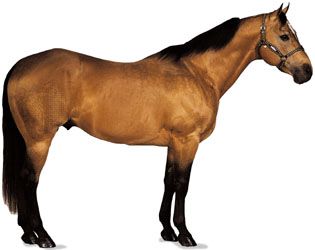
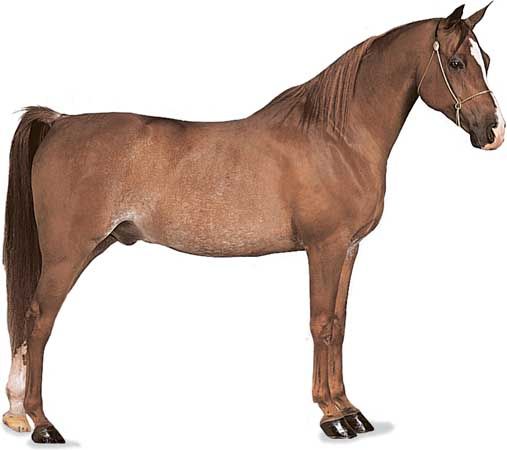
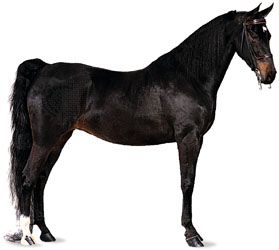
American Saddlebred Horse
The American Saddlebred horse is primarily recognized for its own development through the influence of other breeds rather than as a primary progenitor of…
How has the American Saddlebred horse influenced other horse breeds?
The American Saddlebred horse is primarily recognized for its own development through the influence of other breeds rather than as a primary progenitor of other distinct horse breeds. The American Saddlebred was shaped by crossing Thoroughbreds, Morgans, Standardbreds, Arabians, and various easy-riding horses of mixed background to achieve its signature style, vigor, and specialized gaits.1
While the American Saddlebred is a distinct breed itself, it has contributed to the development of other American gaited horses. Specifically, the Tennessee Walking Horse was derived partially from the American Saddlebred, alongside the Thoroughbred, Standardbred, and Morgan, to create a comfortable mount capable of covering great distances at speed.2
Beyond this specific contribution, the American Saddlebred remains most influential as a premier show horse in the United States, valued for its high-stepping movements and versatility as a pleasure, driving, and sport horse.12
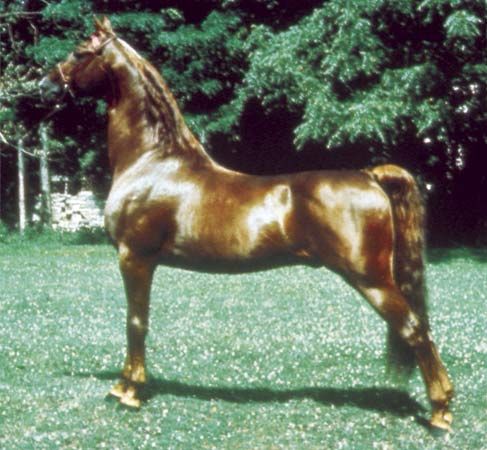
How did the American Saddlebred breed originate and develop?
The American Saddlebred originated in the United States as a specialized riding horse developed for its vigor, style, and unique, easy-riding gaits. The breed was shaped through the selective crossing of several established types, including the Thoroughbred, Morgan, Standardbred, and Arabian, as well as various pacers and horses of mixed background.1
The development of the breed relied heavily on line breeding, with a focus on selecting for beauty, style, and comfortable movement. This process resulted in a horse characterized by a long, arched neck, a short, strong back, and a level croup.1
The American Saddlebred was officially recognized as a distinct breed in 1891 with the organization of the American Saddle Horse Breeders’ Association (now the American Saddlebred Horse Association, Inc.). This organization established the American Saddle Horse Register to maintain the breed’s standards and lineage. Today, these horses are celebrated for their versatility, serving as show horses, pleasure mounts, and driving horses, and are exhibited as either three- or five-gaited animals.1
What is the average size and weight of an American Saddlebred horse?
The American Saddlebred horse typically stands between 15 and 16 hands high, which is approximately 60 to 64 inches or 152 to 163 cm. In terms of weight, the breed generally ranges from 1,000 to 1,200 pounds, or about 450 to 540 kg.1
What are the primary uses and roles of American Saddlebred horses today?
American Saddlebred horses are highly versatile animals that serve a variety of roles in the equestrian world today. Their primary uses include:
- Show Horses: They are the prevailing riding horse in United States horse shows. They are exhibited under flat saddles as either three-gaited (walk, trot, and canter) or five-gaited (the three basic gaits plus the rack and a slow gait, typically the stepping pace) animals.1
- Pleasure and Driving: Beyond the show ring, they are frequently utilized as pleasure riding horses and as driving horses.1
- Sporting Disciplines: Due to their athleticism and agility, they are also commonly used as hunters and jumpers.1
- General Riding: They are recognized as a light breed with an aptitude for riding, valued for their vigor, style, and comfortable, easy-riding gaits.16
Sources
- American Saddlebred horse — Encyclopædia Britannica
- American saddlebred — Merriam-Webster
- horse - American breeds — Encyclopædia Britannica
- Standardbred — Encyclopædia Britannica
- Morgan — Encyclopædia Britannica
- horse - Light breeds — Encyclopædia Britannica
Published on · 2 min read