Woodpecker
Woodpeckers, members of the family Picidae, possess specialized physical characteristics that allow them to thrive in their arboreal environments and perform…
What are the distinctive physical characteristics of woodpeckers?
Woodpeckers, members of the family Picidae, possess specialized physical characteristics that allow them to thrive in their arboreal environments and perform their signature wood-pecking behaviors.
Structural Adaptations for Climbing and Pecking
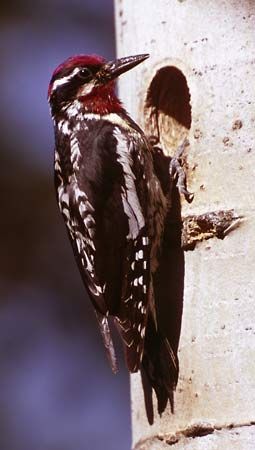
- Tail Feathers: Woodpeckers have exceptionally strong, stiffened central tail feathers that act as a prop, supporting the bird’s body against a tree trunk while it hammers with its bill.12
- Feet: Most species have a zygodactylous foot arrangement, where the outer toe points backward, aiding in perching. However, many specialized climbing species spread their toes laterally and anteriorly to grip vertical surfaces. Some species, such as the three-toed woodpecker, have lost the hind toe entirely.1
- Skull and Bill: Their skulls are unusually thick and feature a built-in shock-absorbing mechanism where the skull curves inward at the base of the bill. The bills are typically sturdy and chisel-tipped, while slitlike nostrils prevent wood chips and sawdust from entering.1
Specialized Feeding Apparatus
- Tongue: Woodpeckers have a long, distensible tongue equipped with tiny barbs and a sticky coating. The hyoid apparatus is tremendously elongated, allowing the tongue to extend deep into holes to extract insects.1
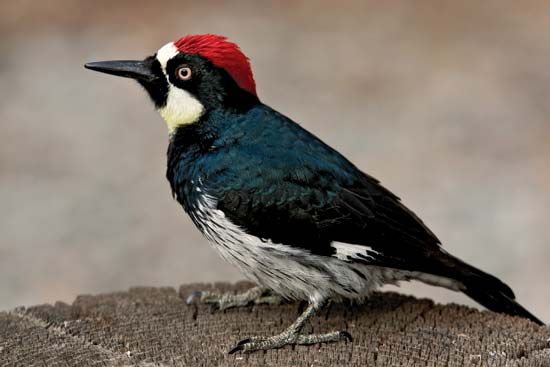
What adaptations do woodpeckers have for climbing trees and finding food?
Woodpeckers, members of the family Picidae, possess specialized physical adaptations that enable them to climb vertical surfaces and extract food from within trees.
Climbing Adaptations
- Tail Support: Woodpeckers have exceptionally strong, stiffened central tail feathers that act as a prop, supporting the bird’s body against a tree trunk while it hammers with its bill.2
- Foot Structure: While many birds have a zygodactylous (yoke-toed) foot, specialized climbing woodpeckers often spread their toes laterally and anteriorly to grip vertical surfaces. Some species, such as the three-toed woodpecker, have lost the hind toe entirely to facilitate this movement.2
Feeding and Pecking Adaptations
- Shock Absorption: The skull is unusually thick and curves inward at the base of the bill, acting as a built-in shock absorber to protect the bird during high-impact pecking.2
- Bill and Nostrils: Their bills are sturdy and chisel-tipped for drilling. Slitlike nostrils prevent wood chips and sawdust from entering the respiratory system.2
- Tongue and Hyoid Apparatus: Woodpeckers possess a long, distensible tongue equipped with barbs and sticky mucus. The hyoid apparatus is greatly elongated, allowing the tongue to extend deep into holes to probe for and extract insects.2
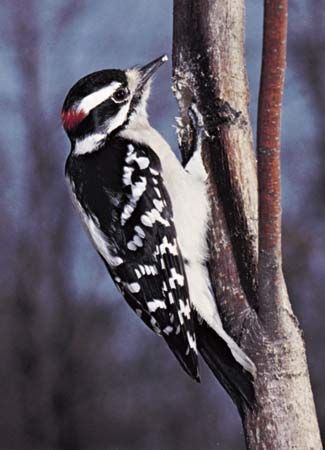
How do different woodpecker species vary in size and appearance?
Woodpecker species exhibit significant variation in size and appearance, reflecting their diverse adaptations and habitats.
Size Variation
Woodpeckers range from small, compact birds to large, robust species:
- Small Species: The downy woodpecker is one of the smallest, measuring only about 15 cm (6 inches) in length.
- Medium-Sized Species: Many common species, such as the acorn woodpecker, the red-headed woodpecker, and the great spotted woodpecker, typically range between 19 and 25 cm (7.5 to 10 inches).
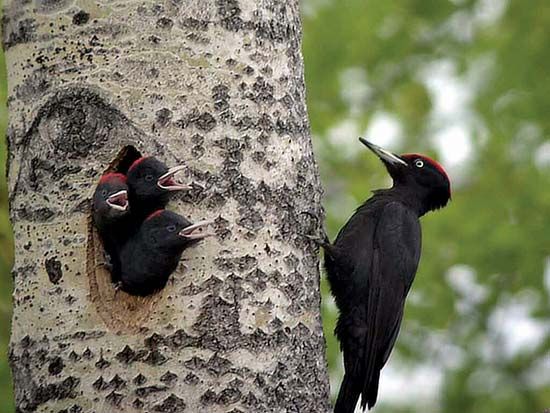
- Large Species: The largest woodpeckers include the black woodpecker (46 cm/18 inches) and the pileated woodpecker (40–47 cm/15.5–18.25 inches). The ivory-billed woodpecker and the imperial woodpecker are also among the largest, reaching lengths of approximately 45–50 cm.
Appearance and Sexual Dimorphism
While plumage varies by species, many woodpeckers share common visual traits:
- Coloration: Many species feature bold patterns, such as the black plumage, red crest, and white face stripes of the pileated woodpecker.
- Sexual Dimorphism: In most species, the sexes are distinguished by simple pattern differences, most commonly the presence or absence of red markings on the head. For example, male pileated woodpeckers have a red cheek stripe, while females do not. These markings serve as vital signals for species and sexual recognition.
How many species of woodpeckers exist, and where are they found?
There are approximately 210 species within the family Picidae, which includes true woodpeckers, piculets, and wrynecks. The subfamily Picinae, which consists of the “true” woodpeckers, accounts for about 180 of these species.18
Woodpeckers have a nearly worldwide distribution, occurring on every continent except for Australia and New Guinea/Australia) and New Guinea. They are also notably absent from Madagascar and regions east of Borneo and Bali, as they do not cross Wallace’s Line. While they are found globally, they are most abundant in South America and Southeast Asia.18
Most woodpeckers are permanent residents of their habitats, though a few species, such as the yellow-bellied sapsucker and the flicker, are migratory.85
Sources
- Woodpecker — Encyclopædia Britannica
- Piciform - Form and function — Encyclopædia Britannica
- Pileated woodpecker: Top Questions — Encyclopædia Britannica
- Locomotion - Climbing birds and mammals — Encyclopædia Britannica
- Piciform - Distribution and ecology — Encyclopædia Britannica
- Piciform - Importance to humans — Encyclopædia Britannica
- Piciform - Reproduction — Encyclopædia Britannica
- Picidae — Encyclopædia Britannica
Published on · 3 min read