Mount Parnassus
Mount Parnassus held profound significance in ancient Greek culture, serving as a sacred landscape that bridged the divine and the literary. It was revered…
How has Mount Parnassus influenced ancient Greek literature and culture?
Mount Parnassus held profound significance in ancient Greek culture, serving as a sacred landscape that bridged the divine and the literary. It was revered as the home of Apollo and the Corycian nymphs, and its slopes housed the Delphic oracle, whose prophecies influenced political decisions, colonization, and religious cults for centuries.12
In the realm of literature, the mountain became a powerful symbol of poetic inspiration. While Mount Helicon was traditionally celebrated as the primary haunt of the Muses, Roman poets specifically favored Parnassus, identifying its Castalian spring as a vital source of creative inspiration. The mountain’s association with the Pythia—who delivered oracular pronouncements often recorded in verse—further cemented its status as a site where the human and divine intersected through language. By providing both a physical setting for religious life and a metaphorical home for the arts, Parnassus remained a central pillar of the ancient Greek imagination.132
What is the significance of Mount Parnassus in Greek mythology?
Mount Parnassus held significant status in Greek mythology as a sacred landscape associated with the divine and the practice of prophecy. Located in central Greece, the mountain was considered sacred to the Dorians and, in mythology, served as a residence for Apollo and the Corycian nymphs.1
The mountain’s most prominent mythological and religious function was its role as the site of the Delphic oracle. Situated on the slopes of Mount Parnassus, this oracle was the most famous in the ancient world. It was believed that the site originally belonged to Gaea before it was claimed by Apollo. The oracle functioned through the Pythia, a priestess who provided divine counsel to those seeking guidance on political actions, wars, and the founding of cults.4
Additionally, the mountain was linked to poetic inspiration. The Castalian spring, located on the mountain, was a site of purification for the Pythia and was celebrated by Roman poets as a source of creative inspiration, often favoring Parnassus over Mount Helicon as the home of the Muses.154
How does Mount Parnassus contribute to modern Greek tourism and recreation?
Mount Parnassus remains a significant destination for modern tourism and recreation in Greece, blending its rich historical legacy with contemporary outdoor activities.
The mountain is perhaps most famous for its proximity to Delphi, an ancient town and site of the renowned oracle of Apollo. As a UNESCO World Heritage site, the archaeological ruins of Delphi attract visitors from around the world who come to explore the remains of the Temple of Apollo and other ancient monuments.13
Beyond its historical appeal, the mountain serves as a hub for winter sports. A ski centre was established above the town of Arachova in 1977, providing modern recreational opportunities on the mountain’s slopes. This combination of ancient cultural heritage and active tourism makes Mount Parnassus a vital part of the region’s contemporary economy and appeal.1
How tall is Mount Parnassus, and how does it compare to other Greek mountains?
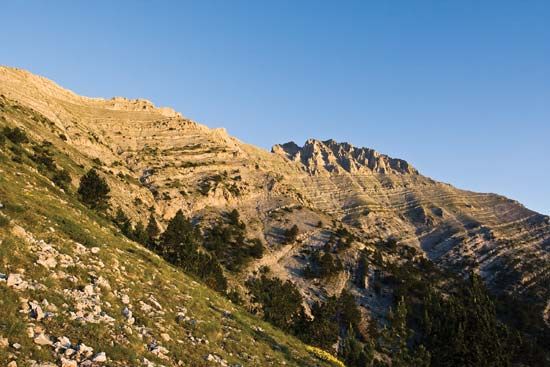
Mount Parnassus reaches a maximum elevation of 8,061 feet (2,457 meters).178
When compared to other mountains in Greece, it is significantly lower than the country’s highest peak, Mount Olympus, which rises to 9,570 feet (2,917 meters). However, it remains a prominent feature of the Greek landscape, standing taller than the Taïyetos Mountains in the Peloponnese, which reach an approximate elevation of 7,874 feet (2,400 meters).79
As a major spur of the Pindus Mountains, Parnassus is distinguished not only by its height but by its cultural and historical significance, serving as a central landmark in the region of central Greece.17
Sources
- Mount Parnassus — Encyclopædia Britannica
- Delphic oracle — Encyclopædia Britannica
- Mount Helicon — Encyclopædia Britannica
- Castalia — Encyclopædia Britannica
- oracle — Encyclopædia Britannica
- Delphi — Encyclopædia Britannica
- Taïyetos Mountains — Encyclopædia Britannica
- Greece - Eastern Greece: Thessalía and Attikí — Encyclopædia Britannica
- Parnassus — Merriam-Webster
Published on · 3 min read