Mount Helicon
Mount Helicon, located in Boeotia, Greece, was celebrated in classical literature as the sacred home of the Muses. While the mountain itself was famed for…
Are there any important archaeological sites or ruins on or near Mount Helicon?
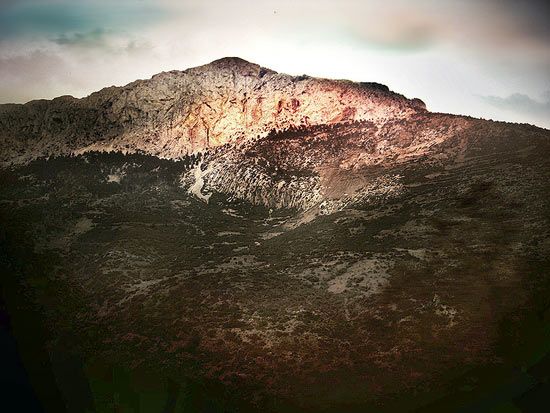
Mount Helicon, located in Boeotia, Greece, was celebrated in classical literature as the sacred home of the Muses. While the mountain itself was famed for its fertile slopes, a sacred temple and grove once stood on its eastern side, though many of its statues were eventually removed by Constantine the Great to Constantinople.1
Archaeological efforts, guided by the descriptions of the 2nd-century geographer Pausanias, have led to the discovery of an ancient theatre at Thespiae, a site situated near the mountain. Additionally, the region of Boeotia contains other significant historical locations, such as Orchomenus, an important Neolithic and Bronze Age site known for its Mycenaean tholos, or “beehive,” tomb and palace.12
What is the mythological significance of Mount Helicon in Greek culture?
In Greek culture, Mount Helicon holds profound mythological significance as the favored haunt of the Muses, the goddesses of inspiration in literature, science, and the arts. Its eastern slopes were considered particularly sacred, featuring a temple and grove dedicated to them.1
The mountain is famously linked to the origins of poetic inspiration through two legendary fountains:
- Aganippe: A fountain associated with the Muses.1
- Hippocrene: A spring believed to be a source of poetic inspiration, which legend says was created when the winged horse Pegasus struck the ground with his hooves.14
Mount Helicon is also central to the history of Greek literature because of the poet Hesiod. Hesiod, who lived near the mountain in the town of Ascra, famously recounted that the Muses appeared to him while he was tending his sheep on its slopes. They bestowed upon him a poet’s staff and the gift of song, instructing him to chronicle the history of the gods in his epic, the Theogony.5
How is Mount Helicon associated with the Muses in Greek mythology?
Mount Helicon in Boeotia, Greece, served as the primary cult center for the Muses, the sister goddesses of inspiration. In classical literature, the mountain was celebrated as their favorite haunt, with its fertile eastern slopes housing a sacred temple and grove dedicated to them.17
The association between the mountain and the Muses was reinforced by two legendary springs located nearby:
- Aganippe: A fountain traditionally linked to the Muses.1
- Hippocrene: A spring said to have been created when the winged horse Pegasus struck the ground with his hooves.1
The site was so central to their worship that a festival known as the Museia, which included musical and athletic contests, was held every four years at the nearby town of Thespiae. While the Muses were originally considered patron goddesses of poets and musicians, their influence eventually expanded to encompass the liberal arts and sciences.7
How has Mount Helicon been depicted in ancient Greek art?
The provided search results do not contain specific information regarding the depiction of Mount Helicon in ancient Greek art. While the sources note that the mountain’s sacred grove was adorned with numerous statues of the Muses, they do not describe how the mountain itself was visually represented by ancient artists.
The available records focus on the mountain’s role as a cult center, its topography, and the literary traditions associated with it, such as the works of Hesiod. We know that statues of the Muses—often holding attributes like a lyre or scroll—were popular decorations in antiquity, but specific artistic depictions of the mountain landscape remain outside the scope of the provided information.17
Sources
- Mount Helicon — Encyclopædia Britannica
- Helicon — Merriam-Webster
- Orchomenus — Encyclopædia Britannica
- Hesiod — Encyclopædia Britannica
- Apollo — Encyclopædia Britannica
- Hippocrene — Merriam-Webster
- Muse — Encyclopædia Britannica
Published on · 3 min read