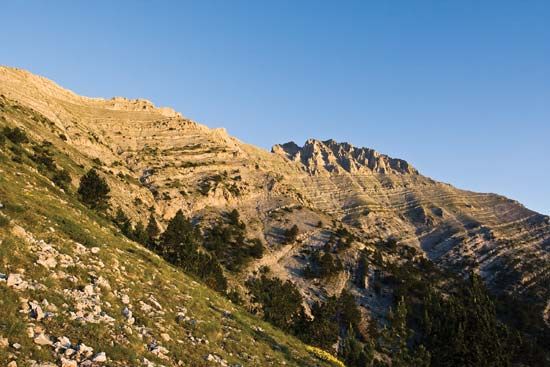
Mount Pentelicus
The chief summit of Mount Pentelicus, known as Kokkinarás, reaches an elevation of 3,632 feet (1,107 meters).
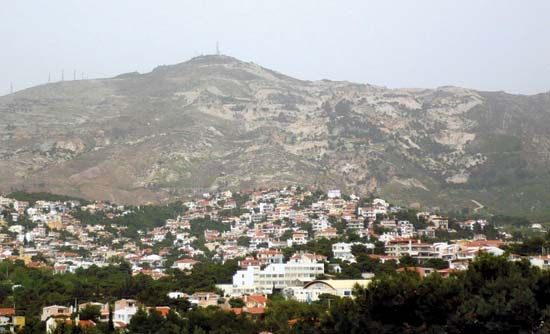
What is the elevation of Mount Pentelicus and how does it compare to other mountains in Greece?
The chief summit of Mount Pentelicus, known as Kokkinarás, reaches an elevation of 3,632 feet (1,107 meters).1
Compared to other prominent mountains in Greece, Mount Pentelicus is significantly lower. For instance, Mount Olympus, the highest peak in the country, rises to 9,570 feet (2,917 meters). Other major ranges, such as Mount Parnassus, reach elevations of 8,061 feet (2,457 meters), while the Taïyetos Mountains in the Peloponnese reach approximately 7,874 feet (2,400 meters).234
While it does not rank among the highest peaks in the nation, Mount Pentelicus is historically significant for its Pentelic marble, which was extensively quarried to construct the sculptures and buildings of ancient Athens ried to construct the sculptures and buildings of ancient Athens.1
Are there any ancient ruins or archaeological sites on Mount Pentelicus?
Yes, Mount Pentelicus is home to significant archaeological evidence from antiquity. The most notable site is the ancient sanctuary dedicated to the goddess Athena, which was located at the mountain’s summit.1
Additionally, the mountain is famous for its extensive historical quarrying operations. During the 5th and 4th centuries BCE, the south slope of the mountain featured 25 distinct quarries situated at elevations between 2,500 and 3,300 feet (760 and 1,000 meters). These sites were the primary source of the high-quality Pentelic marble used to construct many of the iconic buildings and sculptures of ancient Athens.1
How has the proximity of Mount Pentelicus to Athens influenced its importance?
The proximity of Mount Pentelicus to Athens was a defining factor in the city’s architectural and cultural development during the Classical period. Located just 10 miles northeast of the city, the mountain served as the primary source of high-quality white Pentelic marble.1
This geographic advantage allowed the Athenians to undertake one of the most ambitious building programs in history. During the 5th and 4th centuries BCE, the mountain’s south slope featured 25 active quarries that provided the essential materials for the reconstruction of the Acropolis. Iconic structures such as the Parthenon, the Propylaea, and the Erechtheum were all constructed using this locally sourced stone, which gave the city its characteristic gleaming appearance.15
Beyond its material utility, the mountain held spiritual significance, as evidenced by the sanctuary dedicated to the goddess Athena located at its summit. The mountain’s accessibility ensured that Athens could maintain a steady supply of marble, fueling the artistic and civic expansion that defined the city’s zenith.15
How has Mount Pentelicus been significant in ancient Greek history and mythology?
Mount Pentelicus held significant importance in ancient Greek history primarily as the essential source of Pentelic marble. During the 5th and 4th centuries BCE, the mountain’s south slope featured 25 active quarries that provided the high-quality white stone used to construct the iconic buildings of the Acropolis in Athens. This marble was instrumental in the realization of major architectural projects, including the Parthenon, the Propylaea, and the Erechtheum, which defined the aesthetic zenith of the Classical period.16
In terms of mythology and religion, the mountain was also a site of spiritual significance. A sanctuary dedicated to the goddess Athena was located at the summit of the mountain, linking the physical landscape directly to the patron deity of Athens.1
Sources
- Mount Pentelicus — Encyclopædia Britannica
- Greece - Eastern Greece: Thessalía and Attikí — Encyclopædia Britannica
- Mount Olympus: Top Questions — Encyclopædia Britannica
- Taïyetos Mountains — Encyclopædia Britannica
- Pentelic — Merriam-Webster
- Athens - Athens at its zenith — Encyclopædia Britannica
Published on · 2 min read