Mount Taranaki
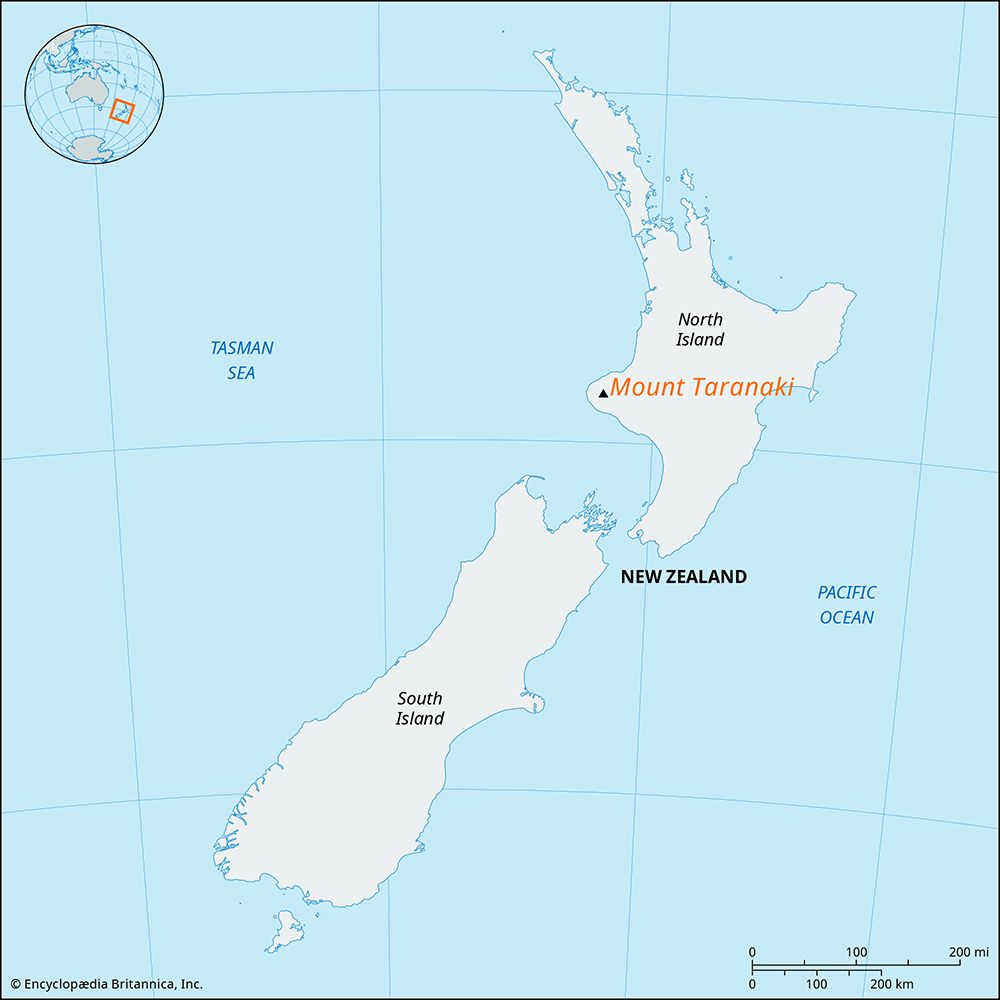
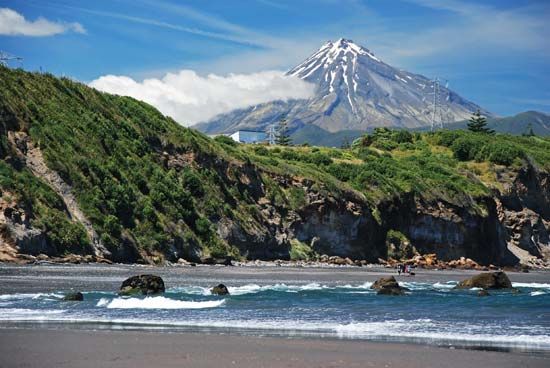
Mount Taranaki is a symmetrical volcanic cone located on the Taranaki Peninsula in the west-central North Island of New Zealand. Rising to an elevation of…
What is Mount Taranaki?
Mount Taranaki is a symmetrical volcanic cone located on the Taranaki Peninsula in the west-central North Island of New Zealand. Rising to an elevation of 8,260 feet (2,518 meters), it features a subsidiary cone known as Fanthams Peak. The mountain is the youngest and most southerly of a volcanic group situated within Egmont National Park.1
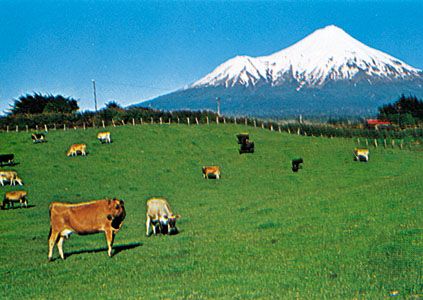
The volcano has remained dormant since the early 17th century. Its slopes are characterized by dense forests and deep gorges carved by streams originating from the summit’s snowfields. The surrounding fertile “ring plain” is a significant dairying region. First sighted by James Cook in 1770, the peak was first successfully climbed in 1839. The mountain is also historically referred to as Mount Egmont.12
What is the significance of Egmont National Park?
Egmont National Park is significant primarily for encompassing the Mount Taranaki volcanic group, which serves as the dominant geographical and scenic feature of the Taranaki region on New Zealand’s North Island.11
The park protects a unique volcanic landscape that includes the dormant Mount Taranaki—a symmetrical cone reaching 8,260 feet—along with the older volcanic peaks of Pouakai and Kaitake. The park’s ecological importance is highlighted by the dense forests that clothe the mountain slopes, which contrast with the surrounding fertile “ring plain” at the base of the volcano. This ring plain is a vital agricultural area, particularly for dairying, which supports the economy of the surrounding region. By preserving these volcanic structures and their surrounding ecosystems, the park acts as a critical natural landmark and a center for environmental conservation in the area.21
How do Maori legends describe the origin of Mount Taranaki?
Sorry, the Britannica knowledge base does not contain this information.
What are the characteristics of a stratovolcano?
A stratovolcano, also known as a composite volcano, is a steep, cone-shaped landform built by repeated volcanic eruptions over thousands of years. These volcanoes are the most common type, with over 700 identified globally, often located above subduction zones such as the Pacific Ocean’s Ring of Fire.34
Key Characteristics
- Structure: They feature a gentle slope at the base that becomes significantly steeper (up to 35°) toward the summit. Rather than neat, continuous layers, they are composed of overlapping lobes of ash, lava flows, pyroclastic material, and volcanic domes.34
- Composition: While rock types vary from basalt to rhyolite, they are generally composed of andesite or [dacite]. This results in cooler, more viscous lava compared to shield volcanoes.34
- Eruptive Behavior: Eruptions typically begin with ash explosions and conclude with the extrusion of thick lava. Because of their steep, composite structure, they are prone to lahars (mudflows), avalanches, and caldera formation following chamber collapse.34
Sources
- Mount Taranaki — Encyclopædia Britannica
- Taranaki — Encyclopædia Britannica
- volcano - Stratovolcanoes — Encyclopædia Britannica
- volcano - Major types — Encyclopædia Britannica
- stratovolcano — Encyclopædia Britannica
Published on · 2 min read