Roncador Mountains
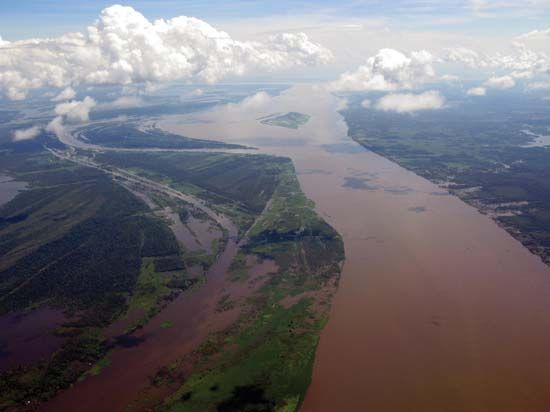
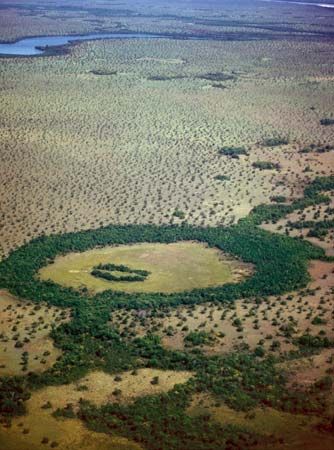
The Roncador Mountains are a mountain range located in central Brazil.
What is Roncador Mountains?
The Roncador Mountains are a mountain range located in central Brazil.1
The range reaches an average elevation of approximately 1,800 feet (550 metres) above sea level and stretches north-south for about 500 miles (800 km). Geographically, the mountains run roughly parallel to Araguaia National Park to the east. They serve as a significant watershed: the western slopes provide the headwaters for the Xingu River, while the eastern flanks feed into tributaries of the Mortes and Araguaia rivers.1
What is the significance of the Xingu River?
The Xingu River is a major tributary of the Amazon River, flowing approximately 1,300 miles (2,100 km) northward through the Brazilian states of Mato Grosso and Pará. Its significance is defined by its ecological, cultural, and developmental roles:
- Cultural Preservation: In the 1950s, the Xingu National Park was established as a vital preserve for Brazil’s Indigenous peoples, including groups like the Tchikao, providing a sanctuary against the threat of extinction.
- Hydroelectric Development: The river has been a focal point for energy infrastructure, notably through the Xingu-Araguaia Hydroelectric Project, which was developed in the late 1970s to harness the river’s power.
- Geographic and Hydrological Role: Rising on the Planalto do Mato Grosso, the river serves as a significant drainage basin. While its upper course is characterized by numerous rapids, its lower course is wide and deep, eventually emptying into the Amazon River near the Ilha Grande de Gurupá.
What kind of wildlife lives in the Araguaia region?
The Araguaia region, particularly around Bananal Island and the National Park of Araguaia, supports a diverse array of wildlife characteristic of central Brazilian ecosystems. While specific comprehensive surveys for the Araguaia region are less frequently detailed in isolation than those of the broader Amazon basin, the area shares many species with the surrounding tropical biomes.
The region is home to a variety of fauna, including:
- Aquatic Life: The river systems are populated by numerous fish species, including the piranha, which is common in tropical river systems of the region.
- Reptiles: The area hosts various crocodilians, such as caimans, as well as iguanas and various snakes, including the water boa.
- Birds: The region is rich in birdlife, with herons, cormorants, and storks frequently found near the water, alongside various game birds.
- Mammals and Insects: The landscape supports diverse terrestrial mammals and a vast population of insects, including mosquitoes, which are prevalent in the island environments.
How do mountain ranges influence local climates?
Mountain ranges significantly influence local climates by acting as physical barriers to air masses and altering atmospheric conditions through elevation and topography.89
Key Climatic Effects
- Temperature and Pressure: As elevation increases, temperature, atmospheric pressure, and humidity generally decrease. High-altitude regions often experience more intense solar radiation due to reduced air density and dust content.8
- Orographic Precipitation: When moist air is forced upward by a mountain range, it cools and condenses, resulting in orographic precipitation on the windward side. This process often leaves the leeward side significantly drier, creating a rain shadow where precipitation is minimal.10118
- Wind Patterns: Mountains can “funnel” regional winds through valleys, increasing their speed. Additionally, the foehn effect occurs when air descending the leeward side is compressed and warmed, resulting in hot, dry, gusty conditions.8912
- Slope Orientation: The direction a slope faces determines its exposure to sunlight and wind, creating distinct microclimates. Sunny southern slopes, for instance, differ significantly from shady northern ones in temperature and moisture.89
Sources
- Roncador Mountains — Encyclopædia Britannica
- Xingu River — Encyclopædia Britannica
- Amazon River - Hydrology of the Amazon River — Encyclopædia Britannica
- Amazon River - Animal life — Encyclopædia Britannica
- Araguaia River — Encyclopædia Britannica
- Brazil - Conservation and ecology — Encyclopædia Britannica
- Río de la Plata - Animal life — Encyclopædia Britannica
- Highland climate — Encyclopædia Britannica
- Asia - The influence of topography — Encyclopædia Britannica
- India - The southwest monsoon — Encyclopædia Britannica
- Orographic precipitation — Encyclopædia Britannica
- Microclimate — Encyclopædia Britannica
- orographic rain — Merriam-Webster
Published on · 3 min read