Rodna Massif
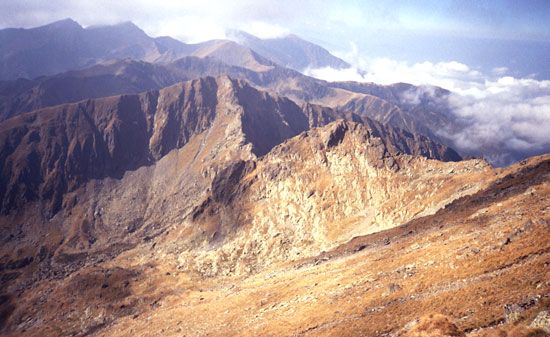
The Rodna Massif is a mountain range that serves as the highest portion of the Eastern Carpathians in northern Romania. It reaches a maximum elevation of…
What is Rodna Massif?
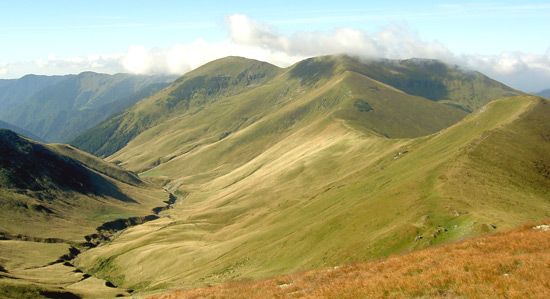
The Rodna Massif is a mountain range that serves as the highest portion of the Eastern Carpathians in northern Romania. It reaches a maximum elevation of 7,556 feet (2,303 meters) at its peak, Pietrosu.12
Geologically, the massif is characterized by a central core of hard, crystalline rocks, which gives the landscape a bold and rugged relief. While the region no longer hosts active glaciers, extensive historical glaciation has shaped the terrain, resulting in fretted peaks and numerous alpine lakes, the largest of which is Lake Lala.12
What are the main differences between the Eastern, Southern, and Western Carpathians?
The Carpathian Mountains are generally divided into three distinct provinces, each with unique geological structures and relief patterns.3
Western Carpathians
This province is characterized by clear zoning in its geologic structure and relief. It is widest in the west (up to 170 miles) and features a central block surrounded by an arc of volcanic rocks.3
- Structure: Divided into the Outer (lower, hilly), Central (highest, including the Tatras), and Inner (lower, broken) ranges.3
- Relief: The Central Western Carpathians exhibit high-mountain glacial features, while the Inner ranges contain significant volcanic formations and limestone tablelands with extensive cave systems.3
Eastern Carpathians
Also known as the Southeastern Carpathians, this region is significantly wider (up to 250 miles) and forms a triangular block surrounding a basin.3
- Structure: They run northwest–southeast and consist of an outer flysch band and an inner band of crystalline and volcanic rocks.3
- Relief: These mountains are generally higher and more compact than their western counterparts, featuring extinct volcanic ranges like the Călimani and Harghita.3
Southern Carpathians
Running east-northeast to west-southwest, these mountains are distinct in their composition and orientation.3
- Structure: Composed primarily of metamorphic rocks, they lack the extensive volcanic bands found in the other two provinces.3
- Relief: They culminate in the Făgăraș Mountains, which display dramatic Alpine-type relief.3
How do glaciers shape mountain landscapes over time?
Glaciers are powerful agents of landscape transformation, reshaping mountain terrain through the dual processes of erosion and deposition.5
Glacial Erosion
As glaciers move under the influence of gravity, they act like massive, abrasive sandpaper. By incorporating rock debris into their base, they scour, polish, and gouge the bedrock. Key erosional features include:6
- Cirques and Tarns: Glaciers often begin in amphitheatre-shaped hollows called cirques. Over time, these hollows may be deepened to form basins that fill with water, creating lakes known as tarns.7
- U-Shaped Valleys: Glaciers drastically reshape V-shaped river valleys into broad, parabolic U-shaped valleys by eroding the valley floor and sidewalls.78
- Arêtes and Horns: When multiple cirques erode a mountain from different sides, they leave behind sharp, knife-edge ridges called arêtes and jagged peaks known as horns, such as the Matterhorn.7
- Hanging Valleys: Because smaller tributary glaciers erode more slowly than the main glacier, their valleys are often left “hanging” high above the main valley floor, frequently resulting in waterfalls.8
Glacial Deposition
As glaciers melt, they leave behind till—a mixture of unsorted sediment and rock debris6. This material forms distinct landforms, including moraines (ridges of debris at the glacier’s edge) and drumlins (streamlined hills).5
What kind of wildlife can be found in the Carpathian Mountains?
The Carpathian Mountains host a diverse range of wildlife, with species distribution often dictated by the varying altitudinal zones of the mountain range.9
Forest and Lowland Fauna
The forested slopes of the Carpathians provide a habitat for a variety of mammals. Common forest-dwelling species include:
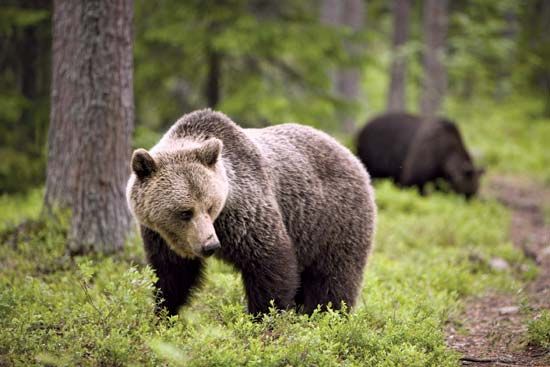
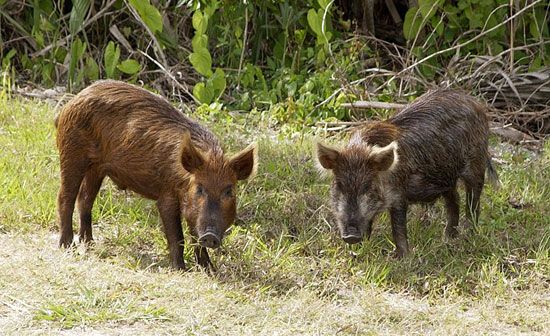
- Large Mammals: Brown bears, wolves, red deer, and wild pigs.93
- Predators and Small Mammals: Lynx, foxes, and martens.93
- Birds: The forests are also home to various songbirds.3
Alpine and High-Mountain Fauna
In the highest elevations, particularly within the Tatras, the environment supports specialized species adapted to harsh, high-altitude conditions. These include:910
- Mammals: Chamois and marmots.910
- Birds: Eagles are frequently found soaring over the alpine heights.310
The preservation of these species is a priority, with several animals, such as the lynx and wild pig, receiving legal protection in certain regions. The eastern part of the mountain range is noted for having particularly well-preserved forests, which serve as a vital refuge for this diverse wildlife.39
Sources
- Rodna Massif — Encyclopædia Britannica
- Romania - Relief — Encyclopædia Britannica
- Carpathian Mountains - Physiography of the Carpathian Mountains — Encyclopædia Britannica
- Carpathian Mountains - Geology — Encyclopædia Britannica
- glacial landform - Cirques , tarns, U-shaped valleys, arêtes, and horns — Encyclopædia Britannica
- glacial valley — Encyclopædia Britannica
- glacial landform - Glacial erosion — Encyclopædia Britannica
- Quaternary - Landforms — Encyclopædia Britannica
- Carpathian Mountains - Plant and animal life — Encyclopædia Britannica
- Romania - Plant and animal life — Encyclopædia Britannica
- Tatra Mountains — Encyclopædia Britannica
Published on · 3 min read