Mouse Opossum
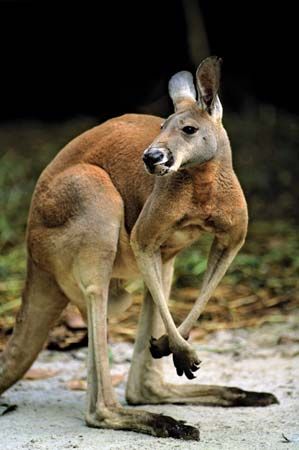
Mouse opossums are among the smaller members of the marsupial group, which includes a vast range of sizes from tiny species to the red kangaroo, the largest…
How big are mouse opossums compared to other marsupials?
Mouse opossums are among the smaller members of the marsupial group, which includes a vast range of sizes from tiny species to the red kangaroo, the largest living marsupial that can reach 90 kg (about 200 pounds).1
In contrast, adult mouse opossums are quite small, with total lengths varying from approximately 10 cm (4 inches) for the pygmy mouse opossum to 49 cm (19 inches) for the larger woolly mouse opossums. They are comparable in size to other small marsupials, such as the short-tailed opossum, which ranges from 11 cm to 28 cm in length, and the long-tailed planigale, which measures barely 12 cm. While many marsupials range from the size of a squirrel to that of a medium-sized dog, mouse opossums occupy the smaller end of this spectrum.213
What are the different species of mouse opossums, and how do they differ from each other?
Mouse opossums are a diverse group of more than 55 species of marsupials belonging to the family Didelphidae. They are categorized into eight distinct genera, each with unique characteristics and distributions:
- Gracile mouse opossums (Gracilinanus): Comprises six species found in South America.
- True mouse opossums (Marmosa): Includes 10 species distributed from southern Mexico through Central and South America to southern Brazil.
- Slender mouse opossums (Marmosops): Consists of 15 species native to South America.
- Woolly mouse opossums (Micoureus): Contains six species found in Central and South America, ranging from Belize to Brazil. These are the largest of the group, reaching up to 49 cm (19 inches) in total length.
- Southern, or fat-tailed, mouse opossums (Thylamys): Includes 10 species found in South America. Unlike other mouse opossums, they can store fat in their tails.
- Pygmy mouse opossums (Chacodelphys): A single species that represents the smallest of the group, measuring just over 10 cm (4 inches).
- Gray mouse opossums (Tlacuatzin): A single species found exclusively in Mexico.
- Kalinowski’s mouse opossums (Hyladelphys): A single species found in South America.
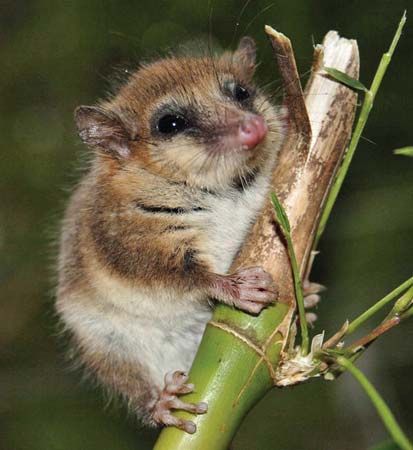
While they vary in size and tail function, all mouse opossums are agile climbers that lack a pouch and possess large naked ears and a dark ring around each eye. Their coloration ranges from pale gray to brown, with darker species typically inhabiting mountain forests.1
Do mouse opossums have any unique behaviors or traits that set them apart from other small mammals?
Mouse opossums possess several distinct biological and behavioral traits that differentiate them from other small mammals, including other marsupials like the short-tailed opossum.
Key Distinguishing Traits
- Absence of a Pouch: Unlike many other marsupials, female mouse opossums lack a pouch. Instead, they possess abdominal mammary glands, and in some species, pectoral glands as well.1
- Prehensile Tails: Most mouse opossums have slender, prehensile tails that are longer than their head and body combined, which aids in their agility as climbers.1
- Fat Storage: A unique adaptation is found in the southern, or fat-tailed, mouse opossums (Thylamys), which have the specialized ability to store fat in their tails.1
- Nesting Habits: These animals are highly adaptable climbers that construct nests in diverse locations, including palms, hollow logs, holes in the ground, and even within large cacti.1
- Reproductive Capacity: They are notable for their high reproductive potential, with some species capable of producing litters of up to 15 offspring.1
While they share the Didelphidae family with terrestrial species like the short-tailed opossum, mouse opossums are primarily defined by their arboreal agility and specialized physical features like their prehensile tails and fat-storage capabilities.14
In which regions of the world are mouse opossums typically found?
Mouse opossums are native to the Americas, with their distribution spanning from northern Mexico through Central America and across much of South America, reaching as far south as Argentina.12
Their specific regional presence varies by genus:
- Mexico: Gray mouse opossums (Tlacuatzin) are found exclusively in Mexico.1
- Central and South America: True mouse opossums (Marmosa) range from southern Mexico through Central America into South America, reaching southern Brazil. Woolly mouse opossums (Micoureus) are found from Belize through Central and South America to Brazil.1
- South America: The remaining genera—including gracile mouse opossums (Gracilinanus), slender mouse opossums (Marmosops), southern or fat-tailed mouse opossums (Thylamys), pygmy mouse opossums (Chacodelphys), and Kalinowski’s mouse opossums (Hyladelphys)—are found only in South America.1
Within these broad regions, they occupy diverse habitats, with darker-colored species typically favoring mountain forest environments.1
Sources
- mouse opossum — Encyclopædia Britannica
- opossum — Encyclopædia Britannica
- marsupial — Encyclopædia Britannica
- short-tailed opossum — Encyclopædia Britannica
- Marmosa — Merriam-Webster
Published on · 3 min read