Koala
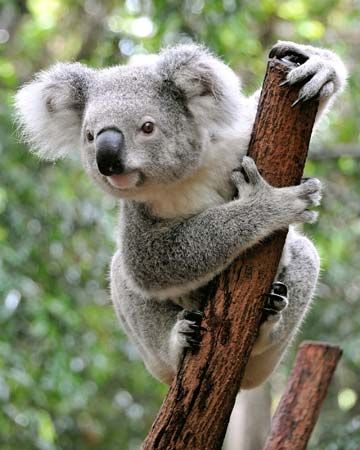
The koala (Phascolarctos cinereus) is a specialized marsupial that relies on a unique digestive strategy to survive on a diet of eucalyptus leaves, which are…
How does the koala’s diet and digestive system differ from other marsupials?
The koala (Phascolarctos cinereus) is a specialized marsupial that relies on a unique digestive strategy to survive on a diet of eucalyptus leaves, which are notoriously low in nutrients and high in toxic compounds like tannins.12
Unlike ruminants, which utilize a rumen for foregut fermentation, the koala is a hindgut fermenter. It processes its food using an exceptionally long cecum—a pouch measuring approximately 2 metres (7 feet) in length. Within this structure, symbiotic bacteria break down complex plant substances and toxins that would otherwise be indigestible.123
This system differs from many other herbivores in its specific adaptation to eucalyptus. Furthermore, the koala exhibits a unique maternal behavior: joey marsupials are weaned on “pap,” a predigested, soupy form of eucalyptus derived from the mother’s cecum, which provides the young with the necessary bacteria to begin their own specialized diet. Because their diet provides little spare energy, koalas have evolved to spend long hours resting to conserve their limited resources.1
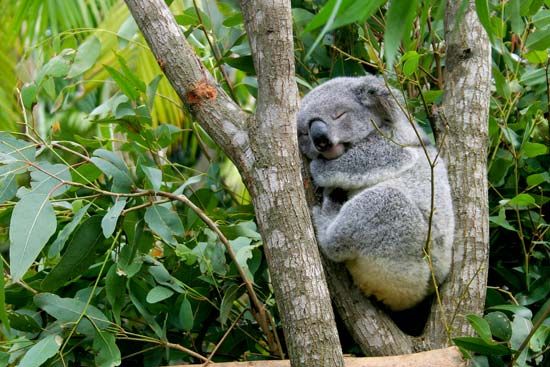
What is the evolutionary history of koalas, and how long have they existed as a species?
The koala (Phascolarctos cinereus) is the sole extant member of the family Phascolarctidae, a group within the suborder Vombatiformes. While the broader infraclass Marsupialia originated in the New World approximately 125 million years ago and later migrated to Australia, the specific evolutionary timeline of the koala as a distinct species is characterized by more recent divergence.156
Current research indicates that the koala species is composed of five distinct populations that began to diverge from one another between 300,000 and 430,000 years ago. As a specialized arboreal marsupial, the koala evolved to occupy a unique ecological niche, relying on a highly specific diet of eucalyptus leaves. This adaptation necessitated the development of a specialized digestive system, including a 2-metre (7-foot) cecum that utilizes symbiotic bacteria to neutralize toxins.1
While the koala has existed in its current form for hundreds of thousands of years, its history has been marked by significant population fluctuations, particularly following European colonization, which led to severe declines due to habitat loss and hunting.15
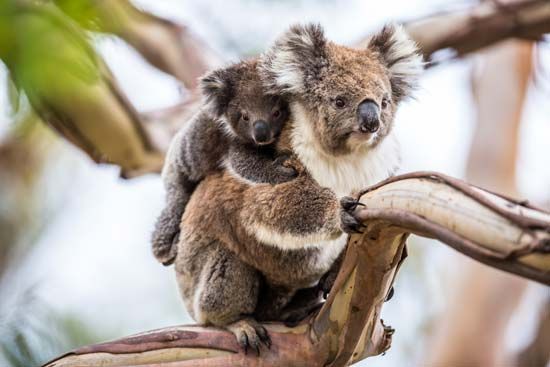
What are some common misconceptions about koalas, and how do they differ from bears?
A common misconception is that the koala is a type of bear, leading to the frequent but erroneous use of the term “koala bear.” In reality, the koala (Phascolarctos cinereus) is a tree-dwelling marsupial belonging to the family Phascolarctidae, which is entirely distinct from the family Ursidae (bears).71
Key Differences Between Koalas and Bears
- Biological Classification: Koalas are marsupials, a group of mammals characterized by giving birth to highly undeveloped young that continue their development in a pouch. Bears are placental mammals, which complete their development within the womb.6
- Reproductive Anatomy: A defining feature of the koala is its pouch, which opens rearward to protect the joey as it develops. Bears do not possess such a structure.71
- Diet and Lifestyle: Koalas are highly specialized herbivores that feed almost exclusively on eucalyptus leaves. Because this diet is low in nutrients, they have evolved a low-energy lifestyle, spending long hours resting to conserve energy. Bears, by contrast, are generally omnivorous and possess different metabolic requirements and digestive systems.786
- Brain Structure: Like other marsupials, koalas have simpler brains compared to placental mammals like bears, notably lacking a corpus callosum.6
While they may share a superficial physical resemblance to small bears, these two groups are separated by millions of years of distinct evolutionary history.76
What is ‘pap’ and why is it essential for a joey’s development?
“Pap” is a specialized, soupy substance consisting of predigested eucalyptus leaves that is produced by the mother koala.71
This substance is essential for a joey’s development during the weaning process, which lasts for up to six weeks. Derived from the mother’s cecum—an intestinal pouch where symbiotic bacteria break down the toxic and complex substances found in eucalyptus—pap provides the joey with necessary nutrients and helps it transition from milk to a leaf-based diet. The joey consumes this substance by lapping it directly from the mother’s anus.71
Sources
- koala — Encyclopædia Britannica
- koala: Top Questions — Encyclopædia Britannica
- cecum — Encyclopædia Britannica
- nutrition - Herbivores — Encyclopædia Britannica
- marsupial - Paleontology and recent history — Encyclopædia Britannica
- marsupial — Encyclopædia Britannica
- What are baby koalas called? — Encyclopædia Britannica
- Are koalas aggressive? — Encyclopædia Britannica
Published on · 3 min read