Marsupial Mole
Marsupial moles (Notoryctes) exhibit several specialized adaptations for their fossorial, or underground, lifestyle:
What adaptations do marsupial moles have for their underground lifestyle?
Marsupial moles (Notoryctes) exhibit several specialized adaptations for their fossorial, or underground, lifestyle:
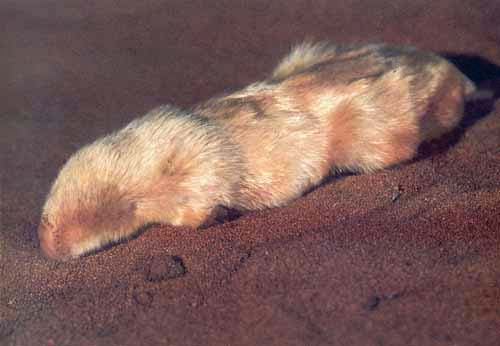
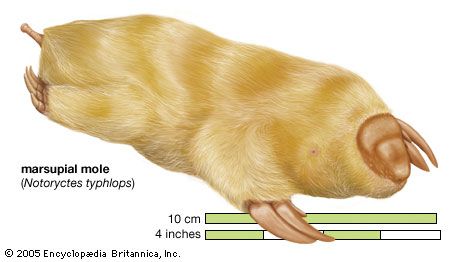
- Digging appendages: They possess powerful, triangular claws on their forefeet, which are specifically adapted for tunneling through soil to find food and shelter.12
- Sensory reduction: Their eyes are poorly developed and virtually hidden beneath their fur, as vision is of limited use in their subterranean environment.13
- Protective features: The skin on their blunt snouts and stubby tails is leathery, providing protection while they move through abrasive sandy substrates.1
- Coat: They are covered in long, silky, iridescent fur that helps them navigate through the soil.1
- Behavioral traits: Unlike many other burrowing animals, they do not maintain permanent tunnels; instead, they burrow just beneath the surface and frequently emerge to breathe. They are also known for an active lifestyle characterized by intense bursts of movement followed by sudden periods of sleep.1
What is the taxonomic classification of marsupial moles within the marsupial order?
Within the infraclass Metatheria (marsupials), marsupial moles are classified as follows:16
This order consists of only two species within a single genus, Notoryctes, which are found in the desert regions of central and western Australia.716
What are the unique characteristics that define marsupials, and how do marsupial moles fit into this category?
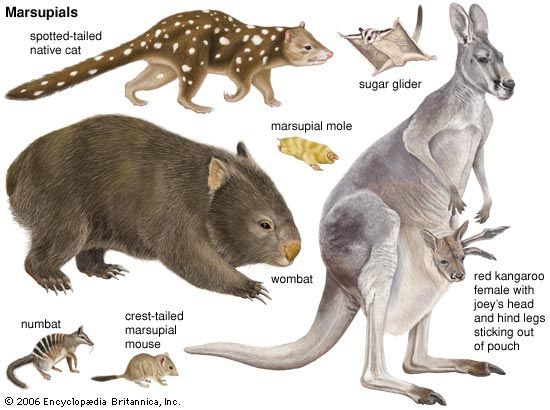
Marsupials are members of the infraclass Metatheria, a group of mammals defined by a unique reproductive strategy: they give birth to young at a very early, vulnerable stage of development. These newborns typically migrate to the mother’s belly to attach to milk-giving teats, where they continue their development for weeks or months. While many species possess a skin flap known as a marsupium (pouch) to protect the young, this is not a universal feature.28
Other defining characteristics of marsupials include:
- Anatomy: Females have twin vaginae that open into a common urogenital sinus, and males have testes located in front of the penis.6
- Skeletal structure: They exhibit specific skull bone patterns, including large openings in the palate and an inturning of the bone at the angle of the jaw, known as the gonial inflection.6
- Brain development: Their brains are generally smaller relative to body size than those of placental mammals and lack a corpus callosum.2
Marsupial moles fit into this category as members of the order Notoryctemorphia within the superorder Australidelphia. They share the fundamental mammalian traits of hair and mammary glands, alongside the specific reproductive and anatomical features that classify them as marsupials. Their unique, burrowing lifestyle is an example of convergent evolution, where they have adapted to fill an ecological niche similar to that of placental moles, despite their distinct evolutionary history.62
Are marsupial moles considered endangered, and what conservation efforts are in place to protect them?
The provided search results do not contain specific information regarding the current conservation status or specific protection efforts for marsupial moles. While the broader article on marsupials notes that historical factors such as land clearing and the introduction of non-native species have driven many Australian marsupials toward extinction or threatened their populations, it does not explicitly detail the status of the genus Notoryctes.19
Because the available documentation does not provide data on whether marsupial moles are currently classified as endangered or what specific conservation measures are in place for them, I cannot provide an accurate answer to that part of your query.
Sources
- marsupial mole — Encyclopædia Britannica
- marsupial — Encyclopædia Britannica
- marsupial: Top Questions — Encyclopædia Britannica
- marsupial mole — Merriam-Webster
- Burrowing — Encyclopædia Britannica
- marsupial - Classification — Encyclopædia Britannica
- mammal - Classification — Encyclopædia Britannica
- mammal - Estrus and other cycles — Encyclopædia Britannica
- marsupial - Paleontology and recent history — Encyclopædia Britannica
- marsupial mouse — Encyclopædia Britannica
Published on · 3 min read