Marsupial Mouse
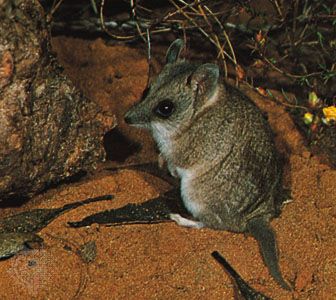
Marsupial mice, which belong to the family Dasyuridae, play a vital role as predators within their native ecosystems in Australia and New Guinea. Despite…
What role do marsupial mice play in their native food chains and ecosystems?
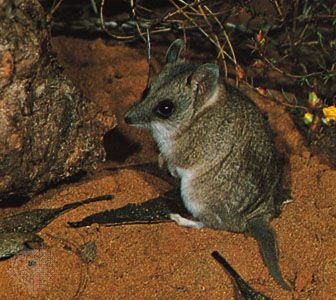
Marsupial mice, which belong to the family Dasyuridae, play a vital role as predators within their native ecosystems in Australia and New Guinea. Despite their name, they are biologically more similar to shrews than to true mice.1
Their ecological contributions include:
- Predatory Control: As active predators, they help regulate populations of insects and small vertebrates. For example, the crest-tailed marsupial mouse is specifically noted for its role in controlling house mouse populations.1
- Trophic Interactions: By consuming insects and small animals, they occupy specific feeding niches, effectively acting as the ecological counterparts to various placental mammals.23
- Pollination: While primarily carnivorous, some species, such as the broad-footed marsupial mice (Antechinus), also consume nectar, which can contribute to the pollination of native plants.1
These animals have adapted to survive in diverse environments, with some species capable of entering torpor to conserve energy when food is scarce. Their presence is essential for maintaining the balance of their respective food chains.12
How do marsupial mice care for their young, and how long do the young stay in the pouch?
Marsupial mice, which are members of the family Dasyuridae, follow the typical reproductive pattern of marsupials. Because they are born in a highly vulnerable, embryonic state, their development is completed outside the womb.31
Care for the Young
Upon birth, the young must make their own way to the mother’s lower belly to find shelter, warmth, and nourishment. In species that possess a marsupium (pouch), the young crawl inside to reach the milk-giving teats. In species that lack a fully developed pouch, the nipples may be exposed or bounded by only small skin remnants, and the young simply cling to them.3
Once the young reach the teats, they attach themselves firmly—often becoming physically fused to the mouth tissues—to receive a continuous supply of milk. This attachment allows them to continue their development for a period that corresponds to the later stages of fetal growth in placental mammals.31
Duration in the Pouch
The young remain attached to the teats and sheltered by the mother for several weeks or months. After this period of continued development, they are weaned and eventually begin to look after themselves.31
How do marsupial mice differ from placental mice in terms of reproduction and development?
Marsupial mice and placental mice differ fundamentally in their reproductive strategies and the developmental stages of their offspring.
Reproductive Differences
- Uterine Development: In placental mammals, the uterus is specialized for embryo implantation, and a placenta facilitates a long period of internal nourishment and protection. In contrast, marsupials lack this specialized uterine wall for implantation, and their period of intrauterine development is significantly shorter, ranging from approximately 8 to 40 days.389
- Birth and Attachment: Placental mammals give birth to relatively well-developed young. Marsupials, however, give birth to young in a highly vulnerable, embryonic state. These newborns must migrate to the mother’s lower belly to attach to teats for continued development.3108
Developmental Differences
- External Development: Because marsupial young are born prematurely, their development is completed outside the womb while attached to the mother’s nipples. This period of external growth corresponds to the later stages of fetal development in placental mammals.3
- Pouch and Care: Many marsupials utilize a marsupium (pouch) to shelter the developing young, though some species lack this structure and the young simply cling to exposed teats. Placental mammals do not utilize a pouch, as their young complete development internally.389
What are some examples of marsupial mouse species, and where are they primarily found?
Marsupial mice, which belong to the family Dasyuridae, are primarily found in Australia and New Guinea. Despite their name, these predatory animals are biologically more similar to shrews than to true mice.1
Several notable examples of marsupial mouse species include:
- Broad-footed marsupial mice (Antechinus): Known for their varied diet, which includes insects, small vertebrates, and nectar.1
- Fat-tailed dunnart (Sminthopsis crassicaudata): A species that stores excess fat in its tail to survive periods of food scarcity.1
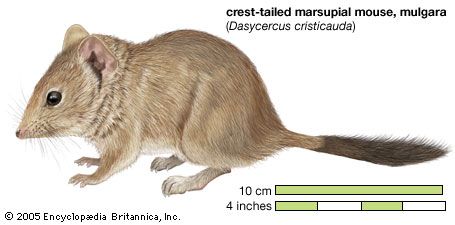
- Crest-tailed marsupial mouse, or mulgara (Dasycercus cristicauda): An arid-land specialist that obtains all necessary hydration from the bodies of its prey.1
- Brush-tailed marsupial mice, or tuans (Phascogale): Arboreal animals characterized by a distinctive, bottle-brush-like tail.1
- Flat-skulled marsupial mice, or planigales (Planigale): Small creatures that closely resemble true shrews in both appearance and behavior.1
- Kultarr (Antechinomys laniger): A jerboa-like species found in the Australian outback that is currently listed as endangered.1
Sources
- marsupial mouse — Encyclopædia Britannica
- mammal - Food habits — Encyclopædia Britannica
- marsupial — Encyclopædia Britannica
- Antechinus — Merriam-Webster
- kangaroo mouse — Encyclopædia Britannica
- Reproductive behaviour - Mammals — Encyclopædia Britannica
- marsupial: Top Questions — Encyclopædia Britannica
- mammal - Estrus and other cycles — Encyclopædia Britannica
- Animal development - Adaptations in mammals — Encyclopædia Britannica
- Gestation — Encyclopædia Britannica
Published on · 3 min read