Mannikin
The term "mannikin" (or "manikin") refers to two distinct subjects depending on the context:
What is Mannikin?
The term “mannikin” (or “manikin”) refers to two distinct subjects depending on the context:
Biological Classification
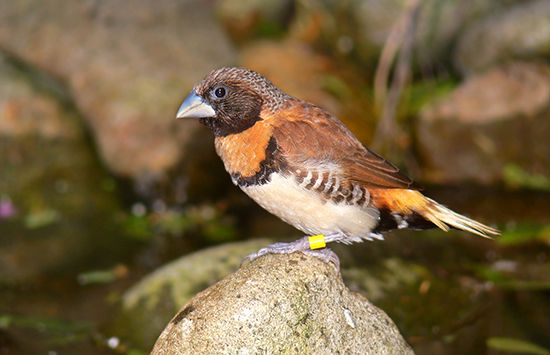
In ornithology, a mannikin is any of numerous songbird species belonging to the tribe Amadini within the family Estrildidae. These finchlike birds are primarily found in open country from Africa to Australia and are often kept as cage birds. Notable species include the bronze mannikin, the nutmeg mannikin (also known as a spice finch), and the striated mannikin. Note that these are distinct from the South American manakins of the family Pipridae.1
Human Representations and Usage
In other contexts, “manikin” is a variant spelling of mannequin, referring to a three-dimensional representation of the human body used for displaying clothing or a person who models merchandise.234
Historically, the term has also been used to describe a “little man” or dwarf. It is important to note that this specific usage is considered dated and disparaging, and it may be perceived as offensive.3
What is the difference between a mannikin and a manakin bird?
Although the names are similar, mannikins and manakins are distinct groups of birds that belong to different families and inhabit different regions of the world.
Manakins
- Family: They belong to the subfamily Piprinae (often classified within the family of New World, or tyrant, flycatchers).5
- Geography: They are native to the tropical forests of the Americas.5
- Characteristics: Manakins are small, stubby, short-tailed birds known for their flamboyant plumage and complex courtship displays. Males often gather in leks to perform intricate dances and produce unique sounds, such as loud wing-snaps, to attract mates. They play a vital role in tropical ecosystems by dispersing seeds through their consumption of fruit.5
Mannikins
- Family: They belong to the tribe Amadini within the songbird family Estrildidae.26
- Geography: These birds are found in the Old World, ranging across Africa, Asia, and Australia.2
- Characteristics: Mannikins are finchlike birds, typically brownish in color and often featuring black throats or fine barring. They are gregarious, often found in large flocks in open country, and are popular as cage birds.26
How are mannikin birds adapted to living in large flocks?
Mannikin birds, which belong to the tribe Amadini within the songbird family Estrildidae, are highly gregarious creatures that frequently congregate in large flocks in open country across Africa, Asia, and Australia.10
While specific evolutionary adaptations for their flocking behavior are not detailed in the provided literature, their social nature is a defining characteristic. For instance, the bronze mannikin (L. cucullata) is known to utilize large communal roosts, which may provide benefits related to protection or social cohesion. Generally, many finch species—to which mannikins are related—exhibit similar gregarious behavior outside of their nesting periods, often forming large flocks that may assist in foraging efficiency or predator detection.102
Why is the term manikin sometimes considered offensive when referring to people?
The term “manikin” is considered offensive when applied to people because it has a historical usage as a disparaging label for individuals of short stature, such as those described as dwarfs or pygmies.3
Derived from the Dutch word mannekijn, meaning “little man,” the term was historically used to diminish a person’s humanity by reducing them to a diminutive object or caricature. While the word is also used neutrally to refer to a mannequin—a three-dimensional representation of the human body used for displaying clothes or as an artist’s figure—its application to human beings is outdated and carries a derogatory connotation that violates the principle of treating all individuals with dignity and respect.3113
Sources
- manikin — Merriam-Webster
- Mannikin — Encyclopædia Britannica
- manikin — Merriam-Webster
- mannequin — Merriam-Webster
- Manakin — Encyclopædia Britannica
- Pipit — Encyclopædia Britannica
- Estrildidae — Encyclopædia Britannica
- Grass finch — Encyclopædia Britannica
- Pipridae — Merriam-Webster
- Reproductive behaviour - Birds — Encyclopædia Britannica
- Avoidance behaviour - Warning behaviour — Encyclopædia Britannica
- Finch — Encyclopædia Britannica
- manikins — Merriam-Webster
- mannequin — Merriam-Webster
Published on · 3 min read