Grass Finch
A grass finch refers to any of several small, finchlike songbirds belonging to the tribe Erythrurini within the family Estrildidae. Native to Australasia…
What is Grass finch?
A grass finch refers to any of several small, finchlike songbirds belonging to the tribe Erythrurini within the family Estrildidae. Native to Australasia, these birds are characterized by their stout, conical bills and long, pointed tails.1
They typically inhabit hot, open country, often in proximity to rivers. Due to their vibrant plumage, several species are popular as cage birds. Notable examples include:1
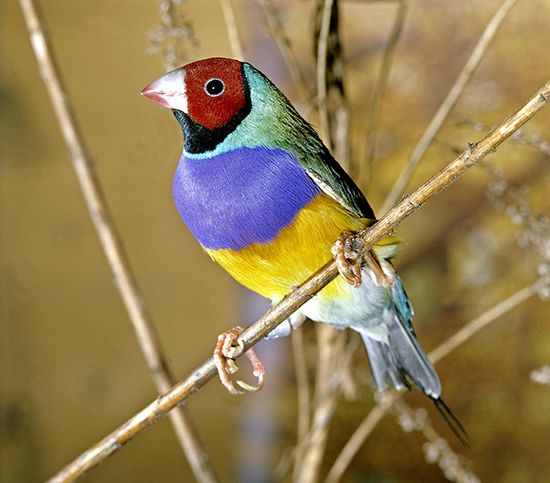
- Gouldian finch: Known for its striking coloration, featuring purple, gold, green, blue, and black plumage.1
- Star finch: Distinguished by a red, white-dotted head and a white-barred red tail.1
- Painted finch: A species marked by red and brown coloration with white-spotted black underparts.1
While they share the conical bill structure common to many finches, grass finches are distinct in their specific classification and regional distribution.12
What makes the Gouldian finch so unique compared to other species?
The Gouldian finch (Chloebia gouldiae) is widely considered one of the most visually striking birds in the world due to its exceptionally vibrant and complex plumage. Unlike many other finch species, it displays a brilliant combination of purple, gold, green, blue, and black feathers.1
A particularly unique feature of the Gouldian finch is the polymorphism found in its facial coloration. Depending on the individual, the bird’s face may be red, orange, or black, a trait that distinguishes it from the more uniform appearance of many other grass finches. This small Australian native, named after the English naturalist John Gould, has become a highly sought-after cage and aviary bird precisely because of this intense, multi-colored display.13
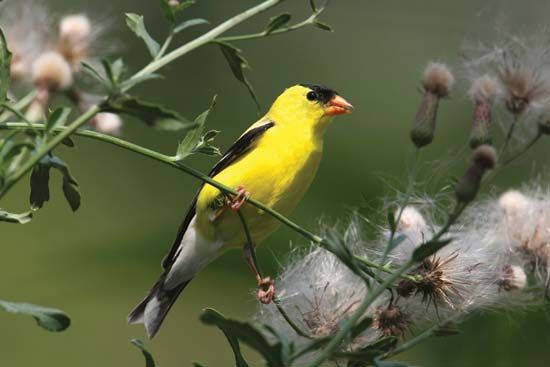
While other finches, such as the American goldfinch, are recognized for their own distinct breeding behaviors and seasonal plumage changes, the Gouldian finch remains unparalleled in the sheer variety of its permanent, vivid coloration.14
How do finches use their conical bills to eat?
Finches are primarily recognized for their heavy, conical bills, which are specialized tools adapted for a seed-based diet. These bills function as mechanical devices used to crack the tough outer shells of grass and weed seeds to access the nutrient-rich interior.2
The morphology of these bills varies significantly across species to accommodate different feeding needs:
- Strength and Size: Some finches, such as the hawfinch, possess exceedingly stout and blunt bills capable of cracking remarkably hard objects, including cherry pits.5
- Precision: Other species, like siskins, have smaller, more pointed bills that allow for more delicate seed extraction.5
- Specialization: Certain groups have evolved unique bill shapes for specific food sources, such as crossbills, whose bills are specialized for extracting seeds from pine cones.5
While these birds are primarily granivorous, they are often opportunistic feeders. Many species supplement their diet with insects, particularly when feeding their young, as nestlings are generally unable to crack seeds.25
What are the main differences between true finches and other songbirds?
The term “finch” is often used broadly to describe various small, seed-eating songbirds within the order Passeriformes. However, a distinction exists between “true finches” and other birds commonly called finches.27
True Finches (Family Fringillidae)
True finches belong to the family Fringillidae, which includes approximately 230 species such as grosbeaks, euphonias, and chaffinches. Key characteristics of this family include:7
- Physical Traits: They possess strong, conical bills that are short and typically thick at the base, specifically adapted for cracking seeds.8
- Sexual Dimorphism: Many species exhibit well-marked differences in appearance between sexes, with juveniles often resembling the females.8
- Global Distribution: They are found on every continent except Antarctica.7
Other “Finches”
Many other songbirds are colloquially referred to as finches but are classified in different families, such as Emberizidae, Thraupidae, and Estrildidae. For example, the Galapagos finch is placed within the family Emberizidae.9 While these birds share the general “finch” appearance—small size and conical bills—they belong to distinct evolutionary lineages.279
Sources
- Grass finch — Encyclopædia Britannica
- Finch — Encyclopædia Britannica
- American goldfinch: Top Questions — Encyclopædia Britannica
- gouldian finch — Merriam-Webster
- Passeriform - Bill — Encyclopædia Britannica
- Charadriiform - Adaptations for feeding — Encyclopædia Britannica
- Fringillidae — Merriam-Webster
- Fringillidae — Encyclopædia Britannica
- Galapagos finch — Encyclopædia Britannica
- Passeriform - Evolution and paleontology — Encyclopædia Britannica
Published on · 3 min read