Negro River
There are two prominent rivers known as the Negro River in South America:
What is Negro River?
There are two prominent rivers known as the Negro River in South America:
The Negro River (Amazon Tributary)
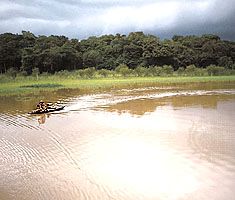
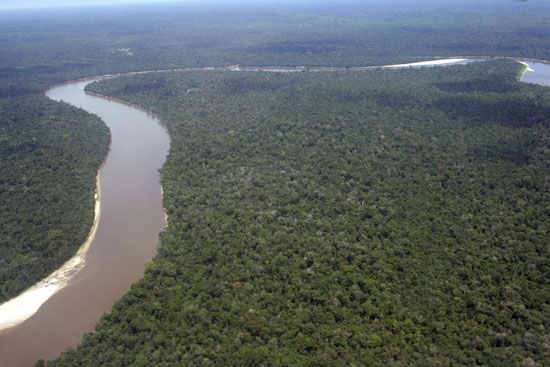
This Negro River is the largest tributary of the Amazon River. It originates in Colombia as the Guainía and Vaupés rivers, eventually flowing through Brazil to join the Solimões River at Manaus, forming the Amazon. Spanning approximately 1,400 miles (2,250 km), it is famous for its distinct jet-black water, caused by the decomposition of organic matter and low silt content. It serves as a vital transportation artery through the Amazon basin.12
The Negro River (Uruguay)
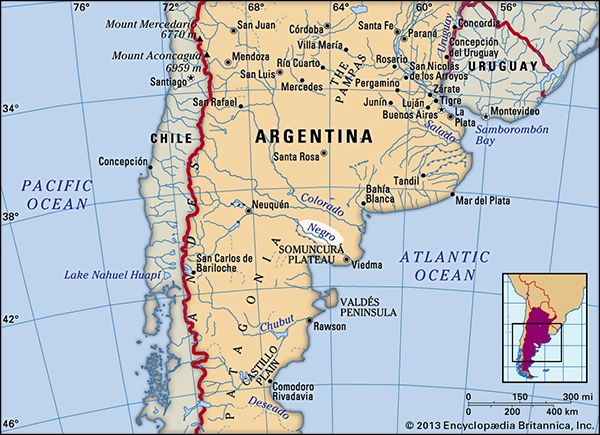
The Negro River in Uruguay rises in the southern highlands of Brazil. It is approximately 500 miles (800 km) long and is heavily utilized for hydroelectric power via several dams, including the Rincón del Bonete Reservoir. It eventually flows westward to join the Uruguay River.3

What causes the water of the Rio Negro to appear black?
The distinct jet-black appearance of the Negro River is primarily caused by the high concentration of humic acids resulting from the decomposition of organic matter in marginal swamps and forests along its course.13
Because the river originates in nutrient-poor, sandy uplands, it carries very little silt or dissolved solids, which allows the dark, tea-like color—derived from these organic compounds—to remain prominent. These tannins, which are phenolic compounds found in woody plants, are responsible for the dark coloration and acidic nature of the water. This “blackwater” characteristic creates a striking visual contrast when the river meets the silt-laden, yellowish “whitewater” of the Amazon River at Manaus.134
What is the Meeting of Waters at Manaus?
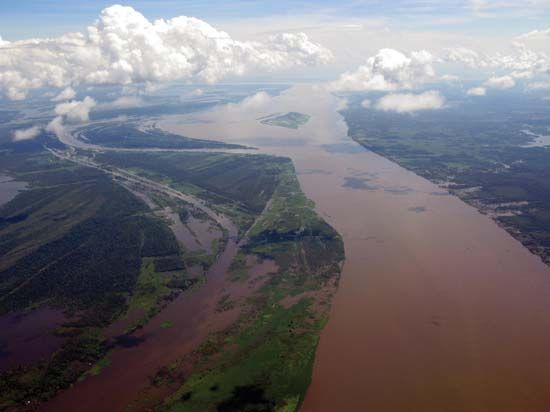
The “Meeting of Waters” (or Encontro das Águas) is a famous natural phenomenon occurring near the city of Manaus, Brazil, where the Negro River and the Solimões River converge to form the Amazon River.51
This junction is visually striking because the two rivers possess vastly different physical characteristics that prevent them from mixing immediately:
- The Negro River: Carries clear, jet-black water that is relatively warm and free of sediment, colored by high levels of humic acids from decaying organic matter.13
- The Solimões River: Contains yellowish, silt-laden “whitewater” derived from the Andes, making it cooler and denser than the Negro.3
Because of these differences in temperature, speed, and density, the waters flow side-by-side for several miles without blending. The darker, warmer waters of the Negro tend to be overrun by the sediment-heavy waters of the Solimões, creating a distinct color boundary that is only erased by turbulence further downstream.3
How do blackwater rivers differ from whitewater rivers in the Amazon?
In the Amazon basin, rivers are categorized by their physical and chemical properties, primarily determined by their source and the terrain they traverse. The differences between blackwater and whitewater rivers are significant:
Blackwater Rivers
- Origin: These rivers typically rise in ancient, nutrient-poor, sandy uplands or crystalline highlands.1
- Appearance and Chemistry: They are characterized by a clear, jet-black color caused by high concentrations of humic acids and tannins resulting from the decomposition of organic matter in marginal swamps and forests.316
- Sediment: They carry little to no silt or dissolved solids.1
- Ecology: They are associated with igapó, or blackwater-flooded forests, which contain slow-growing trees and are more acidic than whitewater environments.6
Whitewater Rivers
- Origin: These rivers originate in the geologically youthful and tectonically active Andes Mountains.1
- Appearance and Chemistry: They are turbid and yellowish due to heavy loads of suspended sediment picked up from the mountains.1
- Ecology: They are associated with várzeas, or whitewater-flooded forests. The sediment deposited by these rivers during annual flooding adds to the fertility of the floodplains, making them more nutrient-rich than blackwater areas.6
Sources
- Negro River — Encyclopædia Britannica
- Negro River — Encyclopædia Britannica
- Amazon River - Physiography of the river course — Encyclopædia Britannica
- tannin — Encyclopædia Britannica
- Solimões River — Encyclopædia Britannica
- Amazon basin — Encyclopædia Britannica
Published on · 3 min read