Musgrave Ranges
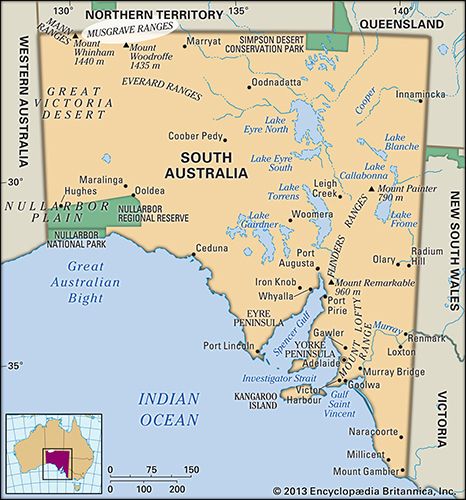
The Musgrave Ranges are a series of granite hills located in northwestern South Australia, extending for 130 miles (210 km) parallel to the Northern…
What is Musgrave Ranges?
The Musgrave Ranges are a series of granite hills located in northwestern South Australia, extending for 130 miles (210 km) parallel to the Northern Territory border. These ranges feature bare rock surfaces and numerous peaks exceeding 3,500 feet (1,100 m), including Mount Woodroffe, which stands at 4,708 feet (1,435 m) and serves as the highest point in South Australia.1
The hills were sighted in 1873 by the English explorer William C. Gosse and were named in honor of Sir Anthony Musgrave, the lieutenant governor of South Australia at that time. Geologically, the area is characterized by isolated granite rocks known as inselbergs that rise above the surrounding plains known as inselbergs that rise above the surrounding plains. Culturally and historically, the region has been a traditional place of initiation for the Pitjantjatjara Aborigines, and it became the subject of significant Aboriginal land-rights claims in the mid-1980s. The ranges also connect to the Petermann Ranges to the northwest.12
Who are the Pitjantjatjara people and what is their connection to the land?
The Pitjantjatjara are an Aboriginal people whose traditional connection to the land is deeply rooted in their cultural and spiritual practices. The Musgrave Ranges, located in northwestern South Australia, have historically served as a significant site for their initiation ceremonies.4
Their relationship with the land is further evidenced by their pursuit of legal recognition of their ancestral ties. In the mid-1980s, the Pitjantjatjara were involved in major land-rights claims concerning the Musgrave Ranges, reflecting the broader struggle of Indigenous Australians to secure formal title to their traditional territories. This connection to the landscape is a fundamental aspect of their identity and heritage, similar to the land-rights efforts seen among other groups, such as the Aranda people, who gained freehold title to their land in the Northern Territory in 1982.41
We could dive deeper into the history of Aboriginal land rights in Australia or explore the cultural significance of initiation sites in the Central Desert region.
What is an inselberg and how does it form?
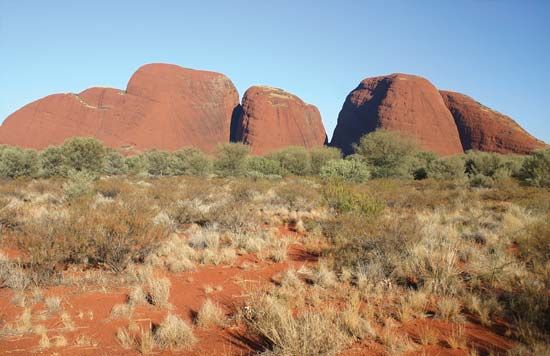
An inselberg (from the German Insel, meaning “island,” and Berg, meaning “mountain”) is an isolated hill or mountain that rises abruptly above a surrounding plain, appearing much like an island in the sea.56
Formation
Inselbergs are considered relict features, meaning they have maintained their height while the surrounding landscape was lowered by erosion. Their formation is primarily attributed to the following processes:
- Differential Erosion: These structures are typically composed of hard, resistant rock—such as granite or volcanic rock—that remains standing as the softer, surrounding material is worn away by wind and weather over millions of years.56
- Subsurface Weathering: Research, notably by C.R. Twidale, has demonstrated that subsurface weathering plays a critical role in shaping the hillslopes and pediments of granitic inselbergs.5
- Stability: As paleoforms, inselbergs are remarkably stable and can survive with little modification for tens of millions of years, with active erosional processes largely confined to the adjacent valley floors and sides.5
Famous examples of these formations include Uluru/Ayers Rock and the Olga Rocks in central Australia.56
How do the Musgrave Ranges compare to other Australian landmarks like Uluru?
The Musgrave Ranges and landmarks like Uluru are both iconic features of the Australian landscape, yet they differ significantly in their geological composition and scale.
Geological Composition
- Musgrave Ranges: These are a series of granite hills that extend for 130 miles (210 km) along the border of South Australia and the Northern Territory. They are part of a broader group of isolated ranges in northwestern South Australia, including the Everard, Birksgate, Mann, and Tomkinson ranges, which are characterized by numerous granite inselbergs standing above the surrounding plains.18
- Uluru: In contrast, Uluru is a giant monolith composed of arkosic sandstone containing a high proportion of feldspar. While the Musgrave Ranges are a mountain system, Uluru is classified as a single, isolated mass of weathered rock, or a tor.9
Scale and Significance
- Elevation: The Musgrave Ranges reach higher elevations, with Mount Woodroffe standing at 4,708 feet (1,435 m), making it the highest point in South Australia. Uluru rises 1,142 feet (348 m) above the desert plain.19
- Cultural Heritage: Both sites hold profound importance for Aboriginal peoples. The Musgrave Ranges have historically served as a significant place of initiation for the Pitjantjatjara people. Similarly, Uluru is deeply revered by local Aboriginal groups and is recognized as a UNESCO World Heritage site for both its natural and cultural significance.19
Sources
- Musgrave Ranges — Encyclopædia Britannica
- Australia - The Western Plateau — Encyclopædia Britannica
- Petermann Ranges — Encyclopædia Britannica
- Aranda — Encyclopædia Britannica
- inselberg — Encyclopædia Britannica
- inselberg — Merriam-Webster
- inselbergs — Merriam-Webster
- Uluru/Ayers Rock — Encyclopædia Britannica
- MacDonnell Ranges — Encyclopædia Britannica
Published on · 3 min read