Mount Bartle Frere
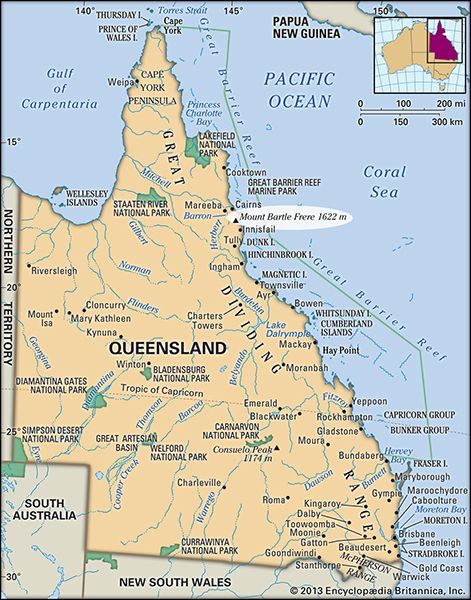
Mount Bartle Frere is a prominent mountain located in the Bellenden-Ker Range of northeastern Queensland, Australia. Standing at an elevation of 5,287 feet…
What is Mount Bartle Frere?
Mount Bartle Frere is a prominent mountain located in the Bellenden-Ker Range of northeastern Queensland, Australia1. Standing at an elevation of 5,287 feet (1,611 meters), it holds the distinction of being the highest point in the state.1
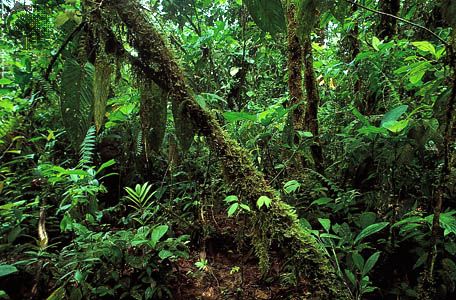
The mountain is situated within a protected national park, and its slopes are characterized by a rain forest climate that supports a diverse array of tropical plants, birds, and mammals. The peak was named in 1873 by the Scottish explorer George A.F.E. Dalrymple to honor Sir Henry Bartle Edward Frere, who served as the governor of Bombay from 1862 to 1867.1
What kind of wildlife lives in the Wooroonooran National Park?
Sorry, the provided search results do not contain specific information regarding the wildlife species found within Wooroonooran National Park. While the results confirm that the broader region of northeastern Queensland—including the nearby Bellenden Ker Range—is home to diverse wildlife such as kangaroos and cassowaries within its tropical rain forests, they do not provide a detailed list of fauna specific to Wooroonooran National Park itself.23
How does the climate change as you climb the mountain?
As you ascend a mountain, the climate changes primarily due to the effects of altitude and relief.
Atmospheric temperature generally drops by approximately 0.5 to 0.6 °C (0.9 to 1.1 °F) for every 100 meters (328 feet) of elevation gained. Additionally, mountains influence local weather by forcing air to rise over their slopes. As this air ascends, it cools and often releases moisture as precipitation on the windward side. Conversely, as air descends on the leeward side, it warms and loses humidity, frequently creating a drier “rain shadow” effect.1
These shifts in temperature and moisture create distinct environmental zones. For instance, while lower slopes may support lush rain forests, higher elevations often reach a tree line—a critical threshold where the climate becomes too harsh for trees to grow, giving way to alpine vegetation. On mountains like Mount Bartle Frere, these climatic variations dictate the distribution of diverse tropical plants and wildlife across the landscape.154
What are some other famous mountain ranges in Australia?
Australia features several notable mountain ranges, many of which are part of the extensive Great Dividing Range, a system of plateaus and mountains stretching 2,300 miles along the eastern coast.68
Key mountain ranges and highland areas in Australia include:
- Australian Alps: Located on the border of New South Wales and Victoria, this segment contains the continent’s highest peak, Mount Kosciuszko.69
- Bellenden Ker Range: Situated in Queensland, these mountains reach elevations of up to 5,000 feet.68
- McPherson Range: Another significant highland area in Queensland, often associated with the Lamington Plateau.68
- Blue Mountains: A popular region in New South Wales known for its national park and rugged terrain.8
- Grampians: Located in Victoria, these mountains mark the western termination of the Great Dividing Range.68
- Petermann Ranges: Found in the interior, these low mountains extend from Western Australia into the Northern Territory.10
- Musgrave Ranges: Located to the southeast of the Petermann Ranges, these mountains are composed of granite and gneiss formations.10
Sources
- Mount Bartle Frere — Encyclopædia Britannica
- Northern Territory - Plant and animal life — Encyclopædia Britannica
- Queensland - Plant and animal life — Encyclopædia Britannica
- Bellenden Ker Range — Encyclopædia Britannica
- Mountain ecosystem - Environment — Encyclopædia Britannica
- Exploring 7 of Earth’s Great Mountain Ranges - Great Dividing Range — Encyclopædia Britannica
- East African mountains - Climate — Encyclopædia Britannica
- Australian Alps — Encyclopædia Britannica
- Great Dividing Range — Merriam-Webster
- Petermann Ranges — Encyclopædia Britannica
- The World’s Highest Mountains by Continent — Encyclopædia Britannica
- Great Dividing Range — Encyclopædia Britannica
Published on · 2 min read