Mylodon
Mylodon is an extinct genus of ground sloth that lived during the Pleistocene Epoch, a period spanning from approximately 2.6 million to 11,700 years ago.
What is Mylodon and when did it live?
Mylodon is an extinct genus of ground sloth that lived during the Pleistocene Epoch, a period spanning from approximately 2.6 million to 11,700 years ago.1
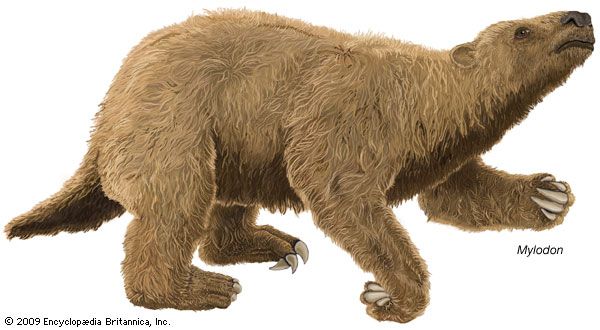
These mammals were native to South America and reached lengths of about 3 meters (10 feet). Physically, they were distinguished from other ground sloths by their triangular cheek teeth, the presence of upper canine teeth, and a small first toe on their hind limbs. Their skin featured embedded bony parts, likely providing defense against predators. Evidence from cave deposits suggests that these animals coexisted with humans, who hunted them for food.1
How did Mylodon become extinct?
The extinction of Mylodon and other large mammals at the end of the Pleistocene Epoch remains a subject of significant scientific debate. While the exact cause is not definitively settled, researchers generally focus on two primary, often overlapping, hypotheses:13
- Overkill Hypothesis: This theory suggests that the arrival and expansion of human hunters played a critical role in the decline of megafauna. Evidence, including the discovery of Mylodon remains in association with human artifacts, indicates that these animals were hunted and consumed by humans. Proponents argue that these large herbivores were vulnerable to skilled human predators who were new to the environment.31
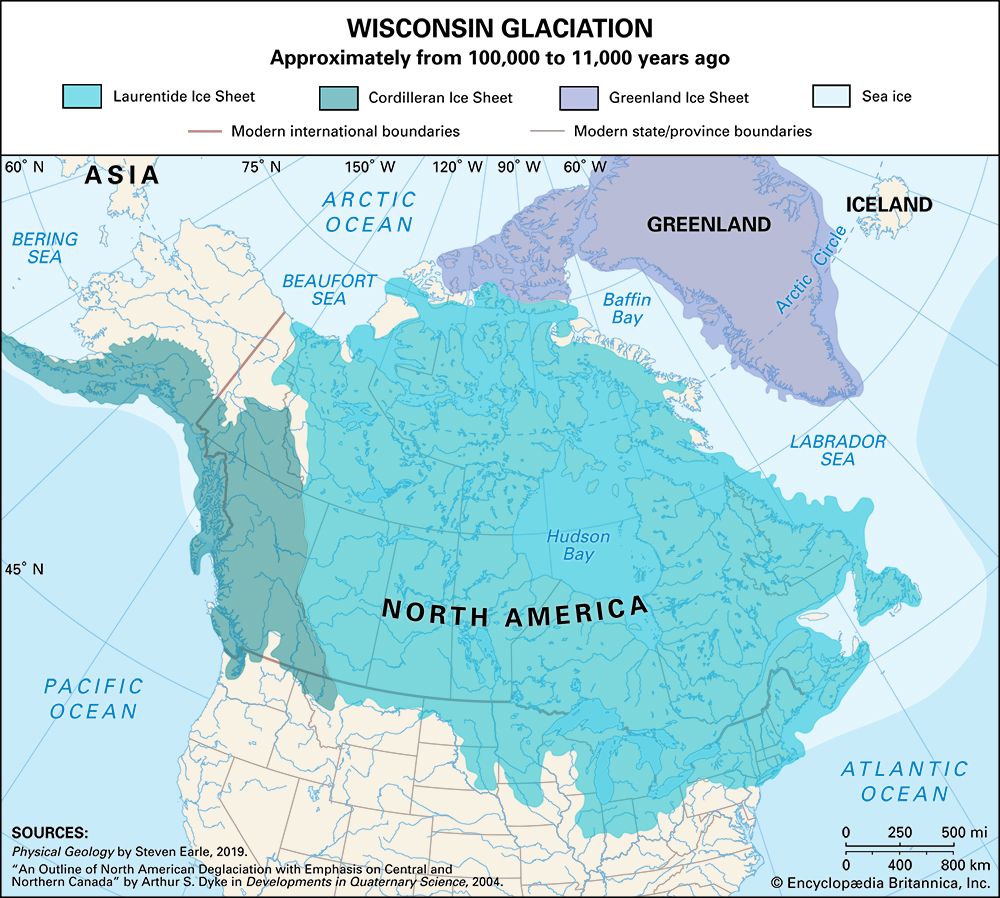
- Climatic and Environmental Change: The end of the last Ice Age brought abrupt shifts in climate and vegetation. These changes led to increased seasonality and environmental stress, which likely disrupted the food sources and habitats necessary for the survival of large ground sloths.34
It is widely believed that these factors likely acted in concert, with the relative importance of human activity and climatic shifts varying by geographic region.3
What were the physical characteristics of Mylodon?
Mylodon was a large ground sloth that reached a length of approximately 3 meters (10 feet). Its physical anatomy included several distinct features that set it apart from other ground sloths, specifically the presence of upper canine teeth, triangular-shaped cheek teeth, and a small first toe on its hind limbs.1
The animal was equipped with well-developed claws, which it likely used to dig for tubers or to grasp branches while feeding on the foliage of trees and shrubs. Additionally, its skin was embedded with numerous bony parts, which served as a form of armor to provide protection against predators.1
How does Mylodon compare to other prehistoric ground sloths?
Mylodon belonged to the family Mylodontidae, which represented the dominant group of South American ground sloths during the Pleistocene Epoch. While many ground sloths shared similar ecological roles as large herbivores, Mylodon is anatomically distinguished from other groups by specific dental and skeletal traits:1
- Dental Features: Unlike other ground sloths, Mylodon possessed upper canine teeth and triangular-shaped cheek teeth.1
- Skeletal Structure: It featured a unique small first toe on its hind limbs.1
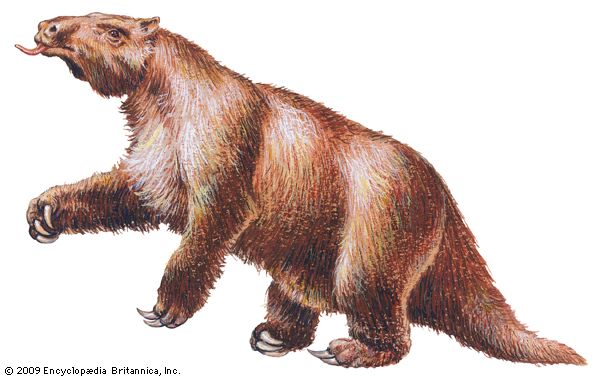
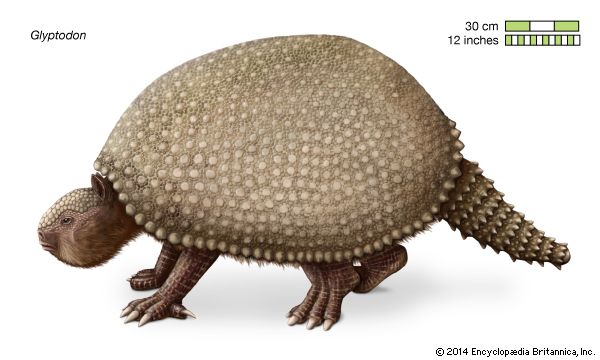
- Related Genera: Mylodon is closely related to Paramylodon and Glossotherium. While Mylodon was primarily found in South American deposits, its relatives were more widely distributed, successfully spreading into various regions of North America.1
Furthermore, some related genera exhibited distinct cranial adaptations; for instance, Glossotherium possessed nostrils completely enclosed by the premaxillae, giving the skull a superficial resemblance to that of a turtle.2
Sources
- Mylodon — Encyclopædia Britannica
- mylodont — Merriam-Webster
- Pleistocene Epoch - Megafaunal extinctions — Encyclopædia Britannica
- sloth - Classification and paleontology — Encyclopædia Britannica
- Megatherium — Encyclopædia Britannica
- Glossotherium — Merriam-Webster
Published on · 2 min read