Glyptodon
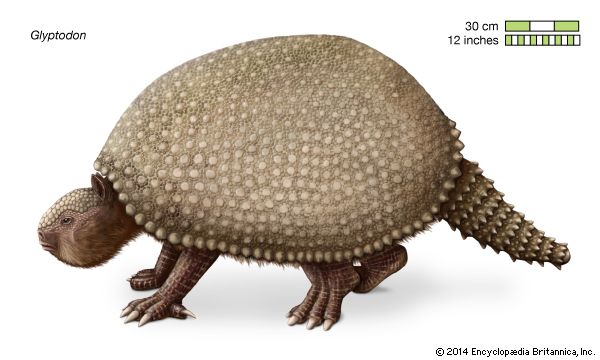
A Glyptodon was a genus of giant, extinct mammals closely related to modern armadillos. These creatures were characterized by a massive, rigid carapace…
What is a Glyptodon and when did it exist?
A Glyptodon was a genus of giant, extinct mammals closely related to modern armadillos. These creatures were characterized by a massive, rigid carapace composed of bony plates that covered their bodies from head to tail, providing significant protection. Some species even possessed a tail armored with bony rings, which could function as a defensive club.12
Regarding their timeline, these animals existed during the Pliocene and Pleistocene epochs, spanning from approximately 5.3 million to 11,700 years ago. Their fossils have been discovered in deposits across both North and South America. As opportunistic feeders, they consumed a varied diet that included plants, insects, and carrion.12
How large was the Glyptodon compared to modern animals?
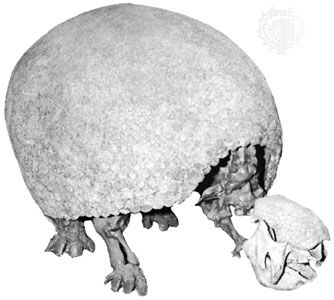
The Glyptodon was significantly larger than any modern armadillo. While modern armadillos are relatively small, the Glyptodon was a massive creature, with its body shell alone reaching lengths of up to 1.5 meters (5 feet).1
To put its size into perspective, the Glyptodon was comparable in overall body length to a small car or a large turtle, though its rigid, bony carapace provided a level of protection and bulk far exceeding that of its living relatives. Its heavy, armored tail further added to its imposing physical presence, distinguishing it as one of the most formidable members of the ancient megafauna.12
What was the Glyptodon’s habitat and diet?
The Glyptodon inhabited regions across North and South America, where its fossilized remains have been discovered in deposits dating from the Pliocene and Pleistocene epochs.12
Regarding its diet, the Glyptodon was an opportunistic feeder. Unlike many specialized herbivores of its time, it consumed a diverse range of food sources, including plants, insects, and carrion.1
How was the Glyptodon related to modern armadillos?
The Glyptodon was a genus of extinct, massive mammals that were close relatives of modern armadillos. Both animals belong to the order Cingulata, a group characterized by their armored, shell-like coverings.13
The relationship between these creatures is defined by several key shared traits:
- Armor Composition: Like modern armadillos, Glyptodon and other glyptodonts were protected by a carapace composed of bony plates. While modern armadillos typically have movable bands in their armor, the Glyptodon possessed a single, rigid, unjointed carapace.142
- Biological Classification: Both are members of the magnorder Xenarthra, an ancient lineage of mammals that also includes sloths and anteaters. A defining feature of this group is the presence of “xenarthrous” vertebrae in the lower back, which provide extra support for activities like digging.3
- Evolutionary History: While the family Dasypodidae is the only surviving family of the order Cingulata today, the order was once much more diverse. Glyptodonts represent an extinct family within this same order that thrived alongside early armadillos during the Pleistocene Epoch.3
Sources
- Glyptodon — Encyclopædia Britannica
- glyptodon — Merriam-Webster
- armadillo — Encyclopædia Britannica
- xenarthran — Encyclopædia Britannica
Published on · 2 min read