Megatherium
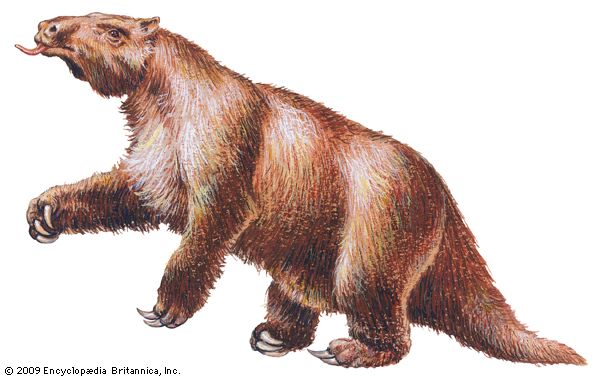
Megatherium was the largest genus of ground sloths, an extinct group of mammals that thrived in South America during the Cenozoic Era. These massive…
What is Megatherium?
Megatherium was the largest genus of ground sloths, an extinct group of mammals that thrived in South America during the Cenozoic Era1. These massive creatures, which reached the size of a modern elephant, were related to modern sloths, anteaters, and armadillos.123
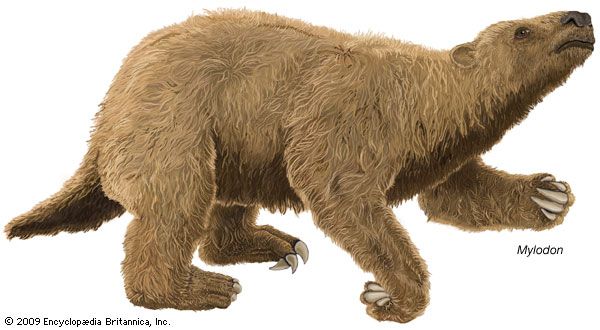
Physically, Megatherium possessed large claws and teeth positioned along the sides of the jaw, reflecting their diet of leaves from trees and bushes. While they originated in South America, they expanded into North America during the Pleistocene Epoch following the formation of a land bridge between the continents. Their eventual extinction occurred near the end of the last Ice Age, a timeframe that coincides with the arrival of humans in North America.13
How do modern sloths compare to their giant ancestors?
Modern sloths and their extinct ancestors, the ground sloths, share a common lineage within the magnorder Xenarthra, but they differ significantly in size, habitat, and lifestyle.1
Size and Physicality
While modern sloths are small, tree-dwelling mammals—with three-toed species weighing only about 4 kg (8.8 pounds)—their extinct relatives varied greatly in size. The giant ground sloth, Megatherium, was as large as a modern elephant, and other species were as tall as present-day giraffes.3451
Habitat and Locomotion
- Modern Sloths: These animals are specialized for life in the forest canopy of South and Central America. Their limbs are adapted for suspension, making them nearly helpless on the ground, where they can only drag themselves using their claws.3
- Ground Sloths: As their name implies, these ancestors were primarily terrestrial. They underwent a successful evolutionary radiation in South America and even expanded into North America during the Pleistocene Epoch after a land bridge formed between the continents.51
What other animals lived alongside the Megatherium?
The Megatherium lived during the Pleistocene Epoch, a period characterized by the presence of numerous other large mammals, often referred to as megafauna. These animals shared the landscape during a time of significant evolutionary change and environmental shifts.16
Animals that lived alongside or during the same era as Megatherium included:
- Predators: Sabre-toothed cats, dire wolves, American lions, and the giant short-faced bear.6
- Herbivores: Woolly mammoths, mastodons, woolly rhinoceroses, horses, camels, llamas, and various species of bison and antelope.6
- Other Ground Sloths: Related genera such as Mylodon, Paramylodon, and Glossotherium also inhabited these regions.7
The coexistence of these species was marked by an “arms race” between predators and prey, leading to extreme physical developments like the large canine teeth of sabre-toothed cats and the massive size of various herbivores. Many of these species, including the Megatherium, eventually faced extinction at the end of the last Ice Age due to a combination of climatic changes and, as some theories suggest, the arrival of human hunters.6
How did the Great American Biotic Interchange affect these animals?
The Great American Biotic Interchange (GABI) was a monumental event triggered by the formation of the Isthmus of Panama approximately 3 million years ago, which reconnected North and South America after millions of years of separation. This land bridge fundamentally altered the evolutionary trajectories of the fauna on both continents.89
Impact on South American Fauna
Before the interchange, South America’s isolated environment allowed for the evolution of highly specialized, endemic species, including many marsupial mammals and unique ground sloths. The emergence of the land bridge introduced intense competition as highly adaptable placental mammals and carnivores migrated from the north. This influx contributed to the extinction of at least four orders of South American land mammals, as the northern invaders were often more successful in competing for food and territory.910
Migration Patterns
- South to North: A smaller number of species successfully migrated northward, including opossums, porcupines, armadillos, and various ground sloths, which briefly inhabited North America during the Pleistocene Epoch.110
- North to South: A much larger wave of northern animals moved south, including dogs, wolves, cats, horses, tapirs, llamas, and mastodons/llama), and mastodons. Interestingly, some of these northern migrants, such as the llama and tapir, eventually went extinct in their original northern range and survived only in their new southern habitats.9
Sources
- Megatherium — Encyclopædia Britannica
- Megatherium — Merriam-Webster
- sloth - Classification and paleontology — Encyclopædia Britannica
- sloth — Encyclopædia Britannica
- sloth - Three-toed sloths — Encyclopædia Britannica
- Quaternary - Fauna and flora — Encyclopædia Britannica
- Mylodon — Encyclopædia Britannica
- land bridge — Encyclopædia Britannica
- Tertiary Period - Mammalian migration between North and South America — Encyclopædia Britannica
- plate tectonics - Evolution — Encyclopædia Britannica
- Isthmus of Panama — Encyclopædia Britannica
Published on · 3 min read