Pliocene Epoch
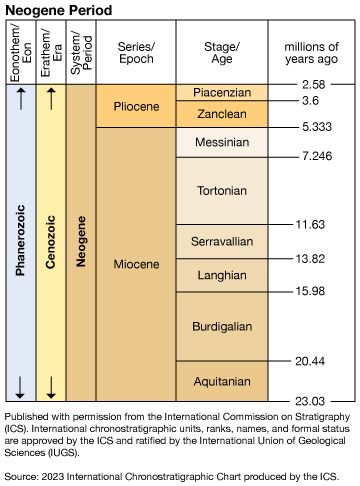
The Pliocene Epoch is the second of two major divisions of the Neogene Period, spanning from approximately 5.3 million to 2.6 million years ago. It follows…
What is the Pliocene Epoch, and where does it fit in the geological time scale?
The Pliocene Epoch is the second of two major divisions of the Neogene Period, spanning from approximately 5.3 million to 2.6 million years ago. It follows the Miocene Epoch and precedes the Pleistocene Epoch of the Quaternary Period.1
Geologically, the epoch is subdivided into two ages: the Zanclean (5.3 to 3.6 million years ago) and the Piacenzian (3.6 to 2.6 million years ago). The Pliocene is characterized by a general cooling and drying trend, though it included warmer intervals, such as one occurring between 3.0 and 3.5 million years ago.1
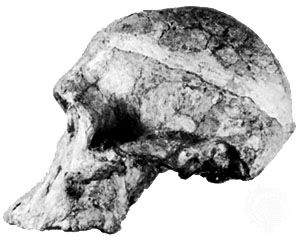
This period was significant for evolutionary history, as it saw the emergence of australopithecines, the first creatures classified as human. Additionally, the mid-Pliocene reestablishment of a land bridge between North and South America facilitated significant faunal migration.1
How did the Pliocene Epoch impact human evolution?
The Pliocene Epoch (5.3–2.6 million years ago) was a transformative period for human evolution, driven largely by significant climatic shifts that reduced forested areas and expanded open terrestrial biomes across Africa. These environmental changes forced hominins to adapt to a diverse array of habitats, ranging from riverine forests and woodlands to dry savannas and grasslands.4
Key impacts on human evolution during this time include:
- Emergence of Australopithecines: The Pliocene saw the appearance of australopithecines, the first creatures widely considered to be human. These early hominins exhibited a mix of apelike and humanlike traits, most notably bipedalism, which allowed them to navigate their changing environments effectively.15
- Refinement of Bipedalism: The shifting landscape played a profound role in honing the energy-conservant bipedal stride, a critical development for survival in more open terrains.4
- Evolution of the Genus Homo: Toward the end of the epoch, the first undisputed evidence of the genus Homo appeared (as early as 2.8 million years ago). This transition was marked by the development of more complex stone tool kits, increased brain size, and a reduction in the size of jaws and teeth.54
- Geographic Expansion: These evolutionary advancements enabled Homo species to eventually venture out of Africa and into the temperate and tropical biomes of Eurasia.4
What were the major climate changes during the Pliocene Epoch?
The Pliocene Epoch (5.3 to 2.6 million years ago) was characterized by a long-term global trend toward cooler and drier conditions compared to the preceding Miocene Epoch.1
Key climatic features and drivers during this period included:
- General Cooling and Drying: Paleobotanical evidence, such as plant and tree remains, indicates that the Earth’s climate became increasingly cool and arid throughout the epoch.1
- Warm Intervals: Despite the overall cooling trend, marine records suggest that the North Atlantic experienced a relatively warm interval between 3.0 and 3.5 million years ago.1
- Tectonic Influence: Major tectonic events significantly altered global climate patterns. The uplift of the Andes, the Tibetan Plateau, and parts of western North America, along with the closing of the Panama seaway, reorganized atmospheric and oceanic circulation.6
- Onset of Northern Hemisphere Glaciation: These tectonic shifts, combined with relatively low atmospheric carbon dioxide concentrations, fostered the development of persistent ice at high northern latitudes, with significant glaciation beginning approximately 3.2 million years ago.6
What methods do scientists use to study and date fossils and rocks from the Pliocene Epoch?
To study and date fossils and rocks from the Pliocene Epoch, scientists utilize an integrated approach that combines several geochronological and stratigraphic methodologies. Because no single technique provides a complete history, researchers synthesize data from multiple sources to create a high-resolution, consistent time scale.9
Key Dating and Analytical Methods
- Radiometric Dating: This is the primary method for quantifying the geologic time scale in years. Techniques such as potassium-argon dating and argon-40/argon-39 dating are used to date volcanic mineral samples, including single crystals. These methods rely on the uniform decay of radioactive isotopes, such as potassium-40 into argon-40, to determine the age of igneous rocks.910
- Biostratigraphy: Scientists identify and arrange fossils within sedimentary rock strata to determine their relative age. By analyzing the regional distribution of microfossils—such as calcareous plankton (foraminiferans and nannoplankton) and siliceous varieties (radiolarians and diatoms)—researchers can correlate sediments across vast geographic distances.119
- Magnetostratigraphy: Rocks often retain the orientation of Earth’s magnetic field present at the time of their formation. By measuring this remanent magnetism, scientists can identify a sequence of polarity reversals, which are then calibrated against isotopic time scales to provide a chronological framework.912
- Tephrochronology: This method uses layers of volcanic ash (tephra) as time-stratigraphic markers. Because volcanic eruptions can deposit ash over wide areas simultaneously, these layers serve as “instantaneous” markers that can be correlated between terrestrial and marine deposits.1314
- Isotopic Geochemistry: Beyond dating, the analysis of oxygen-16 to oxygen-18 ratios in the shells of marine organisms provides a “geologic thermometer,” allowing scientists to infer past ocean temperatures and climatic conditions during the Pliocene.10
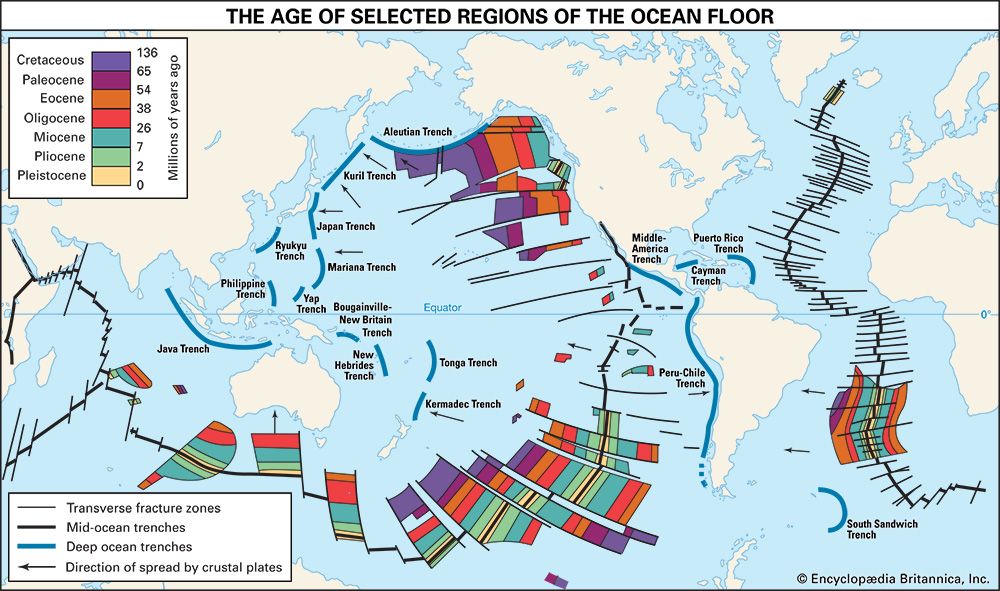
By integrating these techniques—seafloor-spreading history, magnetostratigraphy, and biostratigraphy—scientists can derive a precise and internally consistent history of the Pliocene Epoch.9
Sources
- Pliocene Epoch — Encyclopædia Britannica
- Pliocene — Merriam-Webster
- Pleistocene Epoch - Pliocene–Pleistocene boundary — Encyclopædia Britannica
- human evolution - Hominin habitats — Encyclopædia Britannica
- Australopithecus — Encyclopædia Britannica
- Climate change - Cenozoic climates — Encyclopædia Britannica
- Global warming - Climatic variation since the last glaciation — Encyclopædia Britannica
- Pleistocene Epoch - Coastal environments and sea-level changes — Encyclopædia Britannica
- Tertiary Period - Correlation of Tertiary strata — Encyclopædia Britannica
- biostratigraphy — Merriam-Webster
- geology - Isotopic geochemistry — Encyclopædia Britannica
- Pleistocene Epoch - Chronology and correlation — Encyclopædia Britannica
- Quaternary - Correlation of Quaternary deposits — Encyclopædia Britannica
- Tertiary Period - Establishing Tertiary boundaries — Encyclopædia Britannica
- tephrochronology — Encyclopædia Britannica
- paleogeography - Paleomagnetism — Encyclopædia Britannica
- Pleistocene Epoch - Ice-core records — Encyclopædia Britannica
Published on · 4 min read