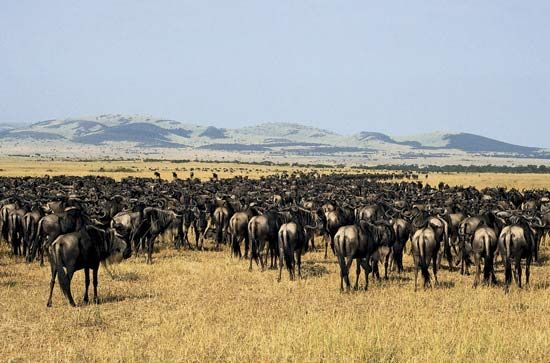
Ngorongoro Conservation Area
The Ngorongoro Conservation Area was established as a distinct entity in 1959, having previously been part of the original Serengeti National Park since…
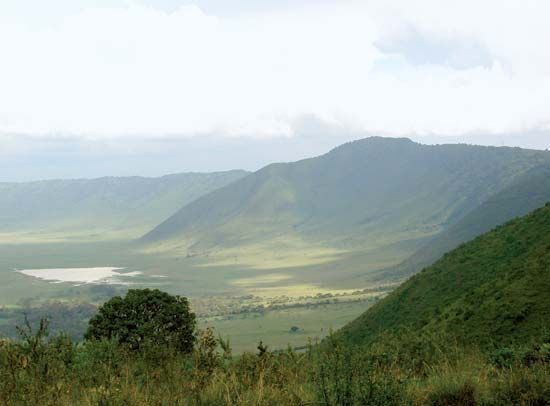
How was the Ngorongoro Conservation Area formed, and what is its connection to volcanic activity?
The Ngorongoro Conservation Area was established as a distinct entity in 1959, having previously been part of the original Serengeti National Park since 1951. It is a protected region in northern Tanzania that spans approximately 3,200 square miles.1
The area’s dramatic landscape is fundamentally shaped by volcanic activity associated with the Eastern (Great) Rift Valley. Its primary geological features, including various volcanic craters and mountains, formed between 20 million and 2 million years ago.21
The most prominent feature, the Ngorongoro Crater, is a massive caldera that formed about 2.5 million years ago. It originated from a large, active volcano that underwent a major eruption, causing the cone to collapse inward and leaving behind the vast, unbroken basin seen today. This volcanic history created the diverse habitats—ranging from grasslands to soda lakes—that support the region’s rich biodiversity.21
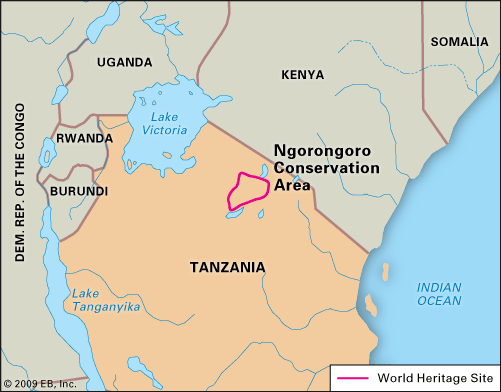
What unique geological features can be found in the Ngorongoro Conservation Area?
The Ngorongoro Conservation Area is defined by a diverse array of geological features shaped by volcanic activity within the Eastern (Great) Rift Valley. These formations, which developed between 20 million and 2 million years ago, include mountains, rivers, swampland, and volcanic craters.1
Key geological highlights include:
- Ngorongoro Crater: One of the world’s largest unbroken calderas, this massive basin measures 10 to 12 miles across. It formed approximately 2.5 million years ago when a large volcano’s cone collapsed inward following a major eruption.21
- Empakaai Crater: This feature is distinguished by a deep soda lake that covers nearly half of its caldera floor.1
- Lake Magadi: A shallow soda lake located within the Ngorongoro Crater, known for attracting large flocks of flamingos.2
- Olmoti Crater: Another significant volcanic formation within the conservation area.1
Beyond its volcanic landscape, the area contains critical archaeological sites such as Olduvai Gorge and Laetoli, which have yielded significant hominin remains.1
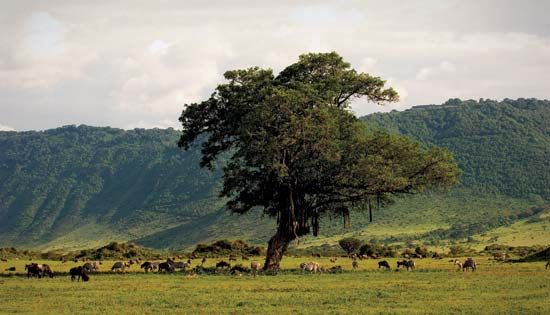
What is the Ngorongoro Conservation Area and where is it located in Tanzania?
The Ngorongoro Conservation Area is a protected national conservation region located in the Arusha region of northern Tanzania, situated southeast of Serengeti National Park.2
Spanning approximately 3,200 square miles, the area extends across part of the Eastern (Great) Rift Valley. It is characterized by a diverse landscape that includes mountains, forests, savanna woodlands, grassland plains, rivers, lakes, and volcanic craters. The most notable feature is the Ngorongoro Crater, one of the world’s largest unbroken calderas.21
Designated as a UNESCO World Heritage site in 1979, the area is also home to significant archaeological sites, including Olduvai Gorge and Laetoli, where important hominin remains have been discovered. While cultivation is prohibited, the Maasai people are permitted to graze their livestock within the conservation area.21
How does the Ngorongoro Conservation Area compare to other wildlife reserves in East Africa?
The Ngorongoro Conservation Area is distinct from other East African wildlife reserves, such as the neighboring Serengeti National Park, primarily due to its unique administrative structure and geological composition.21
- Land Use and Human Presence: Unlike many national parks where human habitation is restricted, the Ngorongoro Conservation Area allows the Maasai people to reside within its borders and graze their livestock. This creates a unique human-wildlife landscape that differs from the strictly protected status of Serengeti National Park.231
- Geological Features: The area is defined by its volcanic history, most notably the Ngorongoro Crater, an unbroken caldera that acts as a natural enclosure for a dense concentration of wildlife, including the world’s densest population of lions. In contrast, the Serengeti is characterized by vast, open grassland plains and acacia woodland savanna, serving as the primary stage for the world’s only remaining large-scale land-animal migrations.231
- Archaeological Significance: The area contains globally significant sites like Olduvai Gorge and Laetoli, which provide a deep historical context regarding human evolution that is not a primary feature of the Serengeti.2
Sources
- Ngorongoro Crater — Encyclopædia Britannica
- Ngorongoro Conservation Area — Encyclopædia Britannica
- Serengeti National Park — Encyclopædia Britannica
Published on · 3 min read