Niagara Falls
Niagara Falls consists of two primary sections with the following dimensions:
What is the height and width of Niagara Falls, and how does it compare to other famous waterfalls?
Niagara Falls consists of two primary sections with the following dimensions:
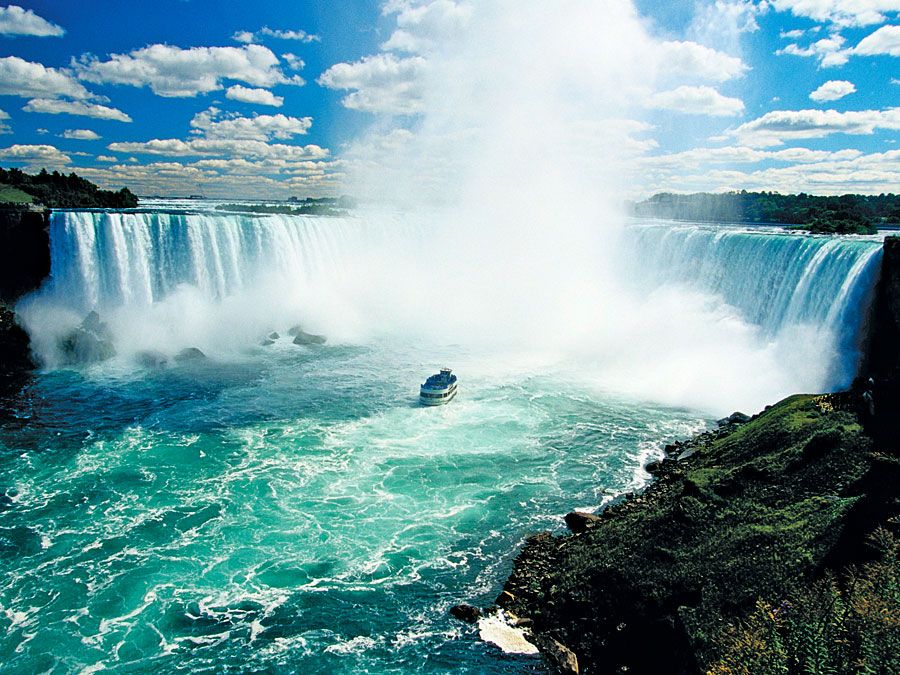
- Horseshoe Falls: 188 feet (57 meters) high and approximately 2,200 feet (670 meters) wide.1
- American Falls: 190 feet (58 meters) high and 1,060 feet (320 meters) wide.1
When compared to other famous waterfalls, Niagara is notable for its volume, though it is surpassed in height and width by several others:
- Victoria Falls: Located on the Zambezi River, it is approximately twice as wide (over 5,500 feet/1,700 meters) and twice as deep (maximum drop of 355 feet/108 meters) as Niagara Falls.2
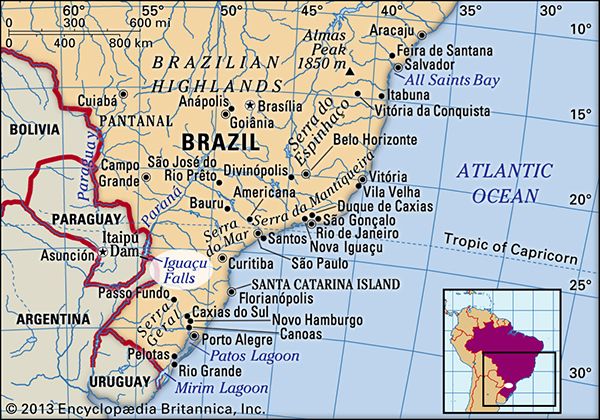
- Iguaçu Falls: This series of cataracts is nearly three times wider than Niagara, extending for 1.7 miles (2.7 km), with individual falls ranging from 200 to 269 feet (60 to 82 meters) in height.3
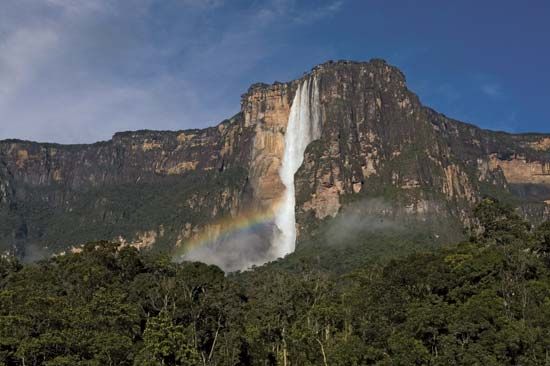
- Angel Falls: As the world’s highest waterfall, it features a dramatic drop of 979 meters (3,212 feet).45
How has Niagara Falls been used for hydroelectric power generation?
The Niagara River is one of North America’s premier sources of hydroelectric power due to its steady, high-volume flow and steep gradient.3
Early Development and Innovation
The industrial potential of the river began to be harnessed in 1881. A pivotal moment occurred in the 1890s when the Westinghouse Electric Company won the contract to install the first power machinery at Niagara Falls. This project utilized Nikola Tesla’s alternating-current system, which successfully transmitted electricity to Buffalo by 1896.78
Modern Operations
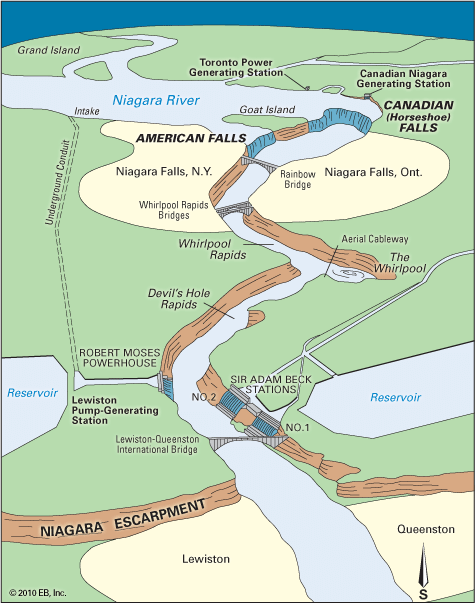
Under a 1950 treaty, the United States and Canada agreed to preserve the falls’ scenic value while diverting excess water for power generation. Today, large-scale diversion occurs upstream, where water is channeled into four massive tunnels that feed power plants located at the end of the Niagara Gorge, specifically near Lewiston, New York, and Queenston, Ontario.3
This hydroelectric infrastructure supports local electrochemical, aerospace, and metallurgical industries, while also supplying electricity to various cities. Furthermore, the diversion of water has significantly slowed the natural erosion of the falls, helping to preserve their structure.379
How has Niagara Falls been portrayed in art, literature, and popular culture?
The provided search results do not contain information regarding the portrayal of Niagara Falls in art or popular culture beyond its status as a tourist destination and a symbol of natural grandeur.
However, in literature, the falls have long served as a metaphor for vastness or overwhelming volume. As early as 1726, Jonathan Swift referenced the site in Gulliver’s Travels to describe a loud, powerful outpouring. This usage has persisted, with the word “Niagara” occasionally employed as a noun to represent any similar massive flow or quantity of something, such as a “Niagara of facts”.1
Beyond this literary usage, the falls are primarily recognized as an icon of Americana and a traditional destination for honeymooners, rather than a subject extensively detailed in the provided records regarding its broader artistic or cultural history.9101
What are the different parts or sections of Niagara Falls?
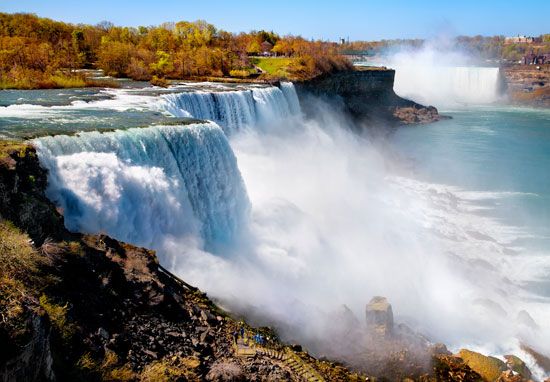
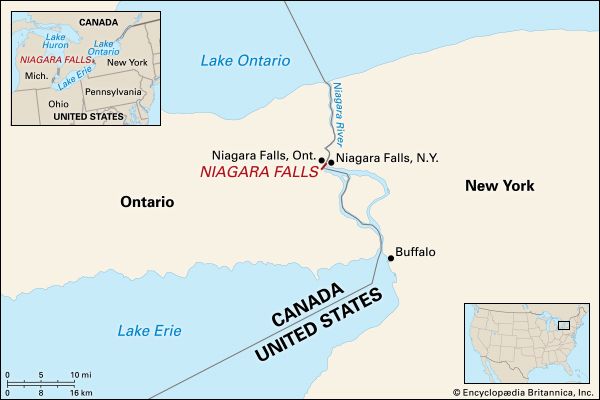
Niagara Falls is composed of three distinct sections, separated by islands within the Niagara River:13
- Horseshoe Falls: Also known as the Canadian Falls, this is the largest section, adjoining the Canadian bank. It features a curving crest line approximately 2,200 feet (670 meters) long and stands 188 feet (57 meters) high. It carries about 90 percent of the river’s total discharge.13
- American Falls: Located on the U.S. side of the border, this section is 190 feet (58 meters) high and spans about 1,060 feet (320 meters) across.13
- Bridal Veil Falls: This is a much smaller section of the falls, also situated on the American side.1
These sections are separated primarily by Goat Island, which visitors can reach via a footbridge from the U.S. shore to access various viewing points and attractions, such as the Cave of the Winds.13
Sources
- Why is Niagara Falls famous? — Encyclopædia Britannica
- waterfall — Encyclopædia Britannica
- Niagara River — Encyclopædia Britannica
- river - High plateaus — Encyclopædia Britannica
- Iguaçu Falls — Encyclopædia Britannica
- Victoria Falls — Encyclopædia Britannica
- Nikola Tesla — Encyclopædia Britannica
- Niagara Falls — Encyclopædia Britannica
- Niagara Falls — Encyclopædia Britannica
- 6 Words That Come from Names of Places | Niagara — Merriam-Webster
- river - Development of waterfalls — Encyclopædia Britannica
Published on · 3 min read