Ninety Mile Beach
It is a common misconception that Ninety Mile Beach is 90 miles long; in reality, the Ninety Mile Beach located on the western coast of the North Island in…
What is Ninety Mile Beach?
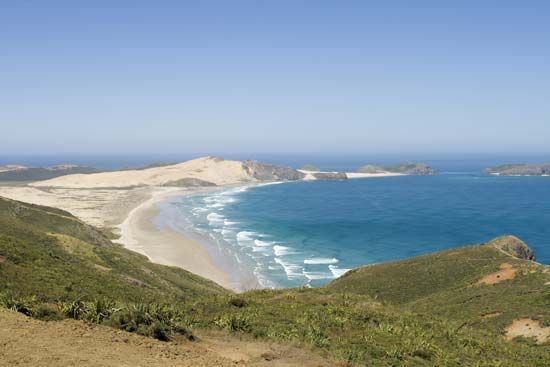
It is a common misconception that Ninety Mile Beach is 90 miles long; in reality, the Ninety Mile Beach located on the western coast of the North Island in New Zealand stretches for approximately 55 miles (88 km) from Scott Point to Ahipara Bay.1
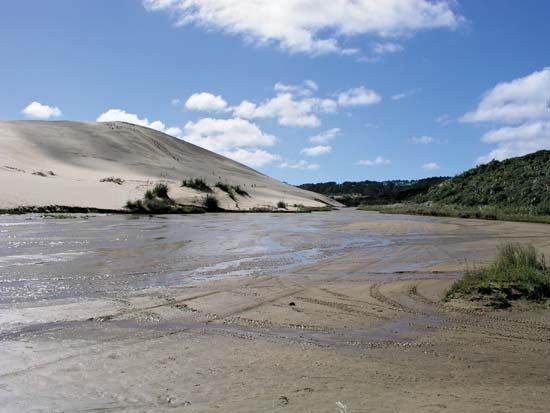
The area is characterized by its bordering scrubland and sand dunes. Historically described by navigator Abel Tasman as a “desert coast,” it has since become a popular resort destination known for fishing—particularly for the toheroa shellfish—and automobile racing on its hard-packed sand.1
Please note that there is another location in Australia formerly known by this name, now called Eighty Mile Beach, which was renamed in 1946 to avoid confusion with a different beach in Victoria.2
Why is the beach named Ninety Mile Beach if it is only 55 miles long?
The name “Ninety Mile Beach” is a misnomer, as the beach in New Zealand’s North Island actually spans only about 55 miles (88 km).1
While the exact origin of the name is not explicitly detailed in the provided records, it is a common historical naming discrepancy. The name has caused enough confusion that other locations, such as the Eighty Mile Beach in Western Australia, were officially renamed in 1946 to avoid being conflated with similarly named beaches in other regions.2
What are the unique characteristics of the Aupori Peninsula?
The Aupori Peninsula is the northernmost extension of the North Auckland Peninsula on the North Island of New Zealand. Its most prominent geographical feature is the famous Ninety Mile Beach, which runs along its western coast.1
The peninsula is characterized by a landscape of scrubland and extensive sand dunes. Historically, the area was described by the Dutch navigator Abel Tasman in 1643 as a “desert coast.” Today, the region has evolved into a popular resort destination, notable for its unique recreational opportunities, such as fishing for the toheroa shellfish and automobile racing on the beach’s hard-packed sand.1
How do tides affect the landscape of beaches like these?
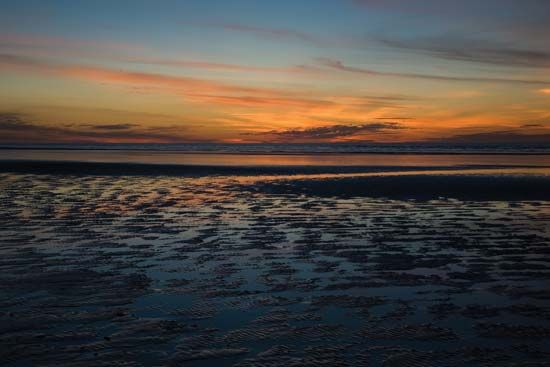
Tides play a fundamental role in shaping the landscape of beaches by influencing both sediment movement and the distribution of wave energy. Their impact is primarily categorized by the tidal range—the vertical difference between high and low tide—which dictates how much of the shore is exposed to coastal processes.3
Mechanisms of Tidal Influence
- Distribution of Wave Energy: As tides rise and fall, they shift the position of the shoreline, effectively moving the zone where waves and longshore currents perform their work. On broad, gently sloping beaches, this can cause the shoreline to shift by as much as one kilometer during a single tidal cycle, significantly expanding the area affected by wave action.3
- Sediment Transport: While tidal currents on open coasts are generally not swift enough to move significant amounts of sand, they become powerful in constricted areas like inlets or estuary mouths. In these locations, tidal currents can exceed two meters per second, transporting large quantities of sediment and potentially eroding bedrock.3
- Profile Development: The height of the tide is a key factor in determining a beach’s profile. In regions with high tidal ranges (greater than two meters), a low-tide terrace may develop, and the frontal beach slope can become exceptionally wide—sometimes exceeding one kilometer in areas with abundant sand.4
The interaction between tidal range and coastal topography ensures that beaches are dynamic environments, constantly reshaped by the predictable, rhythmic movement of the sea.3
Sources
- Ninety Mile Beach — Encyclopædia Britannica
- Eighty Mile Beach — Encyclopædia Britannica
- coastal landforms - Tides — Encyclopædia Britannica
- beach — Encyclopædia Britannica
- coastal landforms - Coastal dunes — Encyclopædia Britannica
Published on · 3 min read