Rajgir Hills
Sorry, the Britannica knowledge base does not contain information regarding how the Rajgir Hills feature in modern Indian literature and art.
How do the Rajgir Hills feature in modern Indian literature and art?
Sorry, the Britannica knowledge base does not contain information regarding how the Rajgir Hills feature in modern Indian literature and art.
The available records focus on the Rajgir Hills as a historical and religious center for Hinduism, Buddhism, and Jainism, noting their significance in the Mahabharata and their association with the Buddha and ancient Magadha rulers like Bimbisara.1
What is the geological composition of the Rajgir Hills?
The Rajgir Hills, located in the central region of the Indian state of Bihar, are primarily composed of massive quartzites.1
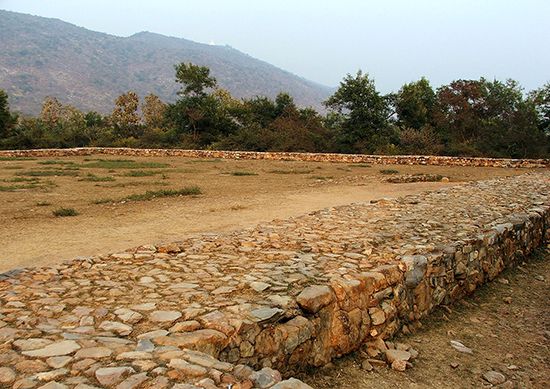
These hills rise sharply from the surrounding South Bihar Plains as an isolated upland region. Geologically, they form two roughly parallel ridges that extend for approximately 40 miles (65 km) in a northeast-southwest direction, enclosing a narrow ravine. While the surrounding landscape consists largely of alluvial lowlands, the summits of the Rajgir Hills stand out, often resembling forested islands.1
Where are the Rajgir Hills located in India, and what is their geographical significance?
The Rajgir Hills are located in the central part of Bihar state in northeastern India.1
Geographically, the hills form an isolated upland region that rises sharply from the surrounding South Bihar Plains. They consist of two roughly parallel ridges of massive quartzite that extend for approximately 40 miles (65 km) in a northeast-southwest direction, enclosing a narrow ravine. While the surrounding alluvial lowlands are largely featureless, the summits of the hills often appear as forested islands, reaching elevations up to 1,272 feet (388 metres).1
Beyond their physical geography, the hills hold immense historical and religious significance. They contain the ancient site of Rajagriha, the legendary capital of the Magadha empire, and serve as a major pilgrimage center for Hinduism, Buddhism, and Jainism, featuring sites associated with the Buddha and ancient rulers like Bimbisara.1
How are the Rajgir Hills connected to ancient Indian religions, particularly Buddhism and Jainism?
The Rajgir Hills are a significant pilgrimage center for both Buddhism and Jainism, with deep historical ties to the life of the Buddha and ancient religious traditions.1
Buddhist Significance
The hills are closely associated with the Buddha, who frequently taught in the region. Key sites include:
- Gridhrakuta (Vulture’s Peak): Known as Chhatagiri, this was one of the Buddha’s favorite retreats.1
- Pippala Stone House: Located on Baibhar Hill, this tower is identified as a residence of the Buddha.1
- Sattapanni Cave: Also situated on Baibhar Hill, this site is traditionally recognized as the location of the first Buddhist council in 543 BCE, where the tenets of the faith were first recorded.14
Jain Significance
The hills also serve as a major center for the Jaina faith:
- Sonbhandar Cave: While sometimes associated with Buddhist history, this cave is now believed to have been excavated by the Jains in the 3rd or 4th century CE.1
- Modern Temples: Several modern Jaina temples are situated on the hills surrounding the valley, reflecting the area’s enduring importance to the religion.1
Sources
- Rajgir Hills — Encyclopædia Britannica
- Bihar - Relief, drainage, and soils — Encyclopædia Britannica
- South Bihar Plains — Encyclopædia Britannica
- Buddhist council — Encyclopædia Britannica
Published on · 2 min read