Old Faithful
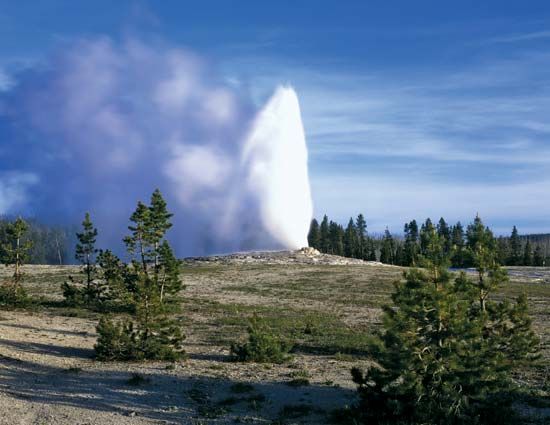
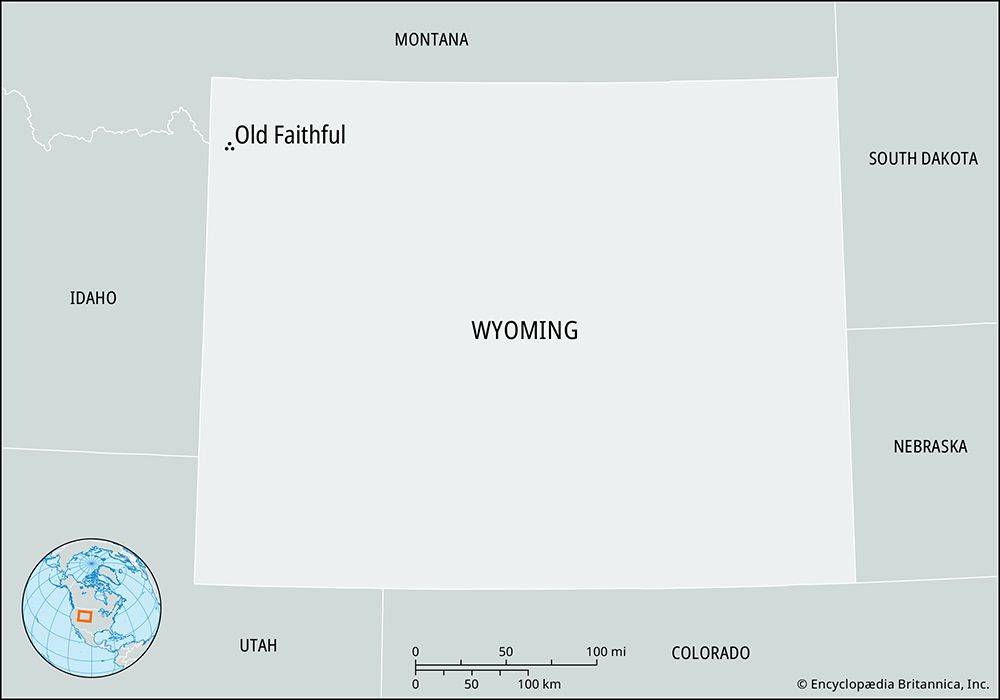
Old Faithful is located at the head of the Upper Geyser Basin in Yellowstone National Park, in northwestern Wyoming, U.S.
Where is Old Faithful located and what makes it unique among geysers?
Old Faithful is located at the head of the Upper Geyser Basin in Yellowstone National Park, in northwestern Wyoming, U.S.1
It is widely recognized for its relatively consistent and predictable eruption patterns, which have made it the most famous geyser in North America. Unlike many other geysers that exhibit erratic recharge times, Old Faithful typically erupts every 60 to 110 minutes, with an average interval of approximately 90 minutes.123
Its uniqueness lies in the direct correlation between the duration of an eruption and the length of the subsequent interval: a longer eruption is followed by a longer wait time, while a shorter eruption results in a shorter interval. As a cone geyser, it ejects between 3,700 and 8,400 gallons of water during each event, reaching heights that often average 130 to 140 feet. While its predictability has fluctuated over time due to seismic activity, it remains a focal point for scientific study and public interest in hydrothermal features.13
What is the average height and duration of an Old Faithful eruption?
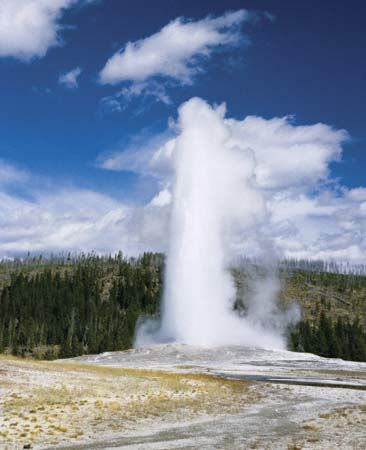
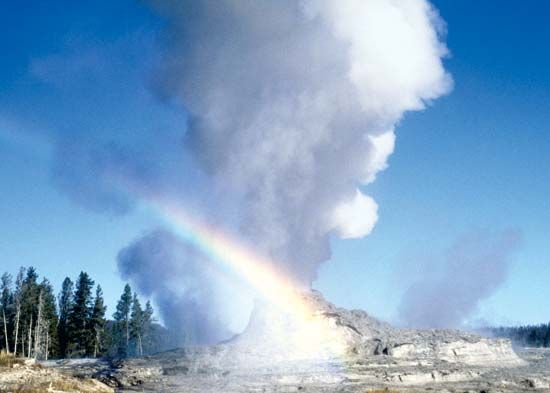
The eruptions of Old Faithful typically last between 1.5 and 5.5 minutes. During these events, the geyser ejects water and steam in fountainlike columns that reach average heights of approximately 130 to 140 feet (40 to 43 meters), though eruptions can occasionally exceed 180 feet (55 meters).1
What is a geyser and how does it form?
A geyser is a rare type of hot spring that intermittently discharges jets of steam and hot water. These features are generally associated with areas of recent or past volcanic activity, where groundwater is heated by shallow bodies of magma or hot igneous rocks.224
The formation and eruption process relies on the relationship between pressure and the boiling point of water:
- Conduit Heating: Water collects in deep, narrow conduits beneath the surface. Because the boiling point of water increases with pressure, water at depth can remain liquid even when heated well above the surface boiling point.24
- Triggering: As steam or gas bubbles form and rise, they push some hot water out of the vent. This reduces the pressure on the water column below.24
- Chain Reaction: With the pressure lowered, the superheated water at depth flashes into steam. This rapid expansion forces the remaining water out of the conduit in a violent eruption.24
- Recharge: Once the supply of boiling water is exhausted, the eruption stops, and the conduits refill with groundwater to begin the cycle again.4
What is the history behind the discovery and naming of Old Faithful?
Old Faithful was named in 1870 by members of the Washburn-Langford-Doane Expedition. The explorers gave the geyser this moniker because it appeared to erupt with remarkable consistency, spouting “faithfully” at intervals of approximately 63 to 70 minutes.1
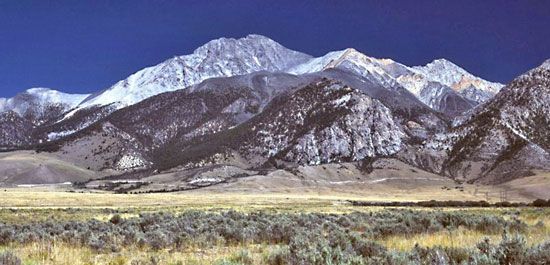
While the name suggests a perfectly regular schedule, continuous observation has shown that the geyser’s activity is more complex. Eruption intervals have historically varied between 33 and 120 minutes, and they have become increasingly less predictable following seismic events, such as the 1983 Borah Peak earthquake. Modern naturalists have determined that the timing of an eruption is best predicted by the duration of the preceding one: a longer eruption typically results in a longer interval before the next event occurs.1
Sources
- Old Faithful — Encyclopædia Britannica
- Did you know? — Merriam-Webster
- volcano - Hot springs and geysers — Encyclopædia Britannica
- geyser — Encyclopædia Britannica
- Yellowstone National Park - Early history and creation of the park — Encyclopædia Britannica
- Old Faithful — Merriam-Webster
- Yellowstone National Park - Development of the park — Encyclopædia Britannica
Published on · 3 min read