Geysir
Geysir is a famous hot spring located in the Haukadalur geothermal area of southwestern Iceland. It is the namesake for all similar geyser phenomena…
What is Geysir?
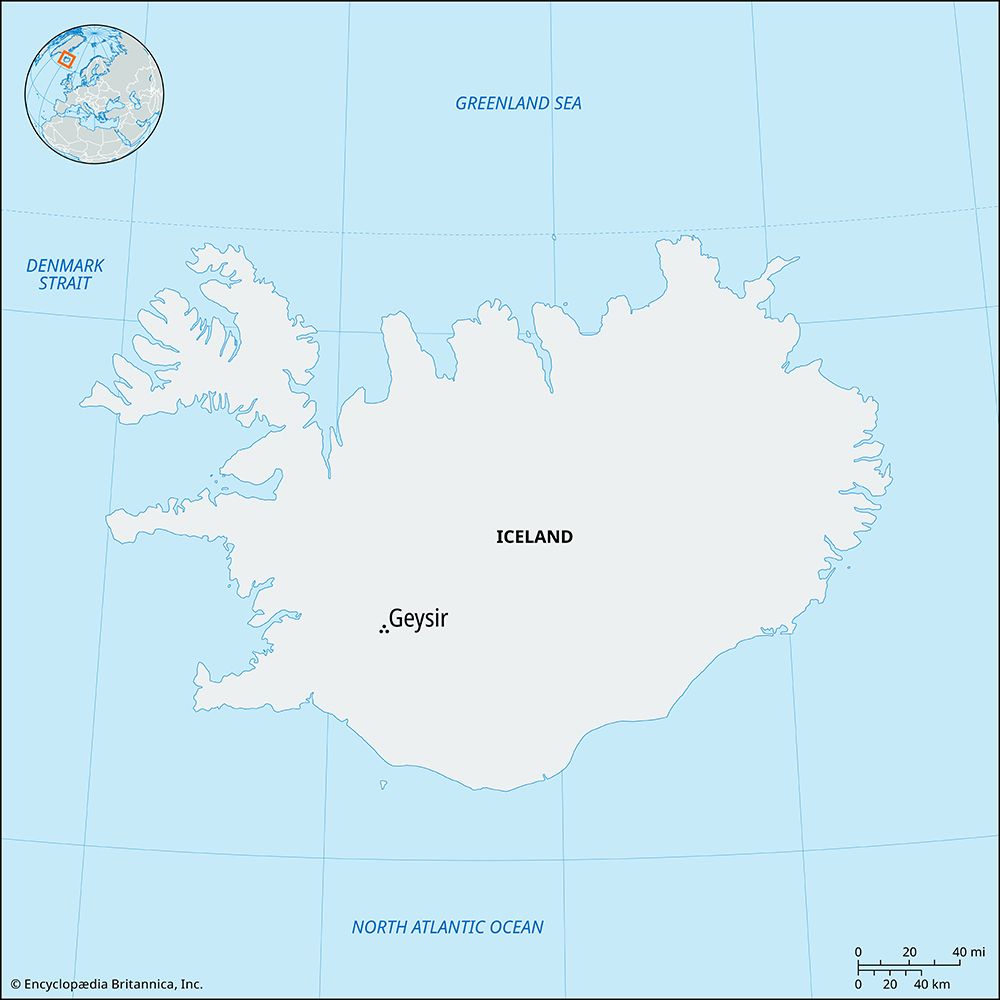
Geysir is a famous hot spring located in the Haukadalur geothermal area of southwestern Iceland. It is the namesake for all similar geyser phenomena worldwide, with the term itself derived from the Icelandic word meaning “to gush”.12
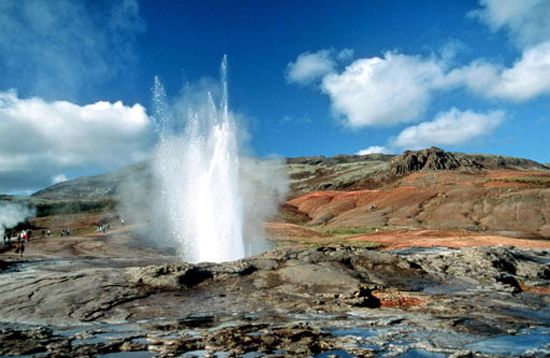
Documented as early as the 13th century, Geysir features a circular pool 60 feet (18 meters) in diameter. While it has historically erupted to heights of nearly 200 feet (61 meters), it has been relatively inactive since 1916 due to sediment buildup in its underground conduits.1
Geysers are rare geological features that occur when groundwater is heated by shallow magma in volcanic regions. The eruption is a chain reaction triggered by the sudden release of pressure, causing superheated water to flash into steam and force water out of the vent.2
How does magma heat underground water?
Magma heats underground water primarily through the process of conduction. When magma—molten rock reaching temperatures as high as 1,200 °C (2,200 °F)—moves upward into the Earth’s crust, it often settles at depths of only a few kilometers.34
At these depths, the intense heat from the magma is transferred to the surrounding groundwater through the rock that separates them. Once the water is heated, it begins to circulate via convection, creating large underground reservoirs of hot water and steam.3
This geothermal system can manifest at the surface in several ways:
- Hot springs: Thermal water escapes to the surface, often heated by these shallow magma intrusions.35
- Geysers: Intermittent jets of water and steam are forced to the surface when pressure builds within these heated reservoirs.35
In some regions, this process is so efficient that the resulting steam or hot water can be tapped to drive turbines for geothermal power generation.36
What is geothermal energy and how is it used?
Geothermal energy is a form of renewable energy derived from the heat stored beneath the Earth’s surface. This heat, which originates from the planet’s interior, is accessed via underground reservoirs of steam and hot water, often found near volcanoes and tectonic plate boundaries.99
How It Is Used
Geothermal energy is utilized in two primary ways:
- Electricity Generation: Large-scale power plants tap into high-temperature underground reservoirs to drive turbines that produce electricity. There are three main types of plants:
- Direct Use: Low-temperature resources are used directly for heating greenhouses, spas, aquaculture ponds, and buildings. Additionally, geothermal heat pumps provide efficient heating and cooling for residential and commercial structures by exchanging heat with the constant-temperature ground.1011
Where are the most famous geysers located?
Geysers are rare geological features found primarily in areas with past or present volcanic activity. Globally, there are approximately 600 known geysers, with the vast majority concentrated in a few specific regions.2
Major Geyser Locations
- Yellowstone National Park (United States): Home to more than 300 geysers, this park contains roughly half of the world’s total. The most famous is Old Faithful, known for its relatively predictable eruptions. Other notable features include the Steamboat Geyser, which is the world’s highest-erupting geyser, capable of reaching heights of 300 feet (90 meters).213
- Kamchatka Peninsula (Russia): This region in the Russian Far East contains approximately 200 geysers.2
- New Zealand: This country hosts about 40 geysers.2
- Iceland: There are 16 geysers located throughout this volcanic island.2
The remaining 50 or so geysers are scattered across various other volcanic regions worldwide.2
Sources
- Geysir — Encyclopædia Britannica
- geyser — Encyclopædia Britannica
- volcano - Volcanoes and geothermal energy — Encyclopædia Britannica
- geothermal power - Types of power generation — Encyclopædia Britannica
- hot spring — Encyclopædia Britannica
- igneous rock - Origin of magmas — Encyclopædia Britannica
- magma — Encyclopædia Britannica
- Earth exploration - Geothermal methods — Encyclopædia Britannica
- Geothermal power — Encyclopædia Britannica
- geothermal energy - Direct uses — Encyclopædia Britannica
- geothermal power - Environmental effects and economic costs — Encyclopædia Britannica
- geothermal power — Encyclopædia Britannica
- Yellowstone National Park - Physical features — Encyclopædia Britannica
Published on · 3 min read