Onverwacht Series
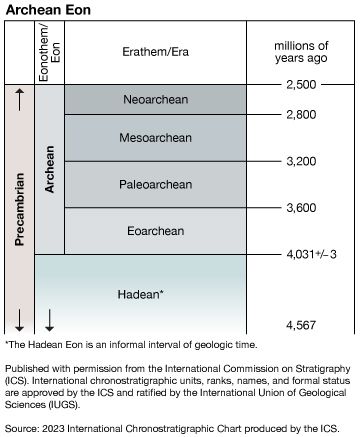
The Onverwacht series, a division of Archean rocks dating back approximately 3.7 billion years, is primarily located in the Komati valley of South Africa.…
What are some of the unique geological features or structures found in the Onverwacht series?
The Onverwacht series, a division of Archean rocks dating back approximately 3.7 billion years, is primarily located in the Komati valley of South Africa1. These rocks serve as the regional basement and are characterized by a diverse composition, including dark andesitic lavas, dolomitic limestones, cherts, jaspers, serpentines, gabbros, and peridotites.1
Due to intense metamorphic processes, many of these rocks have been significantly deformed, resulting in the local presence of schists and marbles. Structurally, the series is part of the complex greenstone-granite belts, which often exhibit intense subhorizontal deformation. These belts are frequently characterized by stratigraphic successions that have been overturned and modified by thrust faults and major horizontal folds known as nappes.12
Beyond its geological structure, the Onverwacht series is scientifically significant for containing tiny cell-like forms and hydrocarbon compounds, which may represent some of the earliest evidence of life on Earth.1
What challenges do geologists face when studying the Onverwacht series?
Geologists face several significant challenges when studying the Onverwacht series, primarily due to the extreme age and complex history of these 3.7-billion-year-old rocks.1
- Intense Deformation: The rocks have undergone severe metamorphic processes, resulting in the widespread development of schists and marbles. This intense subhorizontal deformation, characterized by thrust faults and major horizontal folds known as nappes, complicates the interpretation of the original stratigraphic sequence.13
- Structural Complexity: The stratigraphic successions in these greenstone-granite belts are often overturned and repeated, creating massive, complex deposits that are difficult to map. Furthermore, the diapiric intrusion of younger granites has often distorted the original shapes of these belts.34
- Lack of Modern Analogues: Interpreting the origin and evolution of Archean belts is difficult because there are few modern analogues for comparison. While some features resemble modern oceanic crust or island arcs, the unique conditions of the early Earth make direct correlation with Mesozoic-Cenozoic orogenic belts challenging.53
- Metamorphic Overprinting: Because these rocks have experienced multiple episodes of recrystallization, geologists must carefully distinguish between different fabric generations to reconstruct the structural history.6
What is the significance of the Onverwacht series in the field of geology?
The Onverwacht series is of profound significance to geology primarily because it offers a window into the Archean Eon, dating back approximately 3.7 billion years. As the basement rock for the region, it provides a foundational record of early Earth’s crustal composition, featuring a diverse array of materials including andesitic lavas, dolomitic limestones, cherts, jaspers, and ultramafic rocks like peridotites.1
Beyond its structural role, the series is most celebrated for its potential to reveal the origins of life. Scientists have discovered tiny, cell-like structures and hydrocarbon compounds within its sedimentary layers. These findings suggest that the Onverwacht series may preserve some of the earliest known traces of living organisms on Earth. Consequently, researchers view these rocks as a critical site for investigating the transition from nonliving to living material, potentially documenting the very steps of early biological evolution.1
How was the Onverwacht series formed, and what geological processes were involved?
The Onverwacht series, dating back approximately 3.7 billion years, represents a foundational division of Archean Eon rocks located in southern Africa. Its formation involved a complex sequence of volcanic and sedimentary activity that established the basement rock for the region.1
The series is characterized by a diverse assemblage of materials, including dark, andesitic lavas, which point to significant early volcanic activity. Over time, these volcanic deposits were accompanied by the accumulation of sedimentary layers, such as dolomitic limestones, cherts, and jaspers. The presence of ultramafic rocks, including serpentines, gabbros, and peridotites, further indicates a dynamic geological environment during the early stages of Earth’s history.1
Following their deposition, these rocks were subjected to intense metamorphic processes. This geological transformation caused widespread deformation, resulting in the development of schists and marbles. These structural changes have obscured some of the original features of the series, which now underlies the younger Fig Tree series.1
Sources
- Onverwacht series — Encyclopædia Britannica
- Precambrian - Structure and formation of greenstone-granite belts — Encyclopædia Britannica
- Precambrian - Age and correlation of granulite-gneiss belts — Encyclopædia Britannica
- Precambrian - Greenstone-granite belts — Encyclopædia Britannica
- Precambrian - Age and occurrence of greenstone-granite belts — Encyclopædia Britannica
- Earth sciences - Micropaleontology — Encyclopædia Britannica
- metamorphic rock - Major features — Encyclopædia Britannica
Published on · 3 min read