Opossum
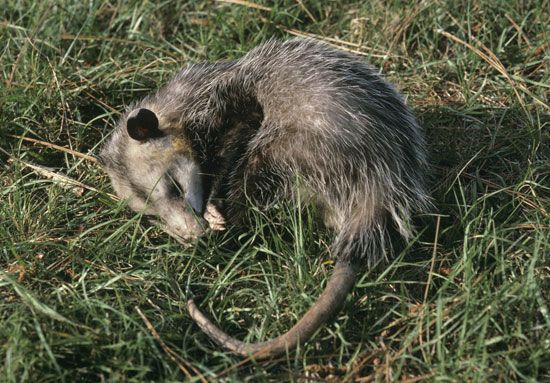
An opossum is any of more than 100 species of New World marsupial mammals belonging to the orders Didelphimorphia, Paucituberculata, and Microbiotheria. The…
What is an opossum?
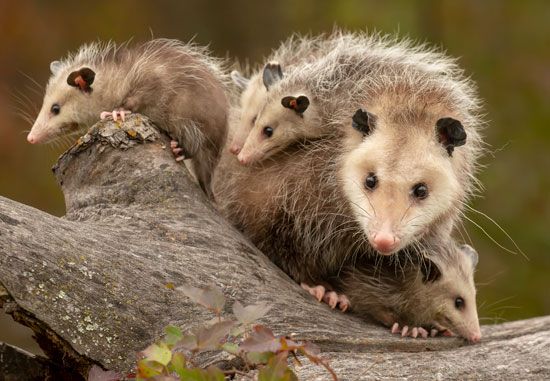
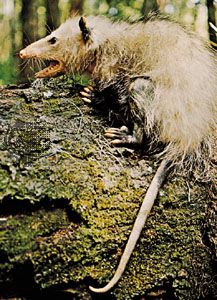
An opossum is any of more than 100 species of New World marsupial mammals belonging to the orders Didelphimorphia, Paucituberculata, and Microbiotheria. The name is derived from an Algonquian word meaning “white animal,” originally referring to the Virginia opossum2.1
The Virginia opossum is the only marsupial found north of Mexico, ranging from southern Canada to Costa Rica. These animals are known for their ability to “play possum”—a catatonic state they enter when threatened—and their resistance to various poisons due to a specialized protein in their blood. While “opossum” is the preferred scientific term, the shortened “possum” is commonly used in general speech, though that term is also applied to unrelated Australasian marsupials.213
Opossums exhibit diverse adaptations, ranging from the semiaquatic water opossum to the pouchless brown four-eyed opossum. Most are found throughout Central and South America, occupying a wide variety of habitats.41
What does it mean to be a marsupial?
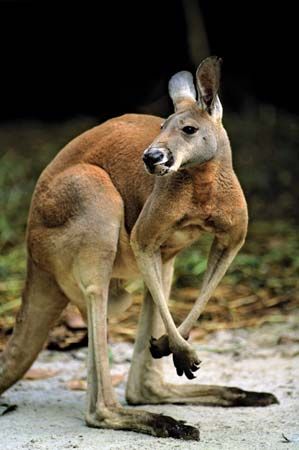
To be a marsupial is to belong to the mammalian infraclass Metatheria, a group defined by a unique reproductive strategy characterized by premature birth and the continued development of the newborn outside the womb.5
Reproductive Characteristics
Unlike placental mammals, which nourish their young through a complex placenta during a long gestation, marsupials have a very short intrauterine development period, ranging from about 8 to 40 days. Because the uterine wall is not specialized for embryo implantation, the young are born in a highly vulnerable, embryonic state.56
After birth, the newborn must migrate to the mother’s lower belly to attach to a teat for nourishment. This attachment is often so firm that the teat and the young’s mouth tissues appear physically fused. While many marsupials possess a marsupium—a specialized pouch or flap of skin that protects and carries the developing young—this is not a universal feature; some species have fully exposed teats or lack a pouch entirely.57
Other Distinguishing Features
Beyond their reproductive cycle, marsupials share several biological traits:
- Anatomy: Females typically have twin vaginae that open into a common cavity, and males possess testes located in front of the penis.8
- Skull Structure: They exhibit specific bone patterns, such as large openings in the palate and an inturning of the bone at the angle of the jaw, known as gonial inflection.8
- Brain Development: Marsupials generally have smaller brains relative to their body size compared to placental mammals and lack a corpus callosum, the structure that connects the two cerebral halves.5
While they are often considered “primitive” compared to placentals, these traits are highly effective adaptations that have allowed marsupials to thrive in diverse environments across Australia, New Guinea, and the Americas.5
Where do opossums live?
Opossums are native to the New World, with their distribution spanning from southern Canada through Central America and into South America.41
- North America: The Virginia opossum is the only species found north of Mexico, with a range extending from lower eastern Canada and the Puget Sound region southward to Costa Rica.41
- Central and South America: The vast majority of the more than 100 species of opossums inhabit these regions. They occupy diverse environments, ranging from the Andes Mountains to the Amazon basin, and are found in countries including Brazil, Argentina, Venezuela, and Chile.4
- Habitats: Opossums are highly adaptable and occupy a variety of habitats, provided water is available. While they are largely arboreal and often den in hollow trees, stumps, or under roots, they are absent from treeless, dry areas. Some species, such as the water opossum, are specifically adapted to semiaquatic life along tropical rivers, streams, and lakes.419
How do opossums carry and care for their young?
Opossums, like other marsupials, have a unique reproductive process characterized by a very short gestation period of 12–13 days. Because the young are born in a highly undeveloped, larvalike state—weighing only about 0.13 grams—they must immediately crawl upward using their forelimbs to reach the mother’s fur-lined pouch.1
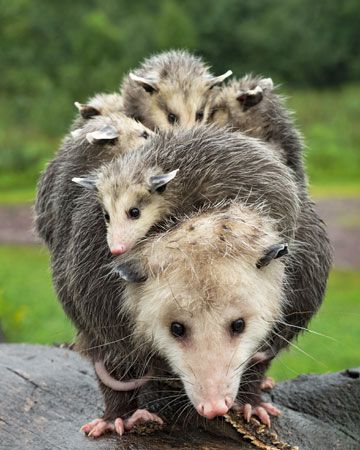
Once inside the pouch, each newborn must firmly attach to a nipple to survive. They remain attached to the nipple for the first 50–55 days of life. After this initial period of development, the young become more mobile and will either continue to travel inside the pouch or cling to the fur on their mother’s back until they are fully weaned and independent.1
While the mother provides care through the pouch for a considerable period—often 13 to 14 weeks for the Virginia opossum—the maximum number of young she can raise is limited by the number of teats available, which is normally 13.18
Sources
- Virginia opossum — Encyclopædia Britannica
- Possum vs. Opossum: Is There a Difference? — Merriam-Webster
- brown four-eyed opossum — Encyclopædia Britannica
- opossum — Encyclopædia Britannica
- marsupial — Encyclopædia Britannica
- marsupium — Encyclopædia Britannica
- marsupial - Classification — Encyclopædia Britannica
- mammal - Estrus and other cycles — Encyclopædia Britannica
- water opossum — Encyclopædia Britannica
- opossum shrimp — Encyclopædia Britannica
- What are baby koalas called? — Encyclopædia Britannica
Published on · 4 min read