Harpy Eagle
The harpy eagle (Harpia harpyja) is a large, powerful, crested bird of prey belonging to the family Accipitridae. Widely considered the most powerful eagle…
What is Harpy eagle?
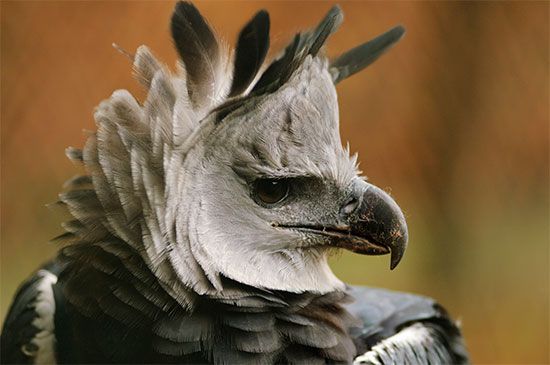
The harpy eagle (Harpia harpyja) is a large, powerful, crested bird of prey belonging to the family Accipitridae. Widely considered the most powerful eagle in the world, it inhabits lowland tropical forests across the Americas, ranging from Mexico through Central America and much of the Amazon Basin.1
As an apex predator and keystone species, the harpy eagle plays a vital role in its ecosystem. It is physically distinguished by its gray head, black back and wings, and white abdomen, with females significantly larger than males. Equipped with keen vision and powerful talons capable of crushing bone, it hunts arboreal animals like sloths and primates.1
Currently classified as a vulnerable species by the IUCN, the bird faces significant threats from habitat loss, hunting, and poaching. Conservation efforts, including captive breeding and habitat protection, are underway to ensure its survival.1
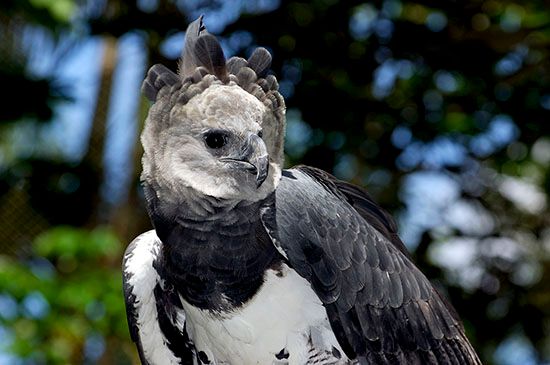
What makes the harpy eagle a keystone species in the Amazon rainforest?
The harpy eagle (Harpia harpyja) is designated as a keystone species because it functions as an apex predator that exerts a disproportionately large influence on the structure and biodiversity of its environment.13
As a top-tier predator with no natural enemies in adulthood, the harpy eagle helps maintain the ecological balance of the Amazon Basin by regulating the populations of various prey species, including primates, sloths, and other arboreal animals. By controlling these populations, the eagle prevents any single species from dominating the community, thereby supporting the overall health and diversity of the forest ecosystem.143
Furthermore, the harpy eagle acts as an “umbrella species.” Because it requires large, undisturbed tracts of lowland tropical forest—specifically areas with tall trees for nesting—conservation efforts aimed at protecting the eagle’s habitat inherently preserve the necessary environment for a wide array of other species that share the same ecosystem.1
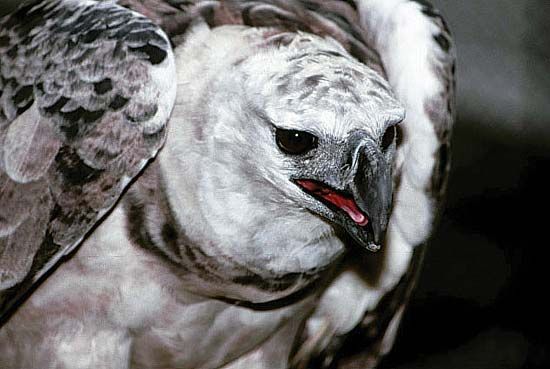
How do harpy eagles use their unique facial disks to hunt?
The harpy eagle (Harpia harpyja) possesses a specialized ruff of feathers around its head known as a facial disk, which is similar to those found on owls. This structure serves a critical sensory function: the bird can lift these feathers to direct sound toward its ears, allowing it to better detect and locate prey within the dense forest environment.4
While the harpy eagle relies on its keen vision to hunt during the day, this ability to manipulate sound reception enhances its effectiveness as an apex predator. By sitting high in trees for hours, the eagle waits for movement, using its acute senses to track arboreal animals such as primates, sloths, and opossums before maneuvering nimbly through the canopy to strike.4
Why are harpy eagles considered an umbrella species for conservation?
The harpy eagle (Harpia harpyja) is considered an umbrella species because conservation efforts designed to protect its habitat inherently safeguard the environment for a wide variety of other species that share the same ecosystem.1
Because harpy eagles require large, undisturbed tracts of lowland tropical forest—specifically areas with tall trees for nesting and at least 50 to 70 percent forest cover—protecting these expansive territories ensures the preservation of the broader landscape. By focusing conservation resources on the needs of this powerful apex predator, organizations can effectively protect the diverse plants and animals that inhabit the same regions, even if those other species are less well-known or lack the broad public appeal of the harpy eagle.16
Sources
- Harpy eagle — Encyclopædia Britannica
- harpy eagle — Merriam-Webster
- keystone species — Encyclopædia Britannica
- Harpy eagle: Top Questions — Encyclopædia Britannica
- Eagle — Encyclopædia Britannica
- trophic cascade — Encyclopædia Britannica
- charismatic megafauna — Encyclopædia Britannica
Published on · 3 min read