Four-eyed Fish
The term "four-eyed fish" refers to two species of tropical American river fishes belonging to the genus Anableps. While the colloquial term "four-eyes" is…
What is four-eyed fish?
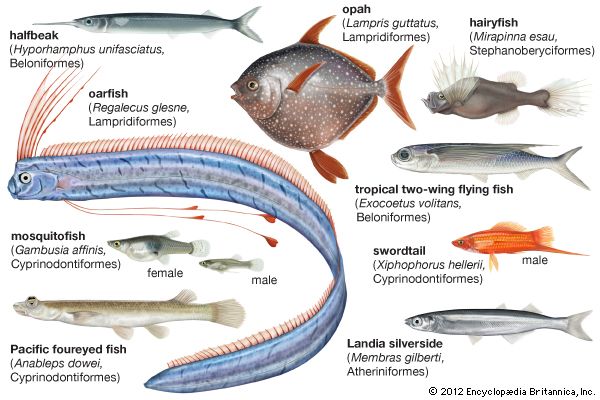
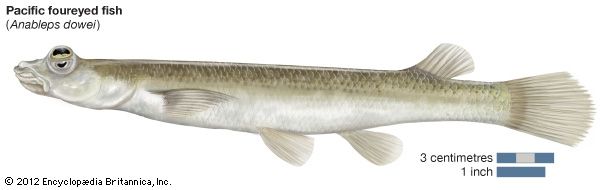
The term “four-eyed fish” refers to two species of tropical American river fishes belonging to the genus Anableps. While the colloquial term “four-eyes” is sometimes used to describe a person who wears glasses, the biological four-eyed fish is a surface-dwelling fish named for its unique ocular anatomy.12
These fish possess eyes positioned on top of their heads, with each eye divided into two distinct parts by a band of tissue. This specialized structure allows the fish to see simultaneously above the water surface with the upper half and below the surface with the lower half. Growing to a maximum length of about 30 centimeters (one foot), these creatures are well-adapted to their environment, using their divided vision to navigate the air-water interface.13
How do these fish hunt for food?
The four-eyed fish (Anableps) hunts by utilizing its specialized ocular anatomy to monitor both its aerial and aquatic environments simultaneously. Because these fish are surface dwellers, they cruise the water’s surface meniscus with their eyes positioned on top of their heads.15
Each eye is divided into two distinct parts by a band of tissue:
- The upper half is adapted for vision in the air, allowing the fish to scan for prey or threats above the water surface.16
- The lower half is adapted for vision in the water, enabling the fish to track prey or navigate beneath the surface.16
This unique arrangement, supported by an elliptical lens, allows the fish to effectively bridge the air-water interface, providing a significant advantage for a surface-feeding lifestyle.5
What other animals have special eye adaptations?
Across the animal kingdom, eyes have evolved into diverse structures tailored to specific environmental needs and survival strategies. Beyond the unique “four-eyed fish” (Anableps), many other species exhibit specialized ocular adaptations:
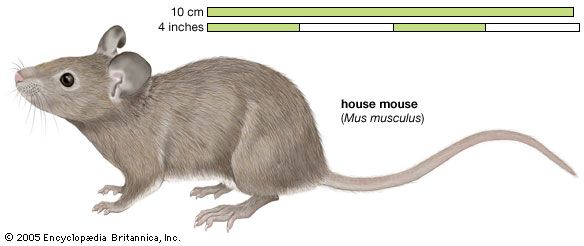
- Predatory vs. Prey Placement: Predators like felines and owls possess forward-pointing eyes, enabling binocular triangulation to judge distance. Conversely, prey species such as mice and rabbits have eyes positioned on opposite sides of the head, providing near-complete panoramic coverage to detect threats.5
- Nocturnal Adaptations: Animals active at night, such as house mice and opossums, often feature large, spherical lenses to maximize light capture. Many also possess a tapetum lucidum, a reflective layer behind the retina that improves vision in low-light conditions.5
- Amphibious Optics: Species that transition between air and water, such as seals and diving ducks, have evolved unique corneas and lens-shaping mechanisms to maintain focus in different refractive environments.5
- Deep-Sea Specializations: Some deep-sea fish have developed tubular eyes to capture limited light from above, while others, like Ipnops, have evolved specialized retinal plates to detect bioluminescent signals.5
Where in the Americas are these fish found?
The four-eyed fish (Anableps) are native to tropical regions of the Americas. They are found in both freshwater and saltwater environments throughout these tropical areas.13
Sources
- four-eyed fish — Encyclopædia Britannica
- four-eyes — Merriam-Webster
- Anableps — Merriam-Webster
- agnathan - Form and function — Encyclopædia Britannica
- Photoreception - Diversity of eyes — Encyclopædia Britannica
- Animal communication - Signal reception — Encyclopædia Britannica
- Photoreception - Pigment cup eyes — Encyclopædia Britannica
Published on · 2 min read