Osborn’s Dwarf Crocodile
Osborn’s dwarf crocodile (Osteolaemus osborni) is a small crocodile species native to the Congo River basin in Africa. Named for the American paleontologist…
What is Osborn’s dwarf crocodile?
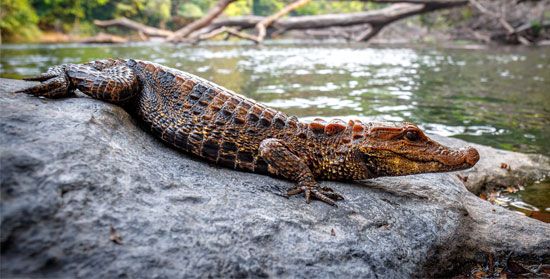
Osborn’s dwarf crocodile (Osteolaemus osborni) is a small crocodile species native to the Congo River basin in Africa. Named for the American paleontologist Henry Fairfield Osborn, it is one of two recognized species within the genus Osteolaemus.1
While it was historically classified as a subspecies of the dwarf crocodile (O. tetraspis), anatomical and genetic studies published in 2007 and 2009 led to its recognition as a distinct species. However, this classification is not universally accepted, and some sources continue to categorize it as a subspecies.1
Anatomically, Osborn’s dwarf crocodile is nearly identical to the African dwarf crocodile, with only minor differences in skull structure. These nocturnal reptiles typically grow to about 1.8 meters (6 feet) in length and feed on small prey, including insects, fish, and amphibians. They face threats from habitat loss and hunting for their meat and hide.1
Where is Osborn’s dwarf crocodile found in the wild?
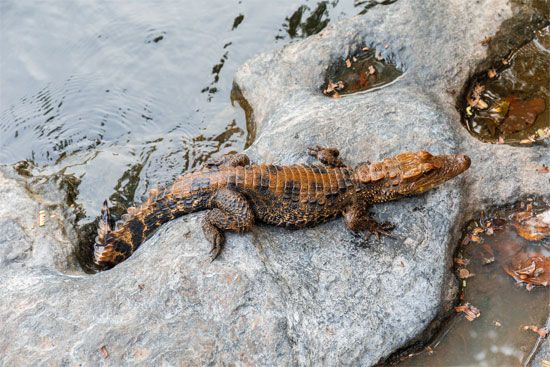
Osborn’s dwarf crocodile (Osteolaemus osborni) is found within the tropical forests and wetlands of the Congo River basin in Africa. Its geographic range spans several countries, extending from southeastern Cameroon and southwestern Central African Republic southward through the following regions:1
- Republic of the Congo
- Democratic Republic of the Congo
- Western Uganda
- Northwestern Angola
How does Osborn’s dwarf crocodile look different from other crocodiles?
Osborn’s dwarf crocodile (Osteolaemus osborni) is anatomically nearly identical to the African dwarf crocodile (Osteolaemus tetraspis), making it difficult to distinguish between the two based on appearance alone.1
The primary physical differences are as follows:
- Skull Anatomy: The two species are distinguished primarily by minor differences in their skull structure species are distinguished primarily by minor differences in their skull structure. In general, crocodilian species are identified by the proportions of the snout, the bony structures on the upper surface of the snout, and the arrangement of their scales.12
- General Appearance: Both species share a prominent charcoal color on the top and sides of their bodies, with a lighter-colored underside. They also feature yellowish cream bands on the lower jaw, which are particularly notable in juveniles.14
- Size: Both species are small, typically reaching a maximum length of about 1.8 meters (6 feet) and a maximum weight of approximately 45.4 kg (100 pounds).14
Because these differences are so subtle, many scientific sources continue to classify Osborn’s dwarf crocodile as a subspecies of the African dwarf crocodile rather than a distinct species.1
What kind of habitat does Osborn’s dwarf crocodile prefer?
Osborn’s dwarf crocodile (Osteolaemus osborni) primarily inhabits the tropical forests and wetlands located within the Congo River basin.1
These crocodiles are typically found in swamp habitats and small freshwater streams.swamp](https://www.britannica.com/science/swamp) habitats and small freshwater streams. Within these environments, they are known to occupy protected swamp areas, where they can reach high population densities. Like other dwarf crocodiles, they are primarily nocturnal and spend much of their day resting in the water, though they are also known to forage for prey on land and may occasionally climb trees to rest on lower branches.21
Unfortunately, these specialized habitats are increasingly threatened by habitat loss resulting from logging and the conversion of land for agriculture and other human uses.12
Sources
- Osborn’s dwarf crocodile — Encyclopædia Britannica
- dwarf crocodile — Encyclopædia Britannica
- Congo River: Top Questions — Encyclopædia Britannica
- crocodile - Size range and diversity of structure — Encyclopædia Britannica
- Congo River - Animal life — Encyclopædia Britannica
- crocodile - Ecology — Encyclopædia Britannica
Published on · 2 min read