Otter Shrew
Otter shrews are amphibious, carnivorous insectivores native to tropical Africa. Despite their name, they are not "true" shrews but belong to the family…
What do otter shrews eat, and how do they hunt for their food?
Otter shrews are amphibious, carnivorous insectivores native to tropical Africa. Despite their name, they are not “true” shrews but belong to the family Tenrecidae.1
These nocturnal hunters catch their prey underwater, though they typically consume it on shore. Their hunting relies on sensitive whiskers located on their broad, flat muzzles to detect movement.1
Dietary preferences vary by species:
- Giant otter shrew (Potamogale velox): Prefers freshwater crabs, which it flips over to bite the soft underside. It also consumes aquatic mollusks, insect larvae, nymphs, fish, and frogs.1
- Dwarf otter shrews (Micropotamogale): Primarily eat earthworms and aquatic insect larvae and nymphs, but also hunt small crabs, fish, and frogs.1
The giant otter shrew hunts by propelling itself through the water with a sinusoidal motion, holding its hind feet against its tail for a streamlined shape. In contrast, dwarf species use their feet to swim and dive, often floating on the surface.1
How are otter shrews related to other mammals, such as otters and shrews?
Otter shrews are often misunderstood due to their common names, but they are distinct from both “true” shrews and otters.
Relationship to Shrews and Otters
- Not “True” Shrews: Despite their name, otter shrews are not members of the family Soricidae, which contains true shrews. While they share some superficial physical similarities with shrews, they belong to an entirely different family.2
- Not Related to Otters: Otter shrews are not related to otters, which are members of the order Carnivora. The giant otter shrew (Potamogale velox) simply shares a similar body shape, fur texture, and coloration with river otters due to convergent evolution, as both have adapted to an amphibious lifestyle.2
Taxonomic Classification
Otter shrews belong to the family Tenrecidae, which is part of the order Soricimorpha. Their closest living relatives are the tenrecs of Madagascar, particularly the amphibious tenrec (Limnogale mergulus). Collectively, these animals are categorized as insectivores, a group of placental mammals that subsist primarily on insects and other small invertebrates.23
How are otter shrews adapted for their semi-aquatic lifestyle?
Otter shrews have evolved several specialized physical and behavioral adaptations that allow them to thrive in their semi-aquatic environments:
- Streamlined Morphology: To move efficiently through water, otter shrews possess a sleek body shape. The giant otter shrew (Potamogale velox) utilizes a sinusoidal, side-to-side swimming motion, holding its hind feet tightly against its vertically flattened tail to create a streamlined profile.
- Water-Repellent Fur: All three species are covered in soft, dense, water-repellent fur, which helps keep them dry and provides buoyancy while swimming.
- Sensory Specialization: Because they are nocturnal hunters, they rely on a broad, flat muzzle equipped with highly sensitive whiskers to detect prey movement in dark or murky water.
- Locomotion and Denning: They are expert swimmers, with some species featuring webbed hind feet or skin fringes on their toes to aid in propulsion. They den in stream banks, with tunnel entrances strategically located underwater for protection.
- Tail Adaptations: Their tails are specialized for their specific swimming styles; for example, the giant otter shrew’s tail is vertically flattened to act as a rudder, while the Ruwenzori otter shrew has a round tail with stiff hairs that form keels.
What are the physical characteristics of the otter shrew?
Otter shrews are a group of three amphibious insectivores native to Africa. While they share some traits with other mammals, they possess distinct physical characteristics:
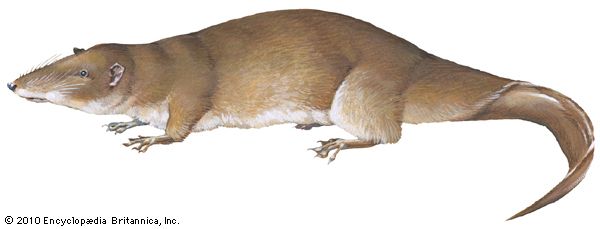
- General Features: All species have small eyes and ears, along with a broad, flat, fleshy muzzle ending in a leathery pad. This muzzle is covered in abundant, sensitive whiskers. Their fur is soft, dense, and water-repellent.2
- Giant Otter Shrew (Potamogale velox): This species is the largest, weighing under 400 grams with a body length of 27 to 33 cm. It has brown upperparts and white or yellowish underparts. Its tail is vertically flattened and finely furred, and its hind feet are unwebbed with skin fringes on the margins.2
- Dwarf Otter Shrews (Micropotamogale): These are smaller, weighing 60 to 150 grams with body lengths of 12 to 20 cm. The Ruwenzori otter shrew (M. ruwenzorii) has webbed feet and a round tail with stiff hairs forming keels. The Nimba otter shrew (M. lamottei) has unwebbed feet, a round tail, and a uniform brownish-gray color.2
Across all species, the second and third toes are fused.2
Sources
- otter shrew — Merriam-Webster
- otter shrew — Encyclopædia Britannica
- tenrec — Encyclopædia Britannica
- insectivore — Encyclopædia Britannica
- How do sea otters stay warm? — Encyclopædia Britannica
- Animal communication - Signal reception — Encyclopædia Britannica
Published on · 3 min read