Tenrec
Tenrecs are primarily found on the island of Madagascar and nearby islands, where the majority of the 29 known species are endemic.
Where are tenrecs primarily found in the wild?
Tenrecs are primarily found on the island of Madagascar and nearby islands, where the majority of the 29 known species are endemic.1
While most tenrecs are associated with Madagascar, it is important to note that the otter shrews (subfamily Potamogalinae), which are members of the family Tenrecidae, are native to the African mainland. These animals exhibit a diverse range of physical forms, including both shrewlike and hedgehoglike varieties, and have adapted to various environments ranging from terrestrial and arboreal habitats to rice fields and aquatic settings.1
How are tenrecs related to other mammal families?
The evolutionary relationships of tenrecs (family Tenrecidae) remain a subject of scientific debate, as their precise placement within the mammalian family tree is currently unresolved.1
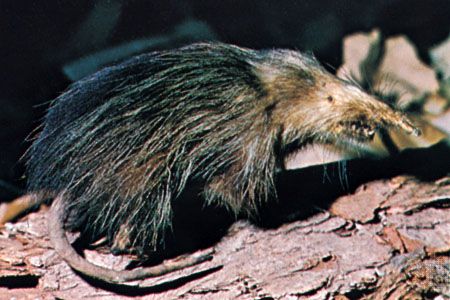
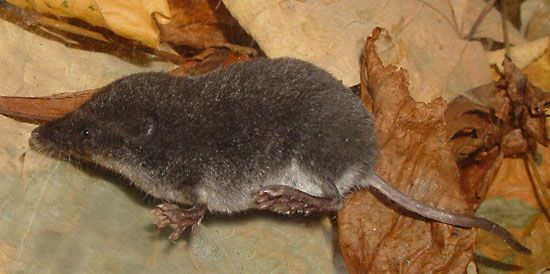
Historically, tenrecs were grouped within the order Soricimorpha alongside solenodons, true shrews, and moles. However, more recent classifications and studies offer different perspectives:1
- Afrosoricida: Some modern classifications place tenrecs in the order Afrosoricida, grouping them with golden moles.3
- Anatomical and Molecular Evidence: Research suggests that tenrecs may be more closely related to golden moles than to the other groups previously associated with them in the grandorder Lipotyphla.14
Because of these conflicting findings, tenrecs are often considered a challenging group to classify. While they share certain physical traits with other insect-eating mammals—such as a long snout and a lack of a cecum—their evolutionary history is distinct, likely involving independent colonizations of Madagascar by different ancestral groups.14
What are the dietary habits and behaviors of tenrecs?
Tenrecs exhibit a wide range of dietary habits and behaviors, largely dictated by their diverse physical forms and environmental adaptations.
Dietary Habits
While the term “tenrec” encompasses various species, their diets generally reflect their ecological niches:
- Insectivorous and Carnivorous: Many tenrecs are primarily insectivorous, feeding on a variety of invertebrates.
- Specialized Feeders: The amphibious tenrec (Limnogale mergulus) mirrors the habits and diet of water shrews, hunting aquatic prey. Burrowing species, such as the rice tenrecs (Oryzorictes), forage within soil and agricultural environments for food.1
Behaviors and Adaptations
Tenrecs display unique behavioral traits to survive in their respective habitats:
- Communication: Hedgehoglike tenrecs possess specialized spines that they scrape against one another to produce sounds for communication.1
- Defense: Species such as the lesser and greater hedgehog tenrecs can curl into a protective ball when threatened. The streaked tenrec utilizes detachable barbed spines as a defensive mechanism.1
- Metabolic Regulation: In response to adverse environmental conditions, such as extreme heat or cold, many animals—including some tenrecs—enter a state of torpor. This state involves a significant reduction in body temperature and metabolic activity, allowing them to conserve energy during periods when resources are scarce.5
- Habitat Diversity: Depending on the species, tenrecs may be terrestrial, arboreal, or semi-aquatic, with some species adapted for burrowing.1
What are the unique physical characteristics of tenrecs?
Tenrecs (family Tenrecidae) exhibit remarkable physical diversity, often categorized into shrewlike and hedgehoglike forms, reflecting their varied ecological adaptations.1
Shrewlike Tenrecs
These species possess soft, dense fur and are physically analogous to true shrews.
- General Traits: They range from the tiny long-eared tenrec, weighing only 5 to 9 grams, to larger, darker species in the genus Microgale.1
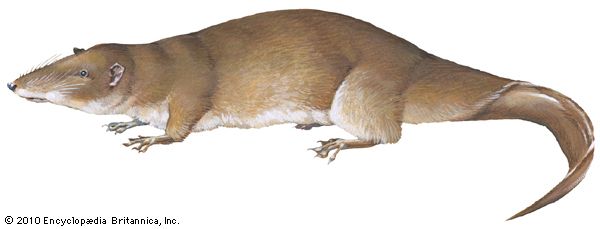
- Specialized Adaptations: Burrowing rice tenrecs feature dark, velvety fur, small eyes and ears, and long front claws for digging. The amphibious tenrec is uniquely adapted for water with webbed feet, a keeled tail, and water-repellent fur.1
Hedgehoglike Tenrecs
These tenrecs are characterized by their bulky bodies and the absence or reduction of external tails.
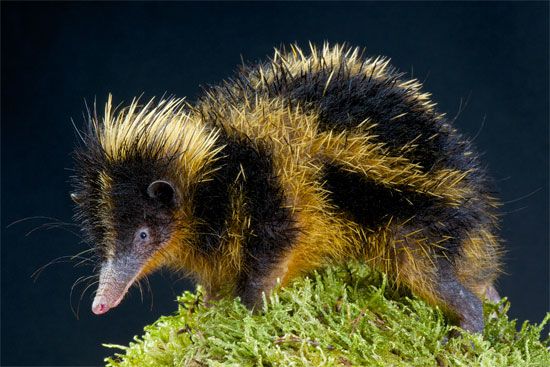
- Spines and Defense: Many species possess specialized spines. The lesser and greater hedgehog tenrecs have densely spined upperparts and can curl into a protective ball. The streaked tenrec features detachable barbed spines.1
- Communication: Several species use their spines to scrape against one another to produce sounds.1
- Size: The common tenrec is the largest, weighing 2 kg or more.1
Sources
- tenrec — Encyclopædia Britannica
- Tenrecidae — Merriam-Webster
- mammal - Classification — Encyclopædia Britannica
- insectivore — Encyclopædia Britannica
- Torpor — Encyclopædia Britannica
Published on · 3 min read