Pachycephalosaurus
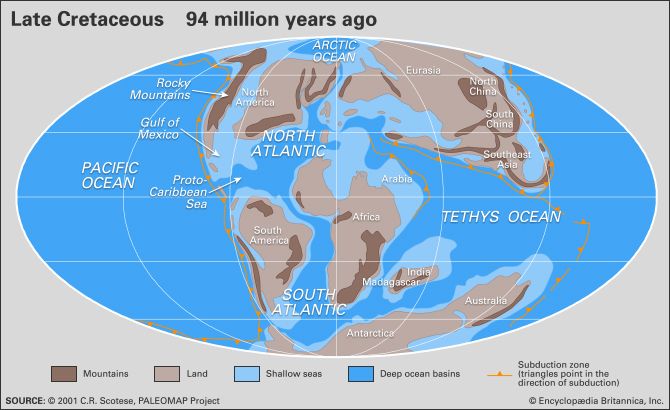
Pachycephalosaurus lived in North America during the Late Cretaceous Period, approximately 65.5 million years ago.
When and where did Pachycephalosaurus live?
Pachycephalosaurus lived in North America during the Late Cretaceous Period, approximately 65.5 million years ago.12
Fossils of these “bone-headed” dinosaurs have been recovered from the Hell Creek Formation, a geological division spanning parts of Montana, North Dakota, South Dakota, and Wyoming. These dinosaurs inhabited coastal-plain environments that existed as the shallow Cretaceous seas retreated from the interior of western North America. While Pachycephalosaurus is specifically associated with these North American deposits, related pachycephalosaur forms have also been discovered in Mongolia.21
How do scientists study Pachycephalosaurus fossils to learn about the species?
Scientists study Pachycephalosaurus and other dinosaurs using a combination of traditional descriptive analysis and modern, multidisciplinary methods. Researchers classify these animals and understand their evolutionary relationships by employing cladistics, which utilizes phylogenetic trees to map how specific features evolved over time.1
To understand the biology and behavior of these extinct animals, scientists use several specialized techniques:
- Functional Anatomic Studies: Researchers apply biomechanical examinations to limbs and joints to estimate movement capabilities, such as walking and running speeds.1
- Microscopic Analysis: By examining the internal bone structure of the characteristic dome-shaped skull, scientists have tested hypotheses about behavior. For instance, microscopic studies of the bone density in Pachycephalosaurus suggest the domes were poorly designed for head-butting, leading researchers to favor theories of species recognition or display instead.34
- Comparative Modeling: Scientists use analogous traits from living animals and mechanical models to infer the functions of unique anatomical features.1
Because the fossil record is often limited, these indirect approaches are essential for reconstructing the lives of these rare dinosaurs.5
What are the key physical characteristics of Pachycephalosaurus?
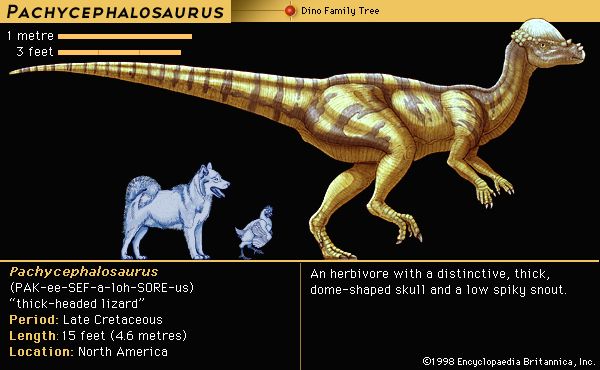
Pachycephalosaurus is defined by several distinct physical characteristics that distinguish it as the largest member of the pachycephalosaur group, reaching lengths of approximately 5 meters (16 feet).14
Key Physical Features
- Domed Skull: The most iconic feature is a high, thick, dome-shaped skull composed of solid bone. This growth covers the temporal openings typically found in related species and protects a relatively small brain.1
- Cranial Ornamentation: The skull is further decorated with abundant bony knobs located at the front and sides, contributing to its unique appearance.1
- Bipedal Stance: Pachycephalosaurus was a biped, characterized by powerful, strong hind limbs and significantly smaller, less developed forelimbs.1
- Ornithischian Anatomy: As a member of the Pachycephalosauria, it followed a basic ornithopod body plan, featuring an ornithischian pelvis and simple, leaf-shaped teeth that were enameled on both sides.4
While the thick dome was once hypothesized to be an adaptation for head-butting, current scientific consensus suggests it likely served purposes related to species recognition or display.14
What did Pachycephalosaurus eat, and how do we know about its diet?
Pachycephalosaurus was a herbivore, meaning it subsisted on a plant-based diet. As a member of the Pachycephalosauria group, it belonged to the larger cerapod suborder of ornithischian dinosaurs, which were generally adapted for consuming vegetation.6
Scientists infer the dietary habits of such dinosaurs primarily through the study of their teeth and general body plan. Pachycephalosaurus possessed simple, leaf-shaped teeth that were enameled on both sides, a structure typical of plant-eating dinosaurs. Unlike the highly specialized “dental batteries” found in their contemporaries—the hadrosaurs and ceratopsians, which were capable of grinding or shearing tough, fibrous plant tissues—the dentition of Pachycephalosaurus suggests a less complex method of food processing.78
Because grasses had not yet evolved during the Mesozoic Era, it is assumed that Pachycephalosaurus fed on the vegetation available at the time, such as low-growing shrubs, ferns, or the fronds of conifers and palms.7
Sources
- Pachycephalosaurus — Encyclopædia Britannica
- Hell Creek Formation — Encyclopædia Britannica
- dinosaur - Modern studies — Encyclopædia Britannica
- dinosaur - Pachycephalosauria — Encyclopædia Britannica
- Animal behaviour - Evolutionary history of behaviour — Encyclopædia Britannica
- dinosaur - The plant eaters — Encyclopædia Britannica
- mammal - Teeth — Encyclopædia Britannica
- ornithopod — Encyclopædia Britannica
- dinosaur - Clues to dinosaurian metabolism — Encyclopædia Britannica
Published on · 3 min read