Pentaceratops
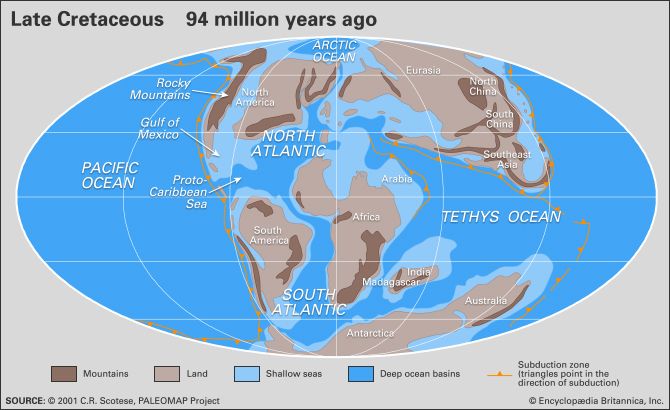
Pentaceratops is a genus of herbivorous dinosaur that lived during the Late Cretaceous Period, approximately 100 million to 65.5 million years ago. Fossils…
What is Pentaceratops?
Pentaceratops is a genus of herbivorous dinosaur that lived during the Late Cretaceous Period, approximately 100 million to 65.5 million years ago. Fossils of this creature have been discovered in North America, with notable specimens found in the Kirtland Shale of New Mexico, U.S.1
Reaching a length of about 6 meters (20 feet), Pentaceratops was a member of the ceratopsian group, making it a relative of the more widely known Triceratops. Its name refers to its five horns: one located on its snout, one above each eye, and one on each side of its large, bony neck frill.1
How does Pentaceratops differ from Triceratops?
Pentaceratops and Triceratops are both members of the ceratopsian group of herbivorous dinosaurs, but they exhibit distinct physical and developmental differences.
Physical Characteristics
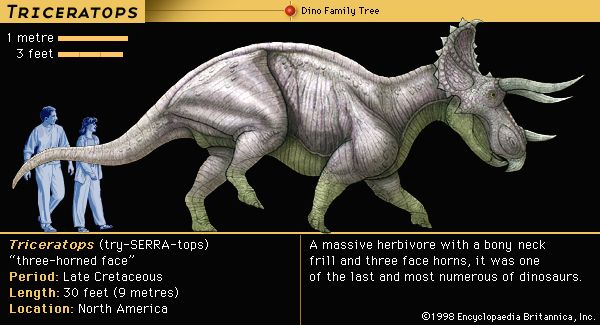
- Horns: As its name implies, Pentaceratops possessed five horns: one on its snout, one above each eye, and one on each side of its large neck frill. In contrast, Triceratops is characterized by three prominent horns—one on the snout and one above each eye—along with numerous small spikes, known as epoccipitals, bordering its frill.31
- Size: Triceratops was generally larger, with a body length approaching 9 meters (30 feet) and an estimated weight of 5,450–7,260 kg. Pentaceratops was smaller, reaching a length of approximately 6 meters (20 feet).13
- Frill Structure: Triceratops is noted for having a short, solid bony frill. While the frill of Pentaceratops is described as large, it is distinct from the solid, thick structure typical of Triceratops.413
Temporal and Geographic Context
- Triceratops lived during the final 3 million years of the Cretaceous Period.1
- Pentaceratops existed earlier, with a range spanning from approximately 100 million to 65.5 million years ago, and is notably associated with the Kirtland Shale of New Mexico.13
What was the purpose of the bony neck frill?
Paleontologists have proposed several hypotheses to explain the purpose of the bony neck frill in ceratopsian dinosaurs, though these theories remain difficult to test definitively.5
- Protective Shield: The frill may have served as a defensive barrier to protect the neck region from predators.5
- Muscle Attachment: It likely provided an attachment site for powerful neck muscles used to wield head horns, or for enlarged jaw muscles.5
- Display and Signaling: The frill may have functioned as an ornament to present a large, intimidating profile to potential attackers or as a means of species recognition. In Triceratops, the shape of the frill and horns changed dramatically as the animal matured, suggesting these structures were used to signal maturity to other members of the group.53
- Thermoregulation: A more unusual hypothesis suggests the frill acted as a heat-control apparatus, with a network of blood vessels on its surface helping to regulate body temperature.5
Because many ceratopsian frills were frames of bone with large openings, they would have provided limited physical protection, leading some researchers to suggest that skin or soft tissues spanned these gaps to enhance their display function.5
What other dinosaurs lived during the Late Cretaceous Period?
The Late Cretaceous Period (approximately 100 million to 66 million years ago) was a time of immense dinosaur diversity, characterized by complex ecosystems similar to those of modern terrestrial mammals.6
Notable Dinosaurs of the Late Cretaceous
- Theropods: This diverse group of flesh-eating dinosaurs included the massive Tyrannosaurus rex, the agile, turkey-sized Velociraptor, and the unusual, clawed Therizinosaurus.78
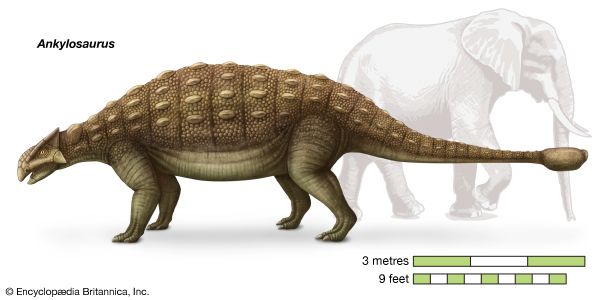
- Armored Dinosaurs: The heavily armored Ankylosaurus, known for its bony tail club, and its relatives like Euoplocephalus and Nodosaurus, were prominent during this time.8910
- Horned and Duck-billed Dinosaurs: In addition to Triceratops, the landscape featured “duck-billed” hadrosaurs such as Shantungosaurus.1112
- Sauropods: The titanosaurs, a group of massive sauropods including Argentinosaurus and Dreadnoughtus, emerged during the second half of the period as the largest land animals to ever exist.68
- Other Forms: The dome-headed Pachycephalosaurus and the small, swift Compsognathus also inhabited the Cretaceous world.8
Beyond these land-dwellers, the era saw the skies dominated by pterosaurs like the massive Quetzalcoatlus, while the seas were filled with giant marine reptiles such as mosasaurs and plesiosaurs.116
Sources
- Pentaceratops — Encyclopædia Britannica
- bivalve - Critical appraisal — Encyclopædia Britannica
- Triceratops — Encyclopædia Britannica
- ceratopsian — Encyclopædia Britannica
- dinosaur - Ceratopsia — Encyclopædia Britannica
- A Journey Through Time Since the Precambrian - Cretaceous Period: 145 million to 66 million years ago — Encyclopædia Britannica
- theropod — Encyclopædia Britannica
- Cretaceous Period - Terrestrial life — Encyclopædia Britannica
- 6 Awesome Dinosaur Species You Should Know — Encyclopædia Britannica
- Ankylosaurus — Encyclopædia Britannica
- Cretaceous Period — Encyclopædia Britannica
- dinosaur - Ankylosauria — Encyclopædia Britannica
Published on · 3 min read