Paeoniaceae
The Paeoniaceae family, consisting of the genus Paeonia, is characterized by distinct botanical features in both its foliage and blossoms.
What are the distinctive features of Paeoniaceae flowers and leaves?
The Paeoniaceae family, consisting of the genus Paeonia, is characterized by distinct botanical features in both its foliage and blossoms.
Leaves
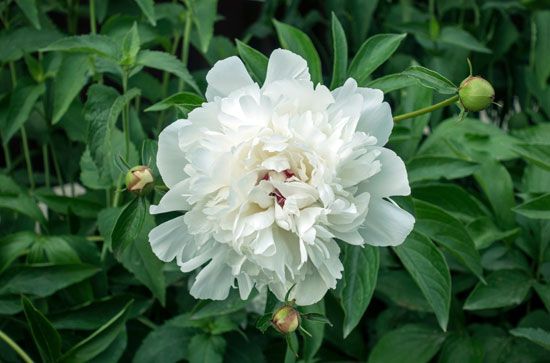
The leaves are produced alternately along the stems and are notably compound. They are typically divided into three primary lobes, with each of those lobes further divided into three smaller segments, resulting in a much-divided, often glossy appearance.12
Flowers
Peony flowers are known for being large, showy, and radially symmetrical. Key features include:
- Structure: They are bisexual and typically possess 5 sepals and 5 petals, though horticultural varieties often feature more than 10 petals, including double-flowered forms.12
- Stamens: The flowers contain an indefinitely large number of stamens.1
- Pistils: The female reproductive structures consist of two to five separate, fleshy pistils or ovaries.1
- Coloration: Blossoms appear in a wide range of colors, including white, pink, rose, deep crimson, lilac, and violet.12
What are the most common or well-known plants in the Paeoniaceae family?
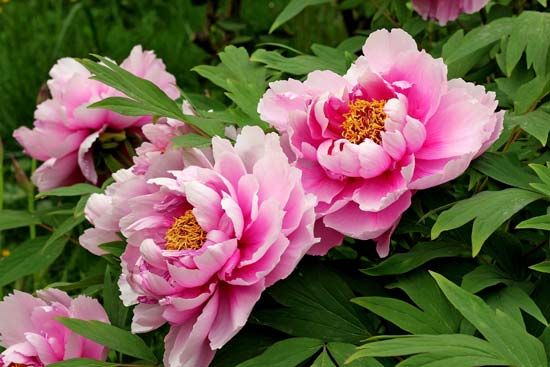
The family Paeoniaceae consists entirely of the genus Paeonia, which includes approximately 30 to 33 species. These plants are categorized into three primary groups: herbaceous Eurasian peonies, Asian tree (or moutan) peonies, and North American peonies.
The most well-known garden varieties are derived from two specific species:
- Chinese peony (P. lactiflora): This fragrant, herbaceous perennial has provided the foundation for hundreds of cultivated varieties, including the popular Japanese types that feature rows of petals surrounding a cluster of petaloid stamens.
- European common peony (P. officinalis): A traditional garden favorite known for its classic form.
Other notable members include:
- Tree Peonies (P. suffruticosa): These are shrubby, woody-stemmed plants that can reach heights of up to 6 feet. They are often crossed with the yellow Chinese species P. delavayi to create unique hybrids.
- North American Peonies: These include the western peony (P. brownii), found from California to Montana, and the California peony (P. californica), native to the Pacific coastal mountains.
How are Paeoniaceae plants used in horticulture and gardening?
Paeoniaceae plants are highly valued in horticulture and the floral industry primarily for their large, showy blossoms, which appear in a diverse array of colors and forms.21
Horticultural Applications
- Ornamental Gardening: Peonies are widely cultivated as perennials in gardens. Gardeners utilize both herbaceous varieties, which grow from fleshy rootstocks, and shrubby tree peonies, which feature permanent woody stems.21
- Floral Industry: Due to their striking appearance and fragrance, many species are grown commercially for the cut-flower market.2
- Breeding and Hybridization: Breeders have developed hundreds of cultivated varieties, such as the Japanese types, by selecting for specific petal arrangements and colors. Hybridization programs, such as crossing P. suffruticosa with P. delavayi, have produced unique plants with varied flower forms.2
Cultivation Practices
- Propagation: While some varieties are grown from seeds—a process that can take two years to germinate—many are propagated through division. Because many horticultural varieties are grafted onto supportive rootstock, they cannot always be propagated by simple division.2
- Environmental Needs: Tree peonies, in particular, thrive best in regions with hot, dry summers.2
Are there any medicinal or cultural uses associated with plants from the Paeoniaceae family?
Plants in the Paeoniaceae family have a long history of both medicinal and cultural significance.
Medicinal and Food Uses
Historically, several species of peonies native to southern Europe and Asia were cultivated as medicinal herbs. The genus name itself, Paeonia, is derived from the Greek physician of the gods, Paeon, reflecting the plant’s ancient association with healing. Additionally, some species have been utilized as food sources.14
Cultural Symbolism
In Eastern traditions, particularly in China, the peony holds deep symbolic meaning:
- Symbol of Good Fortune: The tree peony (Paeonia moutan) is famously designated as the “king of flowers” and is traditionally used to represent prosperity and good fortune.2
- Seasonal Symbolism: In Taoist symbolism, the peony is the designated flower of spring, representing one of the four seasons alongside the plum blossom, lotus, and chrysanthemum.2
- Artistic Contemplation: Peonies have long been integrated into floral decoration, where they are philosophically contemplated as symbols of organic existence and aesthetic beauty.2
Sources
- Paeoniaceae — Encyclopædia Britannica
- peony — Encyclopædia Britannica
- Paeonia — Merriam-Webster
- Floral decoration - China and Korea — Encyclopædia Britannica
- peony — Merriam-Webster
Published on · 3 min read