Penthorum
Penthorum is a genus consisting of two species of perennial herbs native to East Asia and eastern North America. While some classifications place the genus…
What is Penthorum?
Penthorum is a genus consisting of two species of perennial herbs native to East Asia and eastern North America1. While some classifications place the genus within the Saxifragaceae family, it is also frequently treated as its own distinct family, Penthoraceae.1
The two species are:
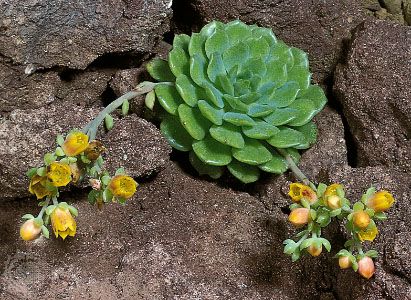
- Ditch stonecrop (Penthorum sedoides): Growing to approximately 60 cm (2 feet), this plant features pale greenish-yellow flowers and leaves that transition to a bright orange color as they mature. It is often used as an ornamental plant in shallow water or near pools.1
- Oriental penthorum (P. chinense): This species can reach up to 90 cm (35 inches) in height and is characterized by its spreading rhizomes.1
Both species are defined by their underground stems, toothed leaves, and one-sided flower clusters located at the tips of their branches.1
What are the main differences between the Saxifragaceae and Crassulaceae families?
The Saxifragaceae and Crassulaceae families are both members of the order Saxifragales, but they exhibit distinct ecological and physiological differences.
Key Differences
- Succulence and Metabolism: The most defining characteristic of the Crassulaceae is their adaptation to arid environments. They possess thick, fleshy leaves and stems designed for water storage and utilize a specialized form of photosynthesis known as Crassulacean Acid Metabolism (CAM) to survive in dry conditions. In contrast, Saxifragaceae are typically associated with rock-garden environments and do not share this specialized succulent metabolism.34
- Habitat and Distribution: While both families are found globally, Crassulaceae are specifically concentrated in arid regions. Saxifragales as an order—which includes Saxifragaceae—encompasses a broader range of plant types, including shrubs and trees, and is characterized by a wide variety of structural forms.34
- Reproductive Features: Crassulaceae flowers are bisexual with perianth parts in sets of four or five and feature a nectar-producing gland at the base of each of their 3–10 separate carpels.3
How do rhizomes help plants like the Oriental penthorum spread?
Rhizomes are horizontally growing underground stems that serve as vital organs for asexual reproduction and food storage in plants like the Oriental penthorum.56
These specialized stems enable plants to spread and propagate through several key mechanisms:
- Vegetative Multiplication: As rhizomes grow horizontally within or upon the soil, they branch out, which directly results in the multiplication of the plant.7
- New Growth: Rhizomes are capable of producing both the shoot and root systems of a new plant. By developing these systems, the parent plant can establish new, independent individuals from its own body.1
- Survival and Persistence: In addition to facilitating spread, rhizomes store starches and proteins. This allows the plant to perennate, or survive through unfavorable seasons, ensuring that the plant remains established in an area and can continue to expand when conditions are favorable.15
Because this process is a form of vegetative reproduction, the new plants produced via rhizomes are genetically identical to the parent, allowing the species to efficiently colonize its surroundings.7
What are some other examples of ornamental plants used in water gardens?
Water gardens feature a diverse array of ornamental plants that can be categorized by their placement and growth habits. Beyond the classic water lily, several other species are commonly used to enhance the aesthetic and ecological balance of these aquatic environments.
Ornamental Aquatic Plants
- Lotus (Nelumbo nucifera): A popular choice for pools, this plant is rooted in the mud and produces striking, iconic flowers.89
- Cape Pondweed (Aponogeton distachyos): Also known as water hawthorn, this species is frequently grown as an ornamental in pools and greenhouses due to its attractive nature.10
- Floating Plants: Species such as the water hyacinth are often used in water gardens, as they float on the surface without requiring anchorage in the mud.9
Marginal and Moisture-Loving Plants
The areas surrounding a pool, often characterized by boggy or damp soil, are ideal for moisture-tolerant plants that provide a transition between the water and the landscape:
Sources
- Penthorum — Encyclopædia Britannica
- Penthorum — Merriam-Webster
- Saxifragales - Order characteristics — Encyclopædia Britannica
- Crassulaceae — Encyclopædia Britannica
- rhizome — Encyclopædia Britannica
- plant - Stems — Encyclopædia Britannica
- vegetative reproduction — Encyclopædia Britannica
- gardening - Water gardens — Encyclopædia Britannica
- aquatic plant — Merriam-Webster
- pondweed — Encyclopædia Britannica
Published on · 3 min read