Painted Snipe
Painted snipes, which belong to the family Rostratulidae, are distinct from the common snipe family (Scolopacidae) and possess several unique physical…
What unique physical characteristics do painted snipes have?
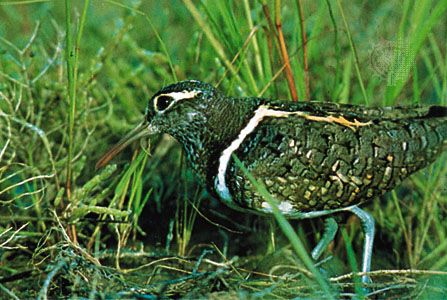
Painted snipes, which belong to the family Rostratulidae, are distinct from the common snipe family (Scolopacidae) and possess several unique physical characteristics.12
These birds are approximately 25 cm (10 inches) in length and feature a snipelike body and bill, with plumage primarily composed of brown and white markings. A notable trait of the family is sexual dimorphism, where the female is consistently larger and more brightly colored than the male.1
Specific physical variations exist between the two species:
- Old World painted snipe: Distinguished by yellowish “spectacles” around the eyes.1
- South American painted snipe: A darker bird characterized by a yellow-striped back.1
Unlike many other bird species, the female painted snipe takes the lead in courtship, while the male is responsible for the majority of nesting duties. Their young are precocial, meaning the downy chicks are capable of taking to the water shortly after hatching.1
How do painted snipes interact with other bird species in their ecosystem?
Painted snipes (family Rostratulidae) exhibit specific behavioral interactions within their ecosystems, primarily centered on courtship and reproductive roles. Unlike many other bird species, painted snipes demonstrate a reversal of traditional gender roles during the breeding season.12
- Courtship Aggression: The female of the Old World painted snipe (Rostratula benghalensis) is notably more aggressive during courtship than the male. She takes the lead in these interactions, often displaying with spread wings and tail to attract a mate.2
- Parental Division: Once courtship is complete, the female leaves the responsibilities of incubation and chick care entirely to the male. This behavior is similar to that observed in certain jacanas and phalaropes, where the female focuses on courtship and aggression while the male manages the nest.2
- Nesting: Painted snipes nest on the ground, typically constructing a shallow platform of bent reeds. Because they are ground-nesters, they rely on their environment for concealment, though they do not exhibit the same pronounced territorial behaviors seen in some other shorebird species, such as the greenshank, which aggressively defend large breeding territories.2
How do male and female painted snipes differ in appearance and behavior?
Painted snipes (family Rostratulidae) exhibit notable differences between males and females, particularly regarding their physical appearance and behavioral roles during the breeding season.13
Physical Appearance
In both species of painted snipe, the female is larger and more brightly colored than the male.1
- Old World painted snipe (Rostratula benghalensis): The female is larger and more vibrant in color than the male, who is more subdued.3
- South American painted snipe (Nycticryphes semicollaris): This species shows less pronounced sexual dimorphism than its Old World counterpart, though females remain slightly larger than males.3
Behavioral Differences
The reproductive behavior of painted snipes is characterized by a reversal of traditional gender roles, similar to that seen in jacanas and phalaropes.3
- Courtship: The female takes the lead role in courtship, displaying with spread wings and tail to attract a mate. She is also more aggressive during these interactions.3
- Parental Care: Once the eggs are laid, the female leaves the nest entirely. The male assumes all responsibilities for incubation and the subsequent care of the chicks.13
What is the diet of painted snipes, and how do they forage for food?
The provided search results do not contain specific information regarding the diet or foraging habits of the painted snipe (family Rostratulidae). While the articles describe the physical characteristics, reproductive roles, and habitat of these birds, they do not detail what they eat or how they obtain their food.12
Sources
- Painted snipe — Encyclopædia Britannica
- Snipe — Encyclopædia Britannica
- Charadriiform - Shorebirds (suborder Charadrii) — Encyclopædia Britannica
Published on · 3 min read