Recurvirostridae
Recurvirostridae is a family of wading birds within the order Charadriiformes, consisting of seven species. These birds are typically moderately large…
What is Recurvirostridae?
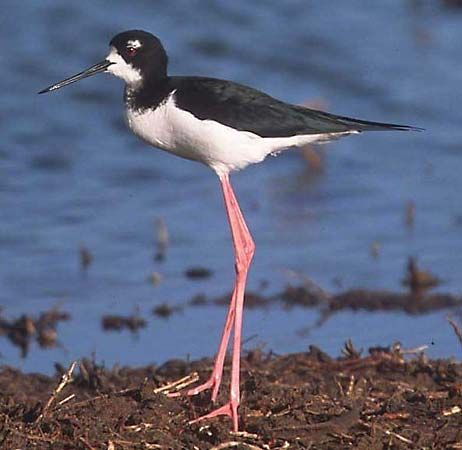
Recurvirostridae is a family of wading birds within the order Charadriiformes, consisting of seven species. These birds are typically moderately large, ranging from 29 to 48 cm (11 to 19 inches) in length, and are physically distinguished by their extremely long legs, relatively small heads, and long, slender bills.1
Well-known members of this family include the avocet, the stilt, and the ibisbill. Their feeding behaviors are specialized for aquatic environments:1
- Avocets and stilts forage in shallow water by sweeping their open bills from side to side across the bottom or near the surface. Stilts also utilize pecking and probing techniques.2
- The ibisbill, which possesses a downcurved bill, inhabits Himalayan rivers and lakes, where it wades into the water to reach under rocks for insects, mollusks, crustaceans, and worms.2
How do avocets and stilts differ in their feeding techniques?
Avocets and stilts, both members of the family Recurvirostridae, share similar habitats but employ distinct feeding techniques while foraging in shallow water.12
- Avocets feed by sweeping their long, slender, upturned bills—held partly open—back and forth across the bottom of the water. They often wade in lines to corral prey, such as minnows and crustaceans, and may occasionally upend in deeper water to reach food.23
- Stilts also forage by sweeping their bills from side to side, but they typically do so near the water’s surface rather than along the bottom. Additionally, stilts utilize pecking and probing techniques to secure their food.2
What makes the ibisbill unique compared to other members of the Recurvirostridae family?
The ibisbill (Ibidorhyncha struthersii) is unique within the Recurvirostridae family due to several distinct physical and behavioral characteristics:
- Bill Morphology: Unlike the long, slender, and often upturned bills of its relatives, the ibisbill possesses a long, red, downcurved bill that resembles that of an ibis.52
- Feeding Technique: While avocets and stilts typically forage by sweeping their bills through water, the ibisbill uses its specialized bill to probe for insects, mollusks, crustaceans, and worms under stones in Himalayan streams and ponds.56
- Physical Build: The ibisbill is a heavyset bird with shorter legs compared to other members of the family.5
- Habitat: It is uniquely adapted to high-altitude environments, nesting at elevations of 3,000 metres (9,840 feet) or higher in the Himalayas and wintering in the foothills.5
What are some other bird families that belong to the order Charadriiformes?
The order Charadriiformes is a diverse group comprising 17 families of birds, generally categorized into three suborders: Charadrii (shorebirds), Lari (gulls and their allies), and Alcae (auks).7
Beyond the well-known sandpipers, plovers, and gulls, the order includes several other distinct families:
- Alcidae: Auks, murres, guillemots, and puffins.7
- Haematopodidae: Oystercatchers.7
- Stercorariidae: Skuas and jaegers.7
- Jacanidae: Jacanas.7
- Rostratulidae: Painted snipe.7
- Burhinidae: Thickknees.7
- Rynchopidae: Skimmers.7
- Glareolidae: Coursers and pratincoles.7
- Dromadidae: Crab plovers.7
- Thinocoridae: Seedsnipe.7
- Chionididae: Sheathbills.9
- Phalaropodidae: Phalaropes.7
- Pedionomidae: The plains wanderer.8
Sources
- Recurvirostridae — Encyclopædia Britannica
- Charadriiform - Locomotion and feeding behaviour — Encyclopædia Britannica
- Avocet — Encyclopædia Britannica
- Ciconiiform - Feeding habits — Encyclopædia Britannica
- ibisbill — Encyclopædia Britannica
- ibisbill — Merriam-Webster
- Charadriiform — Encyclopædia Britannica
- Charadriiform - Critical appraisal — Encyclopædia Britannica
- Charadriiform - General features — Encyclopædia Britannica
Published on · 2 min read