Pauraque
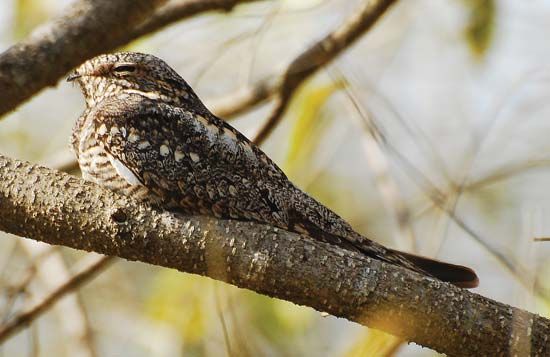
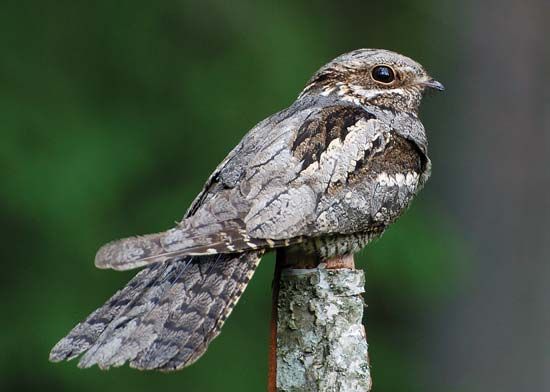
The pauraque (Nyctidromus albicollis) is a nocturnal bird native to brushlands ranging from southern Texas to northern Argentina.
What is Pauraque?
The pauraque (Nyctidromus albicollis) is a nocturnal bird native to brushlands ranging from southern Texas to northern Argentina.1
A member of the Caprimulgidae family, it is a relative of the nightjar) family, it is a relative of the nightjar. The bird typically measures about 30 cm (12 inches) in length and is characterized by its rounded wings and a longish tail. Its plumage is mottled brown, featuring a distinct white bar on each wing, while males are further distinguished by white outer tail feathers.1
What are the unique characteristics of the nightjar family?
The Caprimulgidae family, commonly known as nightjars, consists of insectivorous birds characterized by several unique physical and behavioral traits:
Physical Characteristics
- Appearance: They are sparrow- to pigeon-sized birds with cryptic, mottled gray and brown plumage that provides effective camouflage.23
- Anatomy: They possess enormous gapes (wide mouths), often fringed with bristles, which facilitate catching insects on the wing. Compared to owls, they have flatter heads, laterally placed eyes, and lack raptorial feet.243
- Flight: Their soft plumage allows for noiseless flight, an adaptation for their nocturnal hunting.4
Behavioral Traits
- Feeding: They are primarily crepuscular or nocturnal, feeding on flying insects caught during flight.245
- Roosting: During the day, they typically rest on the ground or perch lengthwise along tree branches to remain concealed.25
- Nesting: They do not build traditional nests; instead, they lay one or two eggs directly on the ground or on rooftops.2
- Vocalization: Their common name, “nightjar,” derives from their jarring, often mysterious-sounding calls.23
How do nocturnal birds like the pauraque hunt for food?
The pauraque (Nyctidromus albicollis), like other members of the Caprimulgidae family, is an insectivorous bird that hunts primarily at night.15
These birds are specialized for catching flying insects “on the wing”—meaning they capture their prey while in flight. To facilitate this, they possess several distinct adaptations:35
- Enormous Gapes: They have exceptionally wide mouths, often fringed with bristles, which allow them to scoop up insects efficiently while flying.235
- Noiseless Flight: Their soft plumage enables them to fly silently, which helps them approach prey undetected.3
- Nocturnal Activity: They are primarily active during twilight or at night, when they hunt insects that are attracted to or disturbed by other animals.25
Unlike some other nocturnal birds, such as owls, which use acute hearing to locate prey on the ground, or oilbirds, which utilize echolocation for navigation, the pauraque and other nightjars rely on their specialized anatomy to snatch insects directly from the air.2378
What is the purpose of the pauraque’s mottled brown feathers?
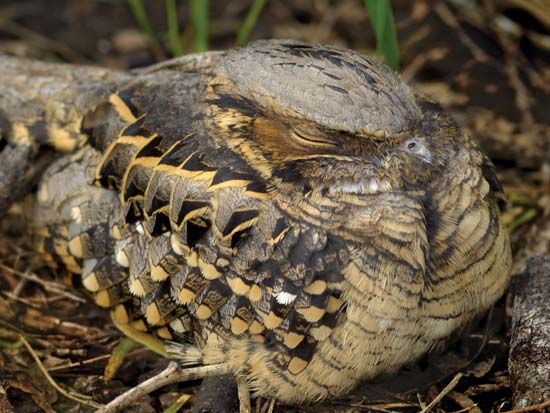
The mottled brown plumage of the pauraque serves as a highly effective form of natural camouflage, which is essential for the bird’s survival during its daytime rest.1
Because the pauraque is a nocturnal bird, it spends its daylight hours inactive on the ground or in brushlands. Its coloration—characterized by various shades of brown, gray, and black—is patterned to match its specific environment, allowing the bird to blend in seamlessly with its surroundings, such as fallen leaves, detritus, or gravelly terrain. This type of disruptive coloration helps break up the bird’s body outline, making it difficult for predators to detect it while it is roosting. By remaining concealed during the day, the pauraque avoids unwanted attention and maintains its safety until it becomes active again at dusk or during the night.1910
Sources
- Pauraque — Encyclopædia Britannica
- Caprimulgidae — Encyclopædia Britannica
- Nightjar — Encyclopædia Britannica
- Caprimulgiform - Natural history — Encyclopædia Britannica
- Caprimulgiform — Encyclopædia Britannica
- Caprimulgiform - Habitat — Encyclopædia Britannica
- sound reception - Uses of hearing in birds — Encyclopædia Britannica
- Why do birds chirp at night? — Encyclopædia Britannica
- coloration - Optical functions: combination of concealing and advertising coloration — Encyclopædia Britannica
- coloration - The adaptive value of biological coloration — Encyclopædia Britannica
- coloration - Disruptive coloration — Encyclopædia Britannica
- Caprimulgiform - Form and function — Encyclopædia Britannica
Published on · 3 min read