Paranaíba River
The Paranaíba River is a waterway in south-central Brazil that rises on the western slopes of the Serra da Mata da Corda. It flows west-southwestward for…
What is Paranaíba River?
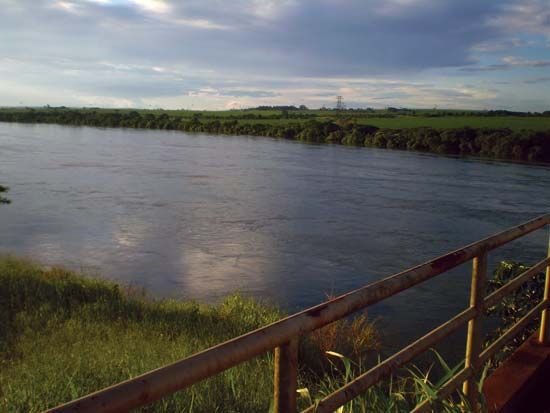
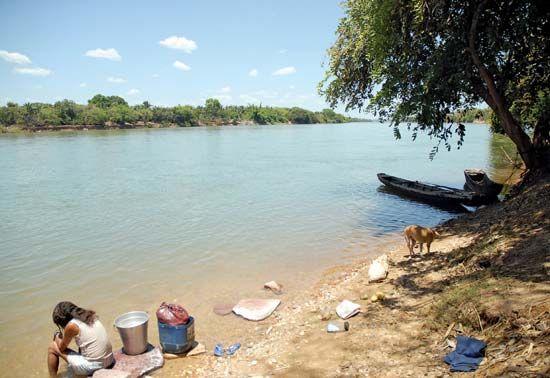
The Paranaíba River is a waterway in south-central Brazil that rises on the western slopes of the Serra da Mata da Corda. It flows west-southwestward for approximately 600 miles (1,000 km), serving as a border between the states of Minas Gerais and Goiás, and briefly separating Minas Gerais from Mato Grosso do Sul.1
The river is a significant tributary of the Paraná River system; it joins the Grande River to form the Alto Paraná. Its course features numerous waterfalls and diamond washings. Economically, the Paranaíba River Valley supports irrigation projects for cattle and various crops, including sugarcane, rice, and corn, and hosts a hydroelectric plant at São Simão.123
It is important not to confuse this river with the Parnaíba River, a separate, longer river in northeastern Brazil that flows north-northeastward to the Atlantic Ocean and forms the border between the states of Maranhão and Piauí.24
How does the Paranaíba River contribute to Brazil’s hydroelectric power?
The Paranaíba River plays a significant role in Brazil’s energy sector by serving as a key resource for the country’s extensive hydroelectric power infrastructure. Because Brazil relies on hydroelectricity for approximately nine-tenths of its total electric power, the nation has actively harnessed its major river systems to meet industrial and urban energy demands.1
The Paranaíba River is specifically recognized as one of the rivers harnessed for these purposes in the Southeast and South of Brazil, regions that consume the vast majority of the country’s power. A notable example of this development is the hydroelectric plant built at São Simão, located approximately 60 miles north of the junction where the Paranaíba and Araguaia rivers meet.25
By contributing to the flow of the Paraná River system—which is a primary hub for Brazil’s hydroelectric capacity—the Paranaíba helps sustain the broader network of dams and generating stations that power the nation.561
What are the main agricultural activities in the Paranaíba River Valley?
Since the late 1970s, the Brazilian government has actively promoted irrigation projects within the Paranaíba River Valley to support a diverse range of agricultural activities. These initiatives have transformed the region into a productive area for both livestock and crop cultivation.1
The primary agricultural activities in the valley include:
- Cattle Raising: A central component of the region’s agricultural economy.1
- Crop Cultivation:
In addition to these agricultural pursuits, the river’s course is known for the presence of diamond washings, and the valley has been further developed through the construction of hydroelectric infrastructure, such as the plant at São Simão, which supports broader regional economic development.1
How does the Paranaíba River differ from the Paranaíba River of the Northeast?
It is important to distinguish between these two rivers, as they are separate geographical entities in Brazil with different locations, courses, and roles.
The Paranaíba River (often spelled with an “i”) is located in south-central Brazil. It rises on the western slopes of the Serra da Mata da Corda and flows west-southwestward for approximately 600 miles (1,000 km). It serves as a state border between Minas Gerais and Goiás, and briefly between Minas Gerais and Mato Grosso do Sul. Ultimately, it joins the Grande River to form the Paraná River, a major component of the southern hydroelectric network.17
In contrast, the Parnaíba River (often spelled with an “a”) is located in northeastern Brazil. It rises in the Serra da Tabatinga and flows north-northeastward for 1,056 miles (1,700 km) before emptying into the Atlantic Ocean through a delta. It marks the border between the states of Maranhão and Piauí and is primarily noted for its navigability by shallow-draft vessels.47
Sources
- Paranaíba River — Encyclopædia Britannica
- Brazil - Rivers of Brazil — Encyclopædia Britannica
- Río de la Plata - Physiography of the Alto Paraná basin — Encyclopædia Britannica
- Parnaíba River — Encyclopædia Britannica
- Brazil - Power — Encyclopædia Britannica
- Brazil - Hydroelectric resources — Encyclopædia Britannica
- Paraná River — Encyclopædia Britannica
- Paraguay - Energy — Encyclopædia Britannica
- Río de la Plata - Resource exploitation — Encyclopædia Britannica
Published on · 3 min read