Porcupine River
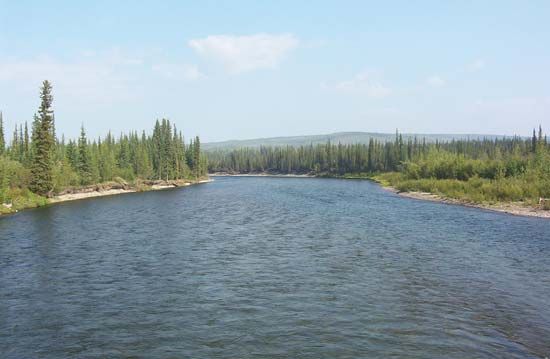
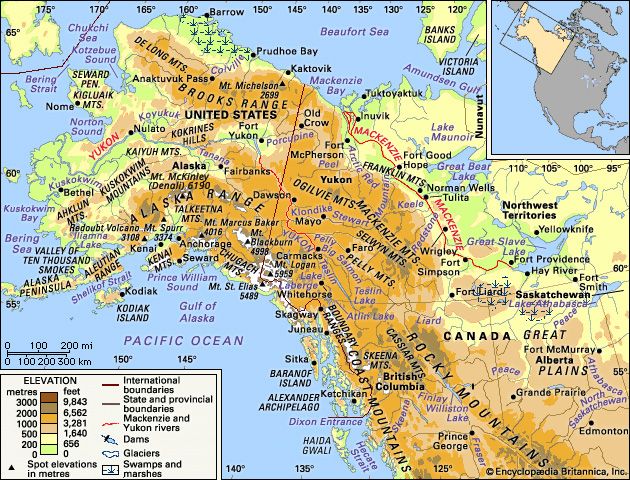
The Porcupine River is a major tributary of the Yukon River, flowing through northern Yukon, Canada, and northeastern Alaska, United States.
What is Porcupine River?
The Porcupine River is a major tributary of the Yukon River, flowing through northern Yukon, Canada, and northeastern Alaska, United States.1
Discovered in 1842 by John Bell of the Hudson’s Bay Company, the river originates in the Mackenzie Mountains of west-central Yukon. It follows a 448-mile (721-km) arc, traveling north and then west across the international border to join the Yukon River near Fort Yukon, Alaska.1
The river is navigable as far as Old Crow, Canada, which serves as a hub for the region’s fur production. Consequently, the Porcupine River functions as a vital transportation link between northern and southern Yukon. Its own primary tributaries include the Bell, Old Crow, Coleen, Sheenjek, and Black rivers.1
What is the significance of the Yukon River?
The Yukon River is a major North American waterway that has played a pivotal role in the history and development of northwestern Canada and Alaska. Its significance is defined by several key factors:
- Historical Gold Rush: The river became world-famous following the 1896 gold strikes on the Klondike River. This event triggered a massive influx of prospectors and settlement, creating an international mythology of a romantic frontier existence.23
- Transportation and Trade: For decades, the river served as a vital artery for commerce. During the gold rush, riverboats transported passengers and freight to booming communities like Dawson. While water transport declined after the rise of road and air travel, the river remains a defining feature of the region’s infrastructure.34
- Economic and Natural Resource Hub: The basin has long been a site for mineral extraction, including gold, lead, zinc, and copper. Additionally, the river’s vast, sparsely populated landscape and pristine scenery have become a primary resource for tourism, attracting those seeking to experience its natural environment.4
- Ecological Scale: Draining an area of approximately 328,000 square miles—larger than Turkey—the river and its many tributaries support diverse ecosystems and wildlife.24
How did the Hudson’s Bay Company influence the region?
The Hudson’s Bay Company (HBC) was a dominant force in North American history, fundamentally shaping the continent’s economic and political landscape for centuries.78
Territorial and Political Influence
Incorporated in 1670, the company was granted proprietary control over Rupert’s Land, a vast region stretching from Labrador to the Rocky Mountains. For two centuries, the HBC acted as a primary colonial authority, maintaining political control over these territories until they were sold to the Canadian government in 1870.78
Exploration and Trade
The company’s pursuit of the fur trade drove the exploration of the North American interior. By establishing inland trading posts, the HBC facilitated the mapping of vast regions, including the Mackenzie River basin and the Yukon. These posts served as essential hubs for commerce and enabled subsequent scientific and overland expeditions.910
Social and Cultural Impact
The HBC’s presence deeply affected Indigenous peoples. While the company built relationships with groups like the Cree, Innu, and Inuit, its arrival also disrupted existing trade networks and led to complex interactions, including intermarriage and kinship ties at trading posts.108
What kind of wildlife lives in the Porcupine River basin?
The Porcupine River basin, as a major tributary of the Yukon River, shares the diverse wildlife characteristic of the broader Yukon River basin. The region supports a variety of species adapted to its northern environment.111
Mammals
The forested valleys and mountainous terrain of the basin are home to several large mammals, including:
- Predators: Black bears, grizzly (brown) bears, and timber wolves are common in the area.11
- Ungulates: Moose, caribou, deer, mountain goats, and mountain sheep inhabit the region, with goats and sheep typically found at higher elevations.11
- Furbearers: The area is historically significant for trapping, with species such as lynx, marten, mink, muskrat, fox, weasel, fisher, and squirrel present.11
Birds and Fish
Sources
- Porcupine River — Encyclopædia Britannica
- Yukon River — Encyclopædia Britannica
- Yukon River - History — Encyclopædia Britannica
- Yukon River - Physiography and hydrology — Encyclopædia Britannica
- Yukon River - People and economy — Encyclopædia Britannica
- Klondike River — Encyclopædia Britannica
- Hudson’s Bay Company — Encyclopædia Britannica
- Arctic - Whale fisheries and the fur trade — Encyclopædia Britannica
- Yukon - Early inhabitants and nonnative settlers — Encyclopædia Britannica
- Native American - Subarctic and Arctic peoples — Encyclopædia Britannica
- Yukon River - Plant and animal life — Encyclopædia Britannica
Published on · 3 min read