Crassulaceae
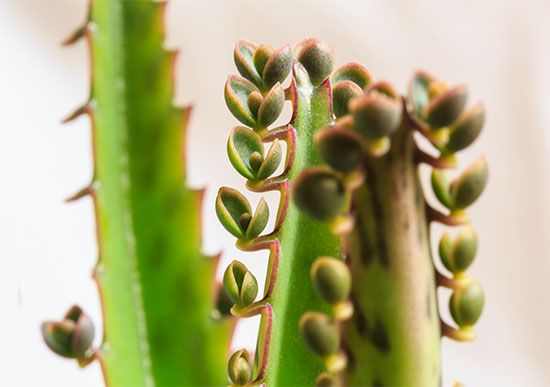
Crassulaceae, commonly known as the stonecrop family, is the largest family within the order Saxifragales. It comprises approximately 30 genera and 1,400…
What is Crassulaceae?
Crassulaceae, commonly known as the stonecrop family, is the largest family within the order Saxifragales. It comprises approximately 30 genera and 1,400 species of perennial herbs or low shrubs that are distributed globally, with a concentration in arid regions.1
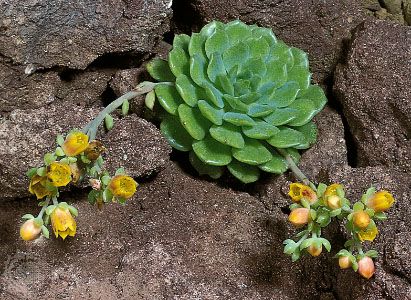
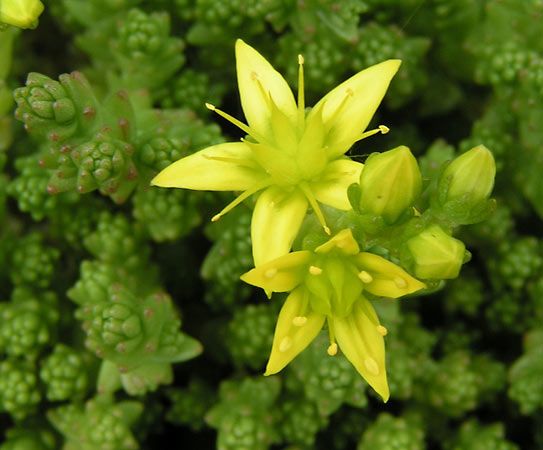
Members of this family are primarily succulents, characterized by thick, fleshy leaves and stems specialized for water storage. They are widely cultivated as ornamentals, including popular genera such as Crassula (e.g., the jade plant), Sedum, Kalanchoe, Echeveria, and Sempervivum.12
The family is scientifically significant for giving its name to Crassulacean Acid Metabolism (CAM), a specialized photosynthetic pathway. CAM plants fix carbon dioxide at night while keeping their stomata closed during the day to minimize water loss, an adaptation that allows them to thrive in dry environments. While this metabolism is a hallmark of the Crassulaceae, it has also evolved in many other plant families.132
How does CAM photosynthesis help plants survive in arid environments?
Crassulacean Acid Metabolism (CAM) is a specialized photosynthetic pathway that enables plants to thrive in arid environments by significantly reducing water loss. The primary mechanism involves a temporal separation of carbon fixation stages, allowing the plant to manage gas exchange during the cooler, more humid nighttime hours.25
Key aspects of how CAM helps plants survive include:
- Nocturnal Gas Exchange: Unlike most plants that open their stomata during the day, CAM plants keep them closed during daylight hours to prevent water loss through evapotranspiration. Instead, they open their stomata at night to assimilate carbon dioxide.26
- Carbon Storage: At night, the enzyme PEP carboxylase fixes carbon dioxide into organic acids, primarily malate. This malate is then stored in the large vacuoles of the plant cells.25
- Daytime Photosynthesis: During the day, while the stomata remain closed, the stored malate is decarboxylated to release carbon dioxide internally. This CO₂ is then fixed by Rubisco in the Calvin-Benson cycle to produce sugars.25
By decoupling the intake of carbon dioxide from the light-dependent stages of photosynthesis, CAM plants require considerably less water than C3 or C4 plants to fix the same amount of carbon.2
What are some other plant families that use CAM photosynthesis?
While Crassulacean Acid Metabolism (CAM) is named after the Crassulaceae family, this specialized photosynthetic pathway is widespread across the plant kingdom. It is utilized by more than 20,000 species spanning 34 different families.2
Beyond the Crassulaceae, some notable plant families that employ CAM photosynthesis include:
- Cactaceae: Many members of the cactus family rely on this pathway to survive in arid desert environments.2
- Orchidaceae: Many orchids, particularly those that grow as epiphytes, utilize CAM.2
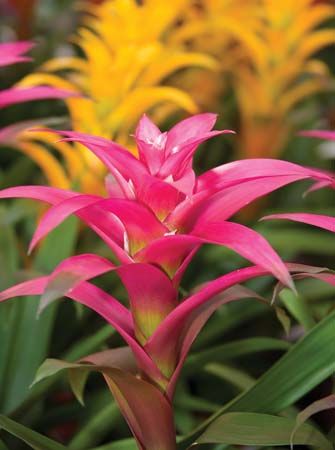
- Bromeliaceae: This family, which includes plants like the pineapple, features many species that use the CAM pathway.2
- Euphorbiaceae: Various succulent species within this diverse family also exhibit CAM.2
While the pathway is most common among angiosperms, it is also found in several non-seed plants, such as ferns and quillworts. Additionally, there is evidence that the gymnosperm Welwitschia utilizes this metabolic strategy.2
How do succulents store water in their leaves and stems?
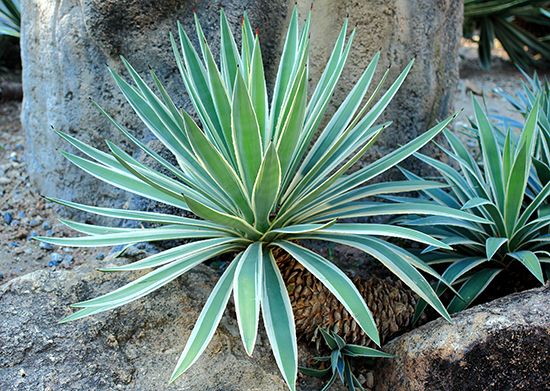
Succulents are plants characterized by thick, fleshy tissues specifically adapted for water storage. Depending on the species, this storage occurs primarily in the stem—as seen in many cacti—or in the leaves, as observed in agaves and aloe.47
At the cellular level, this storage is facilitated by parenchyma tissue, which consists of living, thin-walled cells capable of holding significant amounts of water. Within these cells, the vacuole plays a critical role; it is a large, membrane-bound compartment that stores water, nutrients, and ions. By regulating water movement through osmosis, the vacuole maintains turgor pressure, which provides the structural rigidity necessary for the plant to remain fleshy and upright.89
To minimize water loss while maintaining these reserves, many succulents utilize crassulacean acid metabolism, a photosynthetic adaptation that allows them to keep their stomata closed during the hot, dry day and open them only at night.4
Sources
- Crassulaceae — Encyclopædia Britannica
- photosynthesis - Carbon fixation via crassulacean acid metabolism (CAM) — Encyclopædia Britannica
- Crassulaceae — Merriam-Webster
- succulent — Encyclopædia Britannica
- stomate — Encyclopædia Britannica
- plant - Specific variations in photosynthesis — Encyclopædia Britannica
- angiosperm - Leaf modifications — Encyclopædia Britannica
- parenchyma — Encyclopædia Britannica
- vacuole — Encyclopædia Britannica
Published on · 3 min read