Periyar Wildlife Sanctuary
The Periyar Wildlife Sanctuary, located in the south-central state of Keralam, encompasses a core national park area of 135 square miles (350 square km)…
How does Periyar Wildlife Sanctuary compare to other national parks in India in terms of size and biodiversity?
The Periyar Wildlife Sanctuary, located in the south-central state of Keralam, encompasses a core national park area of 135 square miles (350 square km), while the broader tiger reserve extends over 350 square miles (900 square km).1
Regarding biodiversity, the sanctuary is highly significant, supporting a rich variety of flora and fauna. It is estimated to house over 1,900 species of angiosperms—representing more than 50 percent of Keralam’s species—along with 62 species of mammals, 323 species of birds, 38 species of fish, and 44 species of reptiles. The park is a critical habitat for elephants and tigers, as well as other notable species such as the gaur, leopard, and lion-tailed macaque.123
The provided search results do not contain comparative data regarding the size or biodiversity of other specific national parks in India.
What is the significance of Periyar Wildlife Sanctuary in India’s conservation efforts?
The Periyar Wildlife Sanctuary is a cornerstone of India’s conservation efforts, serving as a critical habitat for diverse wildlife and a protected landscape for over a century. Originally established as a reserve forest in 1899, it evolved into a game sanctuary in 1934, a wildlife sanctuary in 1950, and eventually a tiger reserve in 1978, with its core zone designated as a national park in 1982.112
Its significance lies in its immense biodiversity, which is sustained by the Periyar River. The reserve supports more than 50 percent of the angiosperm species found in Keralam, alongside hundreds of species of birds, mammals, fish, and reptiles. As a vital refuge for megafauna, it provides essential protection for elephants and serves as a key site for tiger conservation, housing a population estimated at approximately 30 to 40 individuals.123
What is the location and geographical features of Periyar Wildlife Sanctuary?
The Periyar Wildlife Sanctuary is located in the south-central state of Keralam in southern India, situated near the border with Tamil Nadu.13
Geographical Features
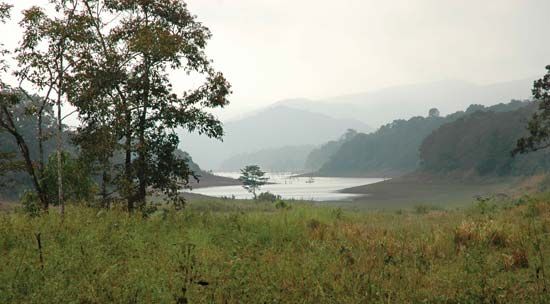
The sanctuary is characterized by a hilly topography at an elevation of approximately 4,600 feet (1,600 meters). A central feature of the landscape is Periyar Lake, an artificial reservoir created in 1895 by damming the Periyar River. This lake, which sits at an elevation of about 2,800 feet (850 meters), is ringed by mountain peaks and features a shoreline varied by numerous creeks, bays, and promontories.132
The vegetation within the park consists of tropical evergreen and deciduous forests, including dense patches of trees such as teak, jackfruit, and kokam. Additionally, much of the park’s grassland has been planted with eucalyptus.3
What are the main flora and fauna species found in Periyar Wildlife Sanctuary?
The Periyar Wildlife Sanctuary hosts a rich variety of flora and fauna, supported by its tropical evergreen and deciduous forest ecosystems.
Flora
The sanctuary is home to over 1,900 species of angiosperms. Notable tree species include:
- Jackfruit (Artocarpus heterophyllus)
- Teak (Tectona grandis)
- Kokam (Garcinia indica)
- Eucalyptus (Eucalyptus species), which covers much of the park’s grassland areas.
Fauna
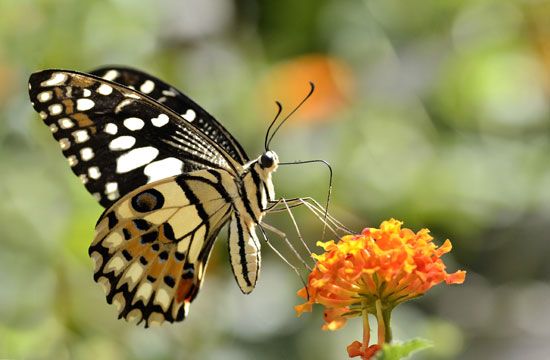
The preserve supports a diverse range of wildlife, including 45 species of mammals, 250 birds, and over 150 species of butterflies.
- Mammals: The park is famous for its herds of Asian elephants. Other residents include tigers, leopards, sloth bears, nilgai, barking deer, bonnet monkeys, langurs, and porcupines.
- Birds: Notable species include the great Indian hornbill, kingfishers, gray jungle fowl, and southern grackles.
- Other: The sanctuary also contains 30 species of fish, 30 species of reptiles, and 10 amphibians.2
Sources
- Periyar Wildlife Sanctuary: Top Questions — Encyclopædia Britannica
- Periyar Wildlife Sanctuary — Encyclopædia Britannica
- Periyar River — Encyclopædia Britannica
Published on · 3 min read