Petrified Wood
Petrified wood is a type of fossil created when minerals invade the cavities within and between the cells of natural wood. This process typically involves…
What is petrified wood and how is it formed?
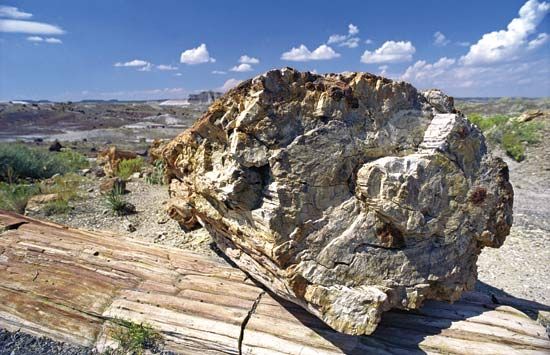
Petrified wood is a type of fossil created when minerals invade the cavities within and between the cells of natural wood. This process typically involves silica (silicon dioxide) or calcite (calcium carbonate).1
The formation occurs through a replacement process where the original organic tissues of the tree are substituted by mineral matter, such as chalcedony (a form of quartz). This replacement is often so precise that the external shape and internal structure of the wood are faithfully preserved, sometimes allowing scientists to determine the original cell structure.1
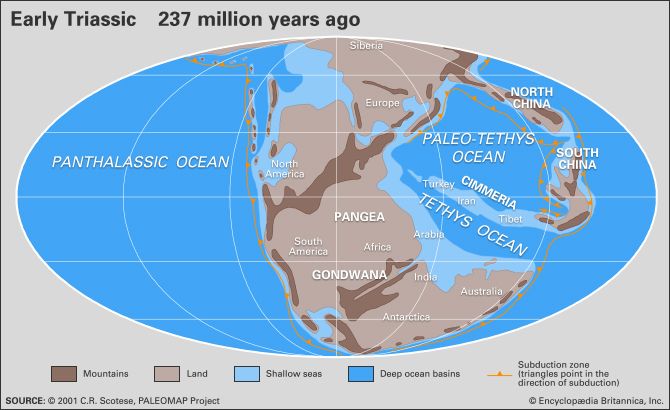
While fossils are generally rare, the preservation of wood into stone provides a detailed record of ancient plant life. Notable examples of this phenomenon can be found in the Petrified Forest National Park, which contains the remains of ancient tropical groves that date back to the Triassic Period.123
Where are some famous locations where petrified wood can be found?
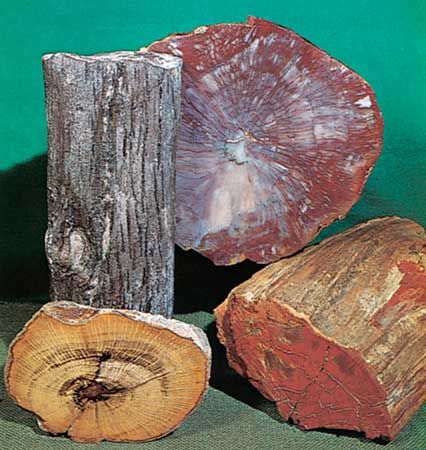
Petrified wood can be found in various locations, with the most prominent examples located in the western United States. These deposits are typically characterized by silicified wood, where original tree tissues have been replaced by chalcedony.2
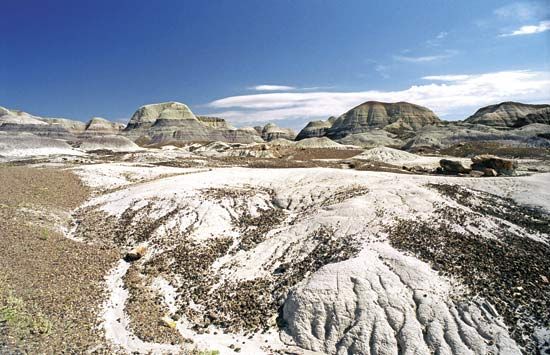
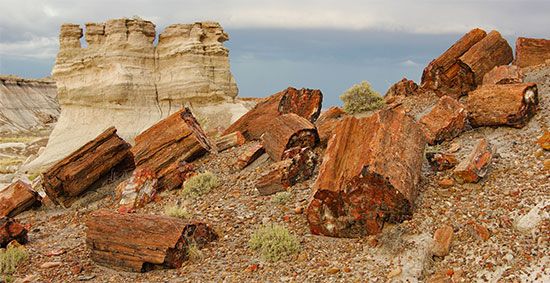
The most famous site is the Petrified Forest National Park in eastern Arizona. This park contains extensive exhibits of petrified wood within several distinct “forest” areas, which represent the remains of ancient tropical groves from the Triassic Period.4
Key sections within the park include:
- Black Forest Bed: Located in the northern portion of the park.4
- Blue Mesa: Known for its fossilized logs and plant remains.4
- Jasper, Crystal, and Rainbow Forests: Sections filled with fossilized leaves, plants, and broken logs.4
These areas are situated within the Painted Desert, a region known for its colorful, wind-eroded hills.41
How does petrified wood differ from other types of fossils?
Petrified wood is a specific type of fossil formed through the process of mineralization, where organic tissues are replaced or infiltrated by minerals like silica or calcite. While many fossils are simply impressions or preserved hard parts, petrified wood is distinct because the mineral replacement is often so precise that it preserves the internal cellular structure and external shape of the original tree.13
Other fossils form through different mechanisms:
- Permineralization: Minerals fill the pores of bones or shells rather than replacing the original material.5
- Carbonization: Vegetable matter is flattened between rock layers, leaving a carbon film.5
- Trace Fossils: These are not the remains of the organism itself but evidence of its activity, such as tracks or waste products.5
- Unaltered Preservation: In rare cases, such as insects in amber or carcasses in ice, soft tissues are preserved with minimal chemical change.5
Unlike many marine fossils that rely on hard shells or skeletons, petrified wood allows for the detailed study of ancient plant anatomy.15
What is the difference between permineralization and replacement?
Permineralization and replacement are distinct processes by which organic remains are preserved as fossils.6
Permineralization In this process, mineral-rich solutions flow into the open spaces, or pores, within an organism’s hard parts, such as bones or shells. The minerals—often calcium carbonate or other salts—precipitate and fill these interstices, effectively cementing the remains into solid rock without necessarily removing the original biological material.6
Replacement Replacement, also known as mineralization, involves the total removal of the original skeletal or organic material. As mineralizing solutions encounter the remains, the original substance is dissolved and almost simultaneously exchanged for a new mineral. This process occurs volume for volume, meaning the new mineral takes the place of the original material while often preserving the fine internal structure and external shape of the organism. A common example of this is the formation of petrified wood, where silica replaces the original wood fibers.36
While permineralization adds material to existing voids, replacement fundamentally substitutes the original biological matter with a different mineral composition.6
Sources
- petrified wood — Encyclopædia Britannica
- Petrified Forest National Park — Encyclopædia Britannica
- fossil — Encyclopædia Britannica
- Petrified Forest National Park — Merriam-Webster
- petrified — Merriam-Webster
- metasomatic replacement — Encyclopædia Britannica
- clay mineral - Interactions with inorganic and organic compounds — Encyclopædia Britannica
Published on · 3 min read